


- According to traditional Sri Lankan paddy farmers, long dry spells have occurred every four to seven years.
- Sri Lanka has experienced around 25-26 El Niño events from 1950 to date, out of which only three have been strong El Niño events, meteorology department officials say.
- The irrigation department has introduced new water-saving techniques such as alternative wetting and drying to preserve excess water during the forecasted dry season.
- Attempts are also being made to integrate science into decision making, but there are gaps in research due to a lack of access to information, academics say.
COLOMBO — Even though Sri Lankan authorities are preparing to face an impending El Niño phenomenon, Rathnayaka Mudiyanselage Suwandarathne feels that the country may not be impacted as forecasted.
A second generation farmer from Thalangama in the Colombo District, Suwandarathne knows about weather and has been leading an agricultural revolution by promoting the cultivation of heirloom varieties of rice.
According to him, it is normal to experience a dry spell between July and September as forecasted. This period coincides with the Yala season, one of two paddy harvesting seasons in Sri Lanka. “By August, the dry period begins, and we need a dry season to obtain the harvest,” he told Mongabay. “We then conduct culturally significant events praying for rains. This is the cycle during the Yala season. Then again from December to March, there’s a drought season, which coincides with the Maha season. Long dry spells occur every four to seven years. But now, we have changed these harvesting cycles,” he said.
The World Meteorological Organization’s (WMO) monthly global seasonal climate update indicates an 80% probability of a rapid development into a strong El Niño event between July and September 2026. WMO Secretary General Celeste Saulo said that it would “intensify chances of drought and heavy rainfall and the risk of heatwaves on land and marine heatwaves in many regions of the world.”
“When going by initial predictions, the time period for developing a very strong El Niño was between November 2026 and January 2027,” Ajith Wijemannage, head of the Meteorology Department in Sri Lanka told Mongabay. “But according to latest predictions, the peak would be somewhere between October and December 2026. From 1950 to date, we have experienced around 25-26 El Niño events and out of them there had been only three very strong El Niño events.”
According to Wijemannage, an El Niño event would impact rainfall. “Along with an El Niño event, the Indian Ocean Dipole becomes positive, thereby suppressing the northeast monsoon. In this case, the northern and eastern provinces would experience heavy rains, and there’s a probability of flooding,” he said. “But it may not have a drastic impact on the southwest monsoon as we have received the average rainfall this year as well. In May and June, we received an above normal rainfall. But the north and north central provinces will experience high temperatures. The temperature in Trincomalee on Saturday (July 25) was 39.9 degrees Celsius (103.8 degrees.)”
In order to monitor and mitigate impacts of the looming El Niño phenomenon, Sri Lanka’s cabinet of ministers approved a proposal presented by President Anura Kumara Dissanayake to establish a special ministerial sub-committee and a supporting officials’ committee. The officials’ committee comprise heads of departments of meteorology, irrigation, agriculture, wildlife and disaster management.
Monitoring and preserving water levels
Sarvajith Priyankara Herath, director of water management at the Irrigation Department, said that water levels in reservoirs and tanks in Ampara, Batticaloa and Trincomalee districts are lower than the expected average. “By the beginning of July, only 29% of water is available in reservoirs in the Ampara and Batticaloa districts, while only 49% of water is available in reservoirs in the Trincomalee district,” he said. Therefore, the department has instructed regional irrigation officers to assess the amount of water available and the amount of water expected from predicted rainfall prior to deciding on dates to begin the next paddy harvesting season and other intermediate seasons.”
The department has also introduced new irrigation techniques such as alternative wetting and drying, which reduces irrigation water use without reducing the yield. Therefore, the excess water could then be utilized for other purposes in the event of a dry spell.

The role of the Disaster Management Centre (DMC) is to facilitate meetings and monitor the situation in all 25 districts. Speaking to Mongabay, Pradeep Kodippili, DMC’s deputy director and spokesperson, said preparations are underway to face drought conditions. “We need to provide water for drinking purposes and also for irrigation. We have deployed water bowsers to local government institutions, water tanks and other equipment. The National Disaster Relief Centre oversees the relief distribution component,” he said.
“We have instructed officials in all 25 districts regarding managing water resources. With respect to floods, we are keeping boats and search and rescue missions on standby. Discussions have been held between tri-forces in case we need more manpower. Right now, we are monitoring the situation in all 25 districts via meetings and strengthening response mechanisms to face these two extreme weather conditions as forecasted.”
Kodippili said different stakeholders have allocated funds for emergencies. “For instance, the paddy insurance board oversees crop damage and necessary compensation that needs to be given to farmers. There’s an integrated approach to execute these plans,” he added.

Even though water has become a scarcity today, ancient hydraulic systems established by kings of yesteryear reflect the country’s heritage in terms of preserving water.
Kusum Athukorala, water activist and co-founder of Global Water Partnership South Asia, said that the thinking of King Parakramabahu should be construed as preserving every source of water. “Every little streamlet is valuable. We are heading towards the worst drought in a very long time, but we haven’t thought of preserving water resources,” she said.“Today, every bit of land is commercialized, and nobody takes notice of the water security aspect.”
In addition, he said in terms of community water management there seems to be a bureaucracy driven response. “There has to be discussions with communities in order to engage them to manage water. Urban communities, for instance, started depending on the water board for water,” she said. “People forgot to preserve urban wells or pumps that were available, and now, they have to wait for water bowsers in case of a water cut. There seems to be zero preparedness to face an impending crisis.”
Science-aided decision making
Research studies on climate resilient paddy varieties are being conducted by various institutions, including the Rice Research and Development Institute, the Hector Kobbekaduwa Agrarian Research and Training Institute (HARTI) and faculties of agriculture in state universities. Studies have also been conducted to identify the availability of weather information for paddy farmers to make informed decisions.

According to Buddhi Marambe, a professor in crop science at the department of agriculture at Peradeniya University, there are some attempts being made to integrate science in decision making. “But things are not perfect as yet. More efforts will have to be made not only to look at impacts of extreme climate events but the overall climate change scenario,” he told Mongabay. “Climate change and climate variability are two different things. El Niño is not climate change.”
Marambe said there are gaps in research due to a lack of access to information. “Long- term research is required, and scientists need to work collectively to produce more scientifically valid information,” he said.
Suwandarathne agrees that Sri Lanka has enough resources and traditional knowledge to brave adverse weather events and improve food security. “But people are being misled by multinational companies. These companies destroyed natural methods of preserving our crops with the introduction of chemical fertilizers. The dragonflies kept mosquitoes away, the spiders that formed cobwebs kept paddy bugs away, but today, we don’t see these insects,” he said. “The chemicals have killed these natural predators. There’s no system to preserve excess water and most farmers have abandoned farming due to these issues. We forgot our heritage and ignored our treasured ecosystems. But I believe that there’s still a chance to set things right.”
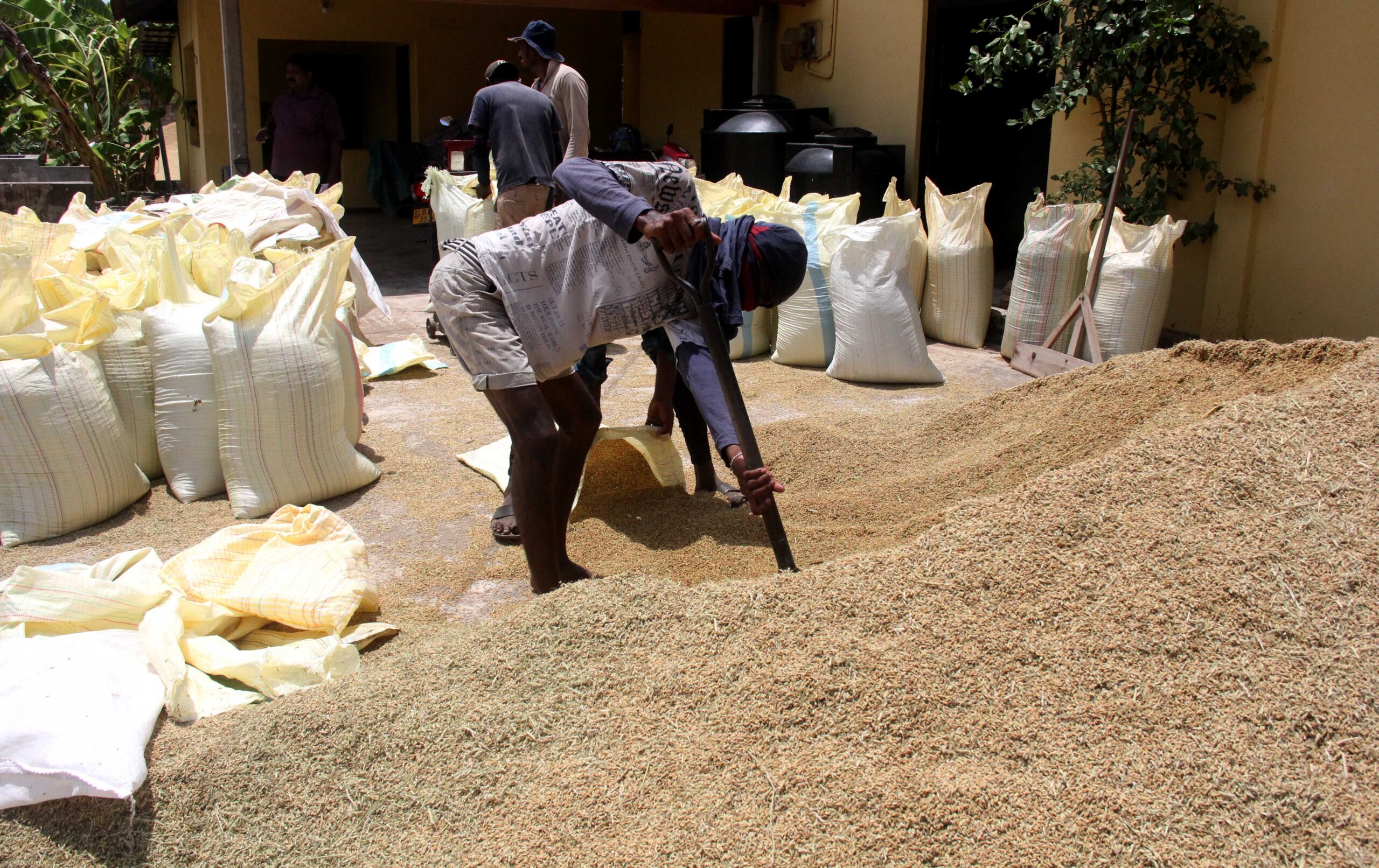
Banner Image: Farmers in the northern Kilinochchi District sorting out paddy stocks prior to distribution. Image courtesy of Kithsiri De Mel.
Cite this article
Kamanthi Wickramasinghe (2026). Sri Lanka prepares for impending El Niño with traditional and new approaches. Mongabay Conservation news. DOI: https://doi.org/10.66709/news-325032

