


Human-induced climate change drastically fueled the weather behind recent devastating wildfires in France and Spain, according to a new rapid analysis by researchers studying the role of climate change on today’s extreme weather.
In its report, the World Weather Attribution (WWA), a global network of researchers, noted that severe blazes scorched 140,000 hectares (346,000 acres) in Spain and more than 115,000 hectares (284,000 acres) in France, forcing more than 300,000 people to flee.
The researchers found that “tinderbox conditions” that favor fires, including extreme heat waves and unusually low rainfall, are at least twice as likely in southwestern France and at least 20 times more likely in central Spain in today’s climate than during the preindustrial climate. (Average temperatures back then, before the advent of large-scale greenhouse gas emissions, were 1.4° Celsius (2.52° Fahrenheit) cooler.) These figures are considered conservative estimates, the researchers said.
In today’s climatic conditions, the report said, fires of the intensity seen in July are expected every 20 years in southwestern France and every six years in central Spain.
The analysis found that a critical driver of the wildfires was above-average winter rainfall that spurred lush vegetation growth, followed by an exceptionally dry spring and summer that turned that biomass into highly flammable fuel.
“Relentless heat — fuelled by human-caused climate change — has created the conditions for sparks to take hold and become massive, dangerous wildfires,” report co-author Clair Barnes, a research associate at Imperial College London, said in a press release.
The analysis also found that the fires released large amounts of pollutants that affected air quality up to 400 kilometers (250 miles) away from places like Bordeaux, France.
“Such hazardous air pollution contributes to an accumulation of detrimental conditions for a population already hit hard by repeated heatwaves since May,” the report said.
Fires breaking out across multiple regions simultaneously can overwhelm national resources, said co-author Andreia Ribeiro, a climate scientist at the Helmholtz Centre for Environmental Research in Germany.
“Overlapping fire extremes makes it harder for countries to cooperate and share firefighting resources with each other when that support is needed most,” Ribeiro in the press release.
While improved fire management has reduced the extent of burned areas in recent decades, the authors said extreme weather is now outpacing these efforts.
“Europe’s climate is shifting faster than governments are adapting,” said co-author Friederike Otto, a professor of climate science at Imperial College London. “Our research showed how climate change is worsening drought across the continent. Now we’re seeing yet another disaster fueled by the same driver: the burning of fossil fuels.”
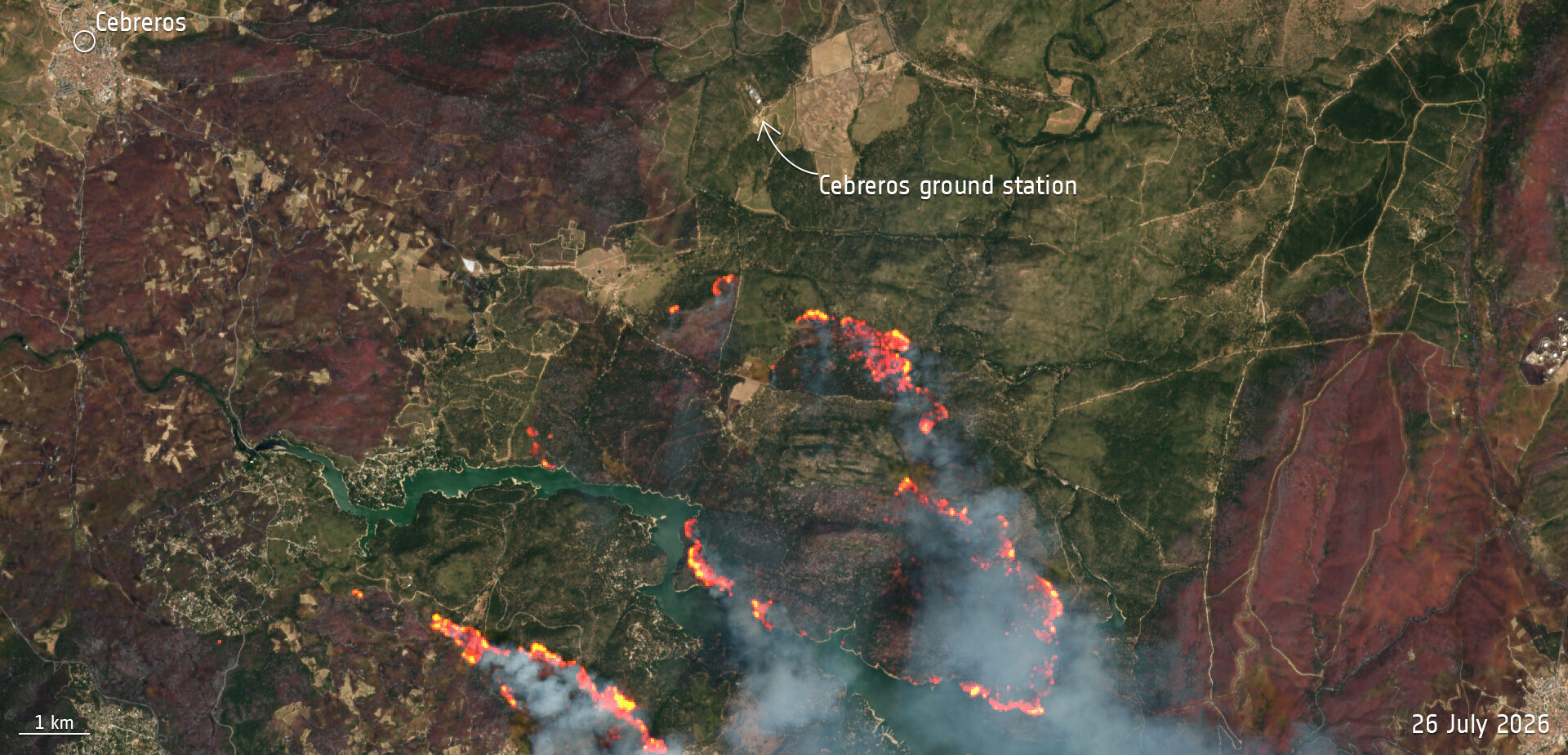
Banner image: This Copernicus Sentinel-2 image shows a zoomed-in view of the Cebreros ground station in Madrid, Spain. The area was among the worst-affected by the fire outbreak in Spain this year. This image contains modified Copernicus Sentinel data 2026, by the European Space Agency via Wikimedia Commons (CC BY-SA 3.0 IGO).
