


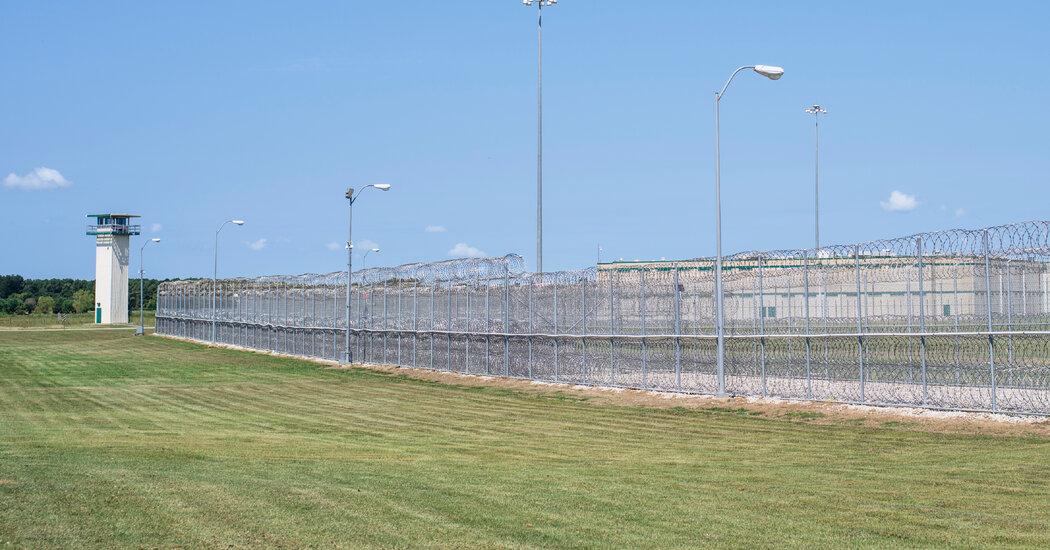
For a few brief years, there was no death penalty in the United States. In 1972, the Supreme Court issued a ruling that declared the death penalty unconstitutional, making the U.S. part of a broad postwar global trend against capital punishment.
And then, just four years later, another decision brought it back. This month is the 50th anniversary of the death penalty’s return to the country. Today, the U.S. is an outlier in the West for its willingness to carry out executions. Why?
Before she went on holiday, Katrin spoke to Maurice Chammah, a journalist for the nonprofit news organization The Marshall Project who focuses on the death penalty. Maurice recently produced a podcast with the Serial team at The New York Times called “The Last 12 Weeks,” focused on the efforts of a group of lawyers to stop their client’s execution. They talked about America’s unusual commitment to the death penalty and the state of capital punishment around the world.
Why America still has the death penalty
Maurice, walk me through the history. Why was the death penalty abolished in the U.S., and how did it come back?
There was a general trend away from the death penalty after World War II. One reason was the emphasis on human dignity and human rights that emerged in the wake of Germany’s death camps. There was this sense that executions were best left in the past, because they had been taken to such an extreme.
So in the early 1970s, the Supreme Court issues a major ruling called Furman v. Georgia, in which it declares the death penalty unconstitutional.
But here’s the thing: In its ruling, the Supreme Court did not say the death penalty itself was wrong. It said the laws governing it created too much arbitrariness. That nuance left the door open for states to rewrite their laws and ask the court to overturn its ruling — which it did in 1976.
What does the actual landscape of capital punishment look like in the U.S. today?
The U.S. is a collection of different states, and each has its own policies. Some have abolished the death penalty, like Michigan and Minnesota. Some sentence people to death, but don’t execute them, like California. And then you have states like Texas and Florida and Alabama that carry it out all the time.
Why is America such an outlier on this?
There are several reasons.
One is race. America has a unique history that includes a massive civil rights struggle born from the legacy of slavery. The history of the death penalty cannot be separated from that. Many scholars have argued the death penalty served as a legal substitute for lynchings. In the years following the Supreme Court’s first ruling, many white people in the South saw this trend against the death penalty as helping criminals, who they tended to picture as Black. They saw the court as depriving them of their ability to maintain law and order, and pushed for the death penalty to be restored.
Another is guns. America is a place where violence leads to death more often because of the prevalence of guns. So you do have more murder, and the death penalty can feel like a tidy solution to that, even if, as an incredible amount of scholarship has shown, it is not a very effective tool to reduce crime.
But also, our criminal justice system is set up in a way that favors the death penalty.
How so?
American prosecutors often see themselves as representing the victim’s family members. And so they’re often pushing for the harshest possible punishment on their behalf. That dynamic is unusual. It’s very different, for example, from European prosecutors, who see themselves as solely representing the public.
The death penalty might be more popular in Europe if there were more vehicles for people to pursue it. It’s a very natural human reaction to demand a harsh punishment for a terrible crime.
But in Europe, prosecutors I’ve met see it as part of their jobs to moderate the rage a population might feel toward criminals. In the U.S., by contrast, there are several vehicles for that rage to be activated politically. Prosecutors are often elected officials and therefore responsive to voters. So are many judges.
That’s very distinct, by the way, from the authoritarian countries that use the death penalty as a tool of their authoritarianism — like say, Iran, Saudi Arabia or China.
Is there any other democracy that still has the death penalty?
Yes, but it’s extremely rare, and of the democracies that have it, the U.S. carries out by far the most executions. It’s definitely something more associated with authoritarian regimes.
And those countries carry out far more executions than the U.S. Last year, 47 people were executed in America. By comparison, Saudi Arabia executed 356 people and Iran over 1,000. China keeps its numbers entirely secret, but they’re estimated to be in the thousands.
What’s the trend going forward? At this moment of resurgent populism and authoritarianism should we expect a resurgence of the death penalty, too?
It’s possible. Amnesty International put out a report last year linking what it calls rising authoritarianism and the use of executions. Authoritarianism and populism are not the same thing. But we are seeing a rise of both across the world.
Donald Trump has been trying to rev up the use of the federal death penalty. And we’re also seeing a return to all of these different experimental execution methods, like the firing squad. A couple of states have even started using or considering gas.
In Israel, the Knesset passed a law earlier this year to allow executions of people whose crimes are working against the state of Israel — in other words, a law that is expected to only be applied to Palestinians.
But actually, overall, the long-term trend is pointing downward. In the U.S., the number of people sentenced to death has been dropping since it last peaked in the 1990s. Juries seem less interested in handing down the death penalty. Prosecutors don’t seek it as often. The public appetite is actually just not as strong as it once was.
An agreement on Gaza disarmament?
Trump said on social media yesterday that the Board of Peace, an organization his administration established to oversee a Gaza cease-fire, had reached an agreement for Hamas to begin disarming in Gaza.
There was no immediate comment from Hamas or Israel. However, the Board of Peace said that Hamas had agreed to a “detailed road map” on disarmament of its forces and Israeli withdrawal from Gaza.
The total disarmament and demilitarization of the enclave is a core demand by Israel. Many members of Hamas view any such deal as surrender.
More on the Middle East:
-
Thousands of migrants climbed over a border fence or swam onto the shores of Ceuta, Spain’s North African enclave, yesterday. Spain has mobilized its military in response. Watch a video.
-
Russian airstrikes on Ukrainian cities killed at least eight people, including five members of the same family, President Volodymyr Zelensky said. NATO said that a missile crashed in Poland during the attack.
-
Mykhailo Fedorov, Ukraine’s recently fired defense minister and drone warfare advocate, discussed battlefield revolutions and his political future in a Times interview.
-
Greece battled a wildfire that killed three firefighters and forced thousands of people to evacuate in Crete.
-
A wildfire also burned in eastern England, a few miles from a nuclear power plant.
-
The death toll from the powerful quake in Japan rose to 34, as rescue efforts continued.
-
The Ebola outbreak in the Democratic Republic of Congo is now the second-worst on record and spreading much faster than previous outbreaks, the health ministry said.
WHAT ELSE IS HAPPENING
TOP OF THE WORLD
The most clicked link in your newsletter yesterday was expert tips during midlife to increase longevity.
SPORTS
Football: European countries agreed to boycott the World Cup if FIFA moves ahead with a plan to sell stakes in the tournament to investors.
Running: Samuel Simba Cherop of Uganda finished seventh in a race at the Commonwealth Games, despite losing a shoe.
The belugas are being moved from a closed marine attraction in Canada to aquariums in the U.S. and Spain. The effort involves cranes, planes, a police escort and for the whales, some anti-anxiety medicine to keep them safe in their transport boxes. So far, six whales have made their way out of Canada and 24 more are expected to be transported in the coming weeks.
MORNING READ
David González imported a 10-kilowatt-hour battery from Spain and is using it in his home to keep Havana’s nightlife alive under the oil embargo. He also wants to create a movement for political change.
“There’s a Cuba that’s dying at the same time a new Cuba is being born,” he said. “And they can’t stop the new Cuba, because there are so many people resisting and creating and dreaming.” Read more about Havana’s hottest spot for artists, activists and intellectuals.
AROUND THE WORLD
The oil rigs are small. And they’re a lifeline.
The Wonocolo oil field in East Java, Indonesia, is home to a few hundred community-run oil wells. Big oil companies have long considered the field, which is especially shallow, commercially insignificant. But subsistence oil drilling has endured there for decades.
Spumoni ice cream cake is an Italian American dessert made by layering pistachio, cherry and chocolate (or sometimes vanilla) gelati. The only true challenge here is making sure there’s room in your freezer.
