


Why this matters
The sheriff’s office said it is working to answer 911 calls faster to meet state requirements. Most county supervisors had nothing to say about it.
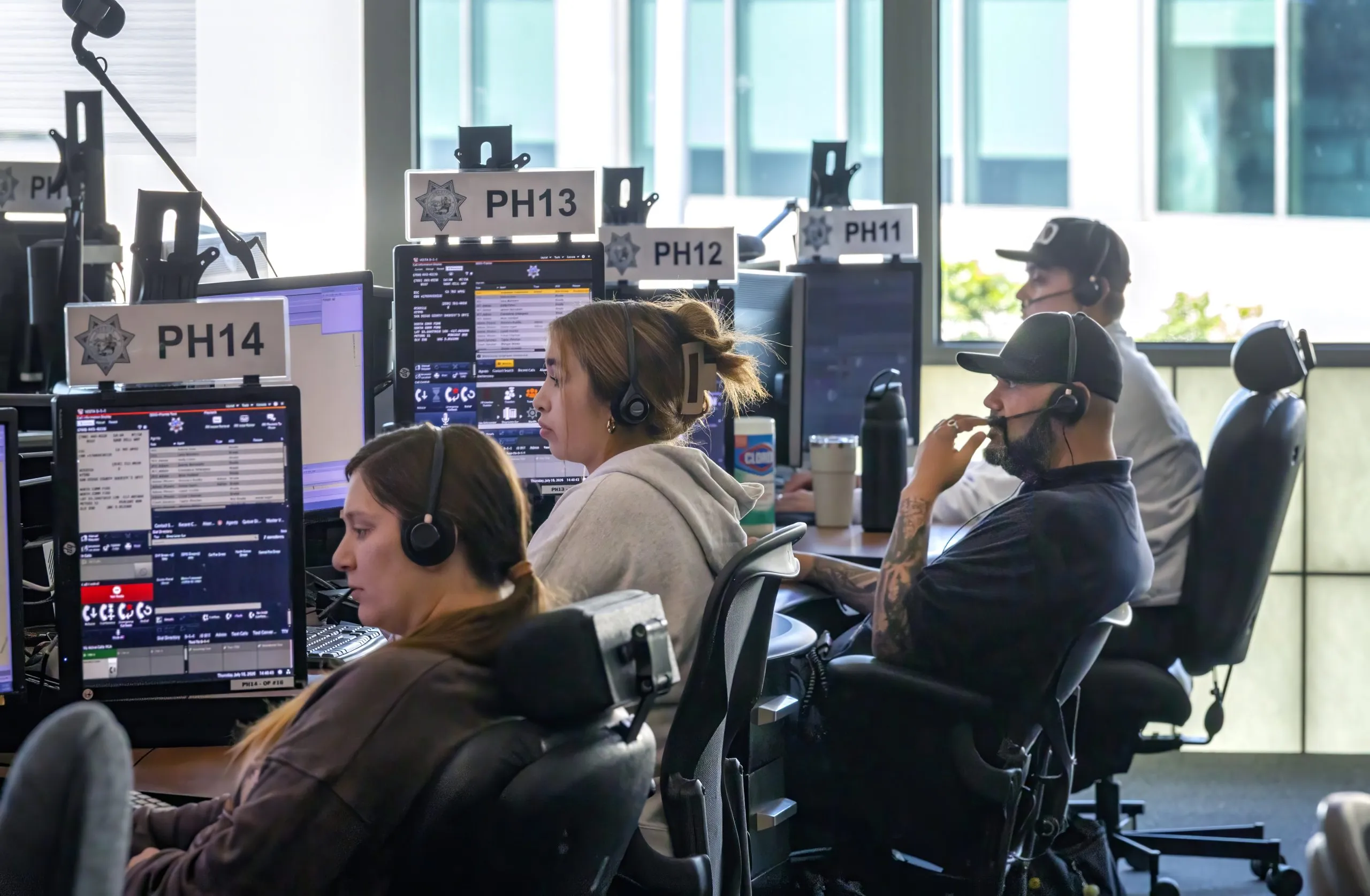
Inside the San Diego County Sheriff’s Office emergency communications center it is quiet — calm, even.
Dispatchers type on desktop computers with vertical screens enclosing the workers like cubicles. They speak plainly into their headsets. They show up every day knowing they’ll be talking to San Diegans experiencing life-changing and possibly life-or-death emergencies.
The 911 dispatchers are the first to hear of serious crimes, fires and medical emergencies before contacting the right agency in San Diego County to respond. But for four years straight, the sheriff’s office — the primary law enforcement agency for 910,000 of the county’s 3.3 million residents — has been too slow to answer those calls and has failed to meet state standards.
In 2025, 1 in 4 callers had to wait more than 15 seconds — and 1 in 5 waited more than 20 seconds – before a dispatcher picked up.
It’s a failure the sheriff’s office blames largely on staffing shortages and the growing complexity of calls, and officers say they are committed to fixing it. But they also acknowledge that additional staffing, a training overhaul and a new program to use artificial intelligence for nonemergency calls may not show substantial results for two years.
Until then, 20% of those calling 911 likely won’t reach a dispatcher for at least 20 seconds. In a statement, Supervisor Jim Desmond said that was news to him — and that it was unacceptable.
“Had I known, I would have pushed for action sooner, because this isn’t an acceptable standard for public safety in San Diego County,” he said. “We’ve made real progress hiring more sworn officers in recent years, but that isn’t enough if the people answering 911 are stretched too thin. Filling those vacant dispatcher positions needs to be a priority, and I intend to make it one.”
inewsource published a story about the San Diego County Sheriff’s Office’s slow 911 pickup times on July 14. The day the story ran, we emailed it to all five of the county supervisors who set the sheriff’s budget each year and asked if they were aware of the issue or had plans to remedy it. Three of the five did not comment – even when granted an extension of time to let constituents know their thoughts on this important issue.
Chair Terra Lawson-Remer’s office said that when it comes to 911 calls, “every second matters” and added, “The dispatchers serving our communities do difficult, high-pressure work every day, and recruiting and retaining enough qualified people is a real challenge. We have made major investments in deputies, firefighters, and emergency response, but threats from wildfires and other emergencies continue to rise.”
Supervisor Joel Anderson declined to comment for this story, and neither Supervisor Monica Montgomery Steppe nor Supervisor Paloma Aguirre responded to multiple requests.
Dave Myers, a former sheriff’s commander who ran for sheriff in 2018 and 2022, said he was surprised to see the call times staying so bad for so long — and being by far the worst of any law enforcement agency in the county.
“It’s grossly incompetent, and I think it is a reflection of what really is a priority within the sheriff’s department,” he said. “It’s not answering those calls for service or even recognizing that it’s a problem.”
‘Five seconds is too long’
Sheriff Kelly Martinez did not grant an interview request, but Capt. Nathan Rowley, the division commander for the sheriff’s emergency communications center, said that answering calls quickly is a top priority for the sheriff’s office.

“The way we see it is five seconds is too long,” Rowley said. “All of our plans that we do, all the changes that we make, ultimately are trying to impact our ability to reach those standards.”
The 911 call standards — that centers are supposed to answer 90% within 15 seconds and 95% within 20 seconds — are tracked through the California Governor’s Office of Emergency Services (Cal OES) – and supposedly mandatory.
But the state agency has not issued any warnings or citations to San Diego County as its failures to meet the accepted standards stretched into four consecutive years.
A spokesperson for the office of emergency services declined to answer questions about whether it enforces the standard or penalizes law enforcement agencies that do not meet the 911 answer times.
The state office’s guidelines say some state funding requires adhering to the standards.
Rowley said the sheriff’s office is “in constant conversation” with the state agency.
“They’re not like the boogeyman that’s from afar that only talks to us when we’re doing something bad,” he said. “They already know what we’re doing. They know the challenges.”
Such lack of communication surprised Myers, who said that when he was a communications lieutenant, Cal OES would call if there were dramatic differences in call times.
The sheriff’s office has funding for 110 emergency services dispatchers in the budget for the fiscal year that began July 1, down from 123 the year before. Supervisors approved that budget in June.
Rowley said those cuts were a result of the sheriff’s decision to restructure the department. He said the cuts didn’t affect 911 call times because they eliminated vacant positions.
“If we had 10 spots open or we had 20 spots open, it doesn’t change anything,” he said. “I still only have the people that I have.”

Rowley added that restoring positions wouldn’t necessarily help the sheriff’s office because it has so many vacancies and is struggling to fill, train and retain dispatchers.
Earlier this month, the sheriff’s office had only 65 fully trained people for its 110 authorized dispatcher positions with 27 more in training. Without more personnel, they’d still be 18 people short. It’s a tough trend to reverse given the grueling nature of the job.
“I call our dispatchers the forgotten first responders,” Rowley said. “Before a cop or a firefighter ever shows up on scene, the call comes through our dispatchers first. It’s a very, very hard job to do.”
Changes inside the sheriff’s office
Rowley has overseen the department for the last year and a half. He said the sheriff’s office has made several improvements, some of which have yet to come to fruition.
He said that around the time of the COVID-19 pandemic, many dispatchers retired or got other jobs and in the years since, the office has worked to hire more people. He said one challenge is that the job has changed dramatically.
He said calls have gotten more complex, especially as people call from cellphones and might not know their exact location unlike when they called from landlines in the past.
“Technology’s changed, the amount of information’s changed, the areas are getting bigger, there’s more people,” he said. “It’s just put on a whole new level of stress and awareness and skill sets that the same type of person may not be successful at today.”
For Myers, that answer wasn’t satisfying.
“Staffing is not a new thing, it didn’t just happen yesterday,” he said. “There’s no complexity, and if you can’t articulate what those newfound complexities are, you’re simply failing the people.”

The sheriff’s office adjusted its training as a result, in part by allowing the trainees to start their studying and onboarding process before they begin an academy and by using artificial intelligence to guide individual lessons.
The agency also increased training officer pay, and now has 21 training officers as compared to five last year.
It has also begun to outsource the nonemergency calls. The sheriff’s office is launching a remote communications unit to allow dispatchers to answer non-emergency calls from home.
The department also began using AI, the aim of which is to improve efficiency and ensure that the emergency service dispatchers remain focused on priority calls. All of the interactions with the system, called Hyper, are recorded and transcribed in real time. The system is designed to transfer a call immediately to a trained dispatcher if it is an emergency or has other challenges.
The county is also pursuing additional revenue to improve the overall 911 system.
Lawson-Remer said that money from the San Diego Health and Safety Act on November’s ballot could help. The half-cent sales tax could generate $367 million a year for a range of healthcare and public safety initiatives. At least 8 percent is set to go towards law enforcement, including investing in regional emergency 911 communications systems, according to the expenditure plan. The portion that might be spent on emergency systems is unspecified.
For now, the county is falling short on its 911 pickup times.
Rowley said, “We want to meet those standards,” but he added the office is concerned with “so much more than just the amount of time it takes to pick up a 911 call.”
“That tells me how many people are on the floor,” he said. “How happy are my folks? How happy are people to be here? Are we properly trained?”
Asked when he expects the sheriff’s office to meet the standards, Rowley said it would be “inappropriate” to put a date on it.
“It’s something we look at daily,” he said. “We’re constantly looking at the call times.”
Type of Content
News: Based on facts, either observed and verified directly by the reporter, or reported and verified from knowledgeable sources.
