


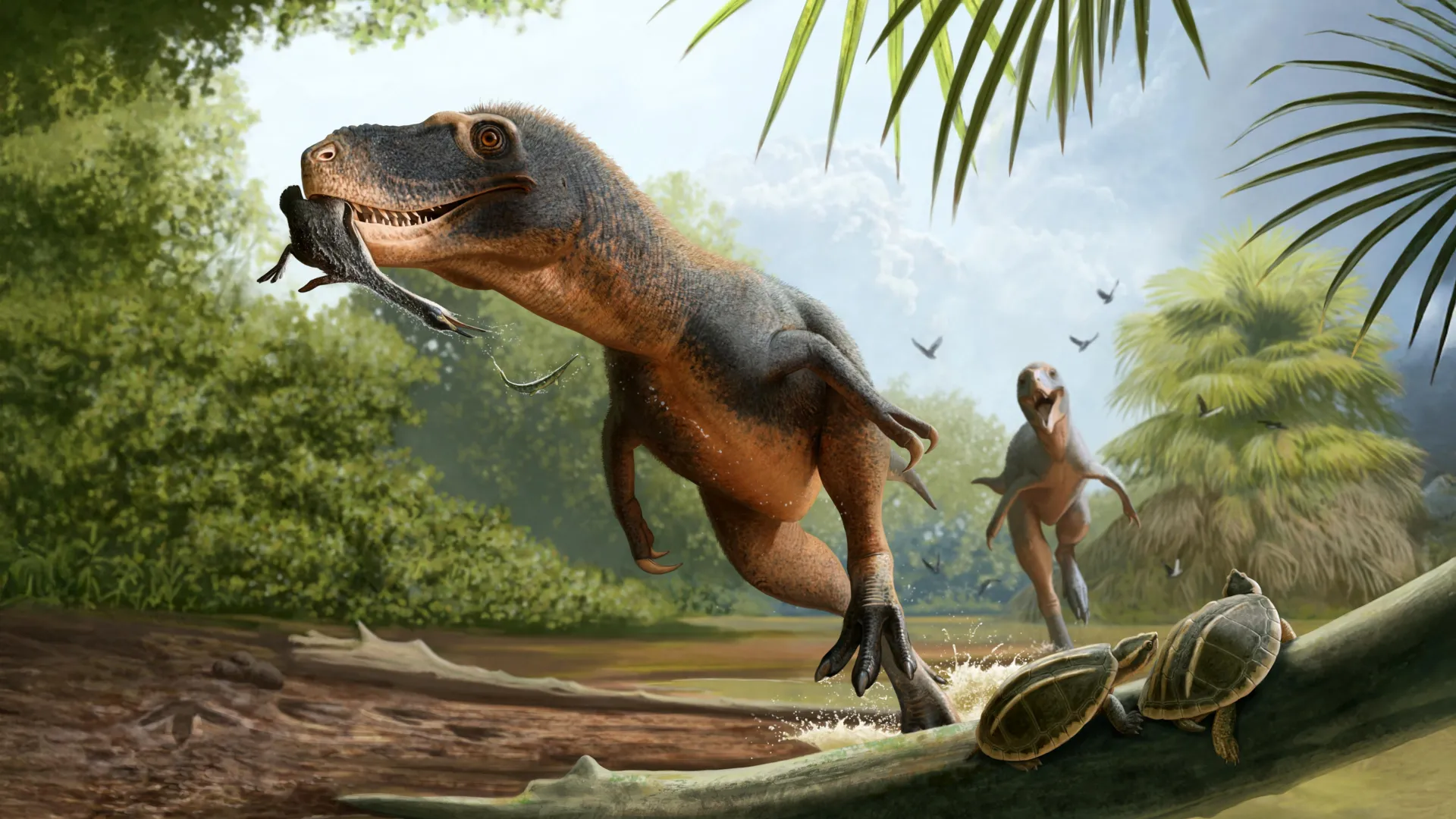
About 66 million years ago, a large dinosaur, possibly a T. rex or Nanotyrannus, swallowed a bird. Remarkably, evidence of that ancient meal survived in fossilized feces, preserving what researchers describe as the finest feather specimen yet discovered from the age of dinosaurs. By examining that feather, scientists say they may have uncovered an important clue to why birds became the only dinosaur lineage to survive the mass extinction at the end of the Cretaceous Period.
The findings were reported in Current Biology.
“It’s such a beautiful, well-preserved feather, from such an unexpected source, and it’s exciting that it could help us answer this huge question in paleontology,” says Jingmai O’Connor, the lead author of the new paper and the associate curator of fossil reptiles at the Field Museum in Chicago.
Why Some Birds Survived the Asteroid
Birds are a highly specialized branch of the dinosaur family tree, with a history stretching deep into the Mesozoic Era. The oldest known bird, Archaeopteryx, lived about 150 million years ago. Birds then continued evolving alongside other dinosaurs for nearly another 100 million years.
That long coexistence changed dramatically 66 million years ago, when an asteroid struck Earth and triggered a global mass extinction. Nearly every dinosaur lineage disappeared, including most types of birds.
One branch, however, survived. Known as Neornithes, this group ultimately gave rise to every bird species alive today.
Why Neornithes endured while other birds and dinosaurs vanished remains one of paleontology’s enduring puzzles. O’Connor has spent years studying fossil birds in search of an explanation. This study, however, took her into unusual territory: feathers preserved inside fossilized feces, known as coprolites.
“As far as I know, no one has ever thought to look for feathers or to study feathers in coprolites, so this project was really exciting,” says O’Connor.
A Tiny Feather Found in Montana
The specimen was discovered in 2016 by David DeMar, Jr., a research scientist and the Hell Creek Project collections manager at the University of Washington Burke Museum and co-author of the paper. DeMar was conducting fieldwork in northeastern Montana when an unusual rock caught his attention.
“I was crawling up a rocky outcrop collecting fish fossils when I came across a dark, reddish-brown nodule about half the size of a golf ball. I picked it up and scanned its surface through my hand lens, and that’s when I couldn’t believe what I was seeing, a tiny fossil feather. I was cautiously optimistic about its discovery, because feathers had not yet been found in the Hell Creek Formation, even after more than 150 years of prospecting,” says DeMar.
Researchers later analyzed the fossil’s mineral composition in the laboratory and used CT imaging to see what was hidden inside. CT scans combine thousands of X-rays into a detailed digital view of the interior of an object without having to destroy it.
“Although the preservation was better than many of the feathers I’d been studying in Burmese amber for my thesis, this was in a rock — and a fairly unremarkable one at that. I suspected it might be a coprolite, but it wasn’t until we got it into the micro-CT scanner at USC’s medical campus that the full feathery fabric of this fossil feces became apparent,” says Nate Carroll, a co-author of the paper and paleontologist at the Carter County Museum in Ekalaka, Montana. “Every hour processing the data revealed another feather, another scale, another bone — in stunning 3D. As someone who had been relying on far-flung amber mines as my main source of 3D feather data, realizing that fossil poop from my home state could yield such exceptional specimens was a game changer.”
An Ancient Diving Bird’s Final Fate
Inside the coprolite, scientists identified several feathers, tiny scales from a gar fish, and leg bones belonging to a hesperornithiform bird. Because both the feathers and bird bones occurred together, the researchers concluded that the feathers most likely came from the same bird.
“Hesperornithiforms were aquatic birds, ecologically similar to loons,” says O’Connor. “Most couldn’t fly, and instead, they used their specialized feet to dive down into the water to hunt for things like fish. The feathers showed adaptations for being underwater that we see in living aquatic birds.”
Hesperornithiforms were close evolutionary relatives of Neornithes, the branch that survived the mass extinction and eventually produced modern birds. But hesperornithiforms belonged to a separate lineage and disappeared along with most other birds.
“The most common birds alive in the Cretaceous were part of a group called the enantiornithines. The modern Neornithes branch of birds were separate from that group, and so were the hesperornithiforms,” says O’Connor.
Water Alone May Not Explain Bird Survival
One hypothesis has proposed that Neornithes survived because many lived around aquatic environments, where conditions may have offered some protection from the devastation following the asteroid impact.
The hesperornithiform fossils complicate that idea. These birds also lived in and around water, yet their lineage still went extinct. That suggests habitat alone cannot fully explain why Neornithes survived.
O’Connor suspects that another critical difference may have involved their feathers and how those feathers were replaced.
“We think the types of feathers that these birds had, and/or the way they molted those feathers, may have been one of the underlying causes of the selectivity of the end-Cretaceous mass extinction — essentially, why some birds died out and why others survived,” she says.
Primitive Feathers and a Deadly Impact Winter
The feathers inside the coprolite are the first ever identified from a hesperornithiform. Their structure appears to fall somewhere between the plumage of enantiornithines and that of modern birds.
“Some of these diving birds’ feathers seem to have been modern-looking and waterproof, but they also had some smaller, fuzzy, primitive body feathers that we associate with dinosaurs and enantiornithines,” says O’Connor.
Body feathers play a major role in keeping birds warm. If hesperornithiforms and enantiornithines had plumage that trapped heat less efficiently than feathers found in Neornithes, that difference could have become crucial after the asteroid impact.
The collision is thought to have thrown enormous amounts of dust and debris into the atmosphere, reducing sunlight and contributing to a dramatic period of cooling known as an impact winter. Birds with better insulation may have been better equipped to endure those harsh conditions.
Because hesperornithiforms belonged to neither Neornithes nor enantiornithines, their newly discovered feathers provide another piece of the extinction puzzle.
“The hesperornithiforms retain primitive feather types that may not have been as efficient for insulation as modern plumaceous feathers, and that could explain why they went extinct along with the enantiornithines,” says O’Connor.
A Rare Look at Predator and Prey
Greg Wilson Mantilla, a professor at the University of Washington, curator of vertebrate paleontology at the Burke Museum, and co-author of the study, says the discovery is especially valuable because fossil birds and their feathers are exceptionally uncommon.
“We rarely find fossils of birds and even more rarely their feathers, giving us such important insight into the evolution of this key aspect of their biology. On top of that, these bird feathers found within a large fossilized dinosaur dung give us an incredible window into predator-prey interactions 66 million years ago.”
The specimen therefore captures more than just feather evolution. It also preserves evidence of an ancient food web, revealing what a large dinosaur consumed shortly before the end of the dinosaur era.
Fossil Poop Opens a New Window Into the Past
For O’Connor, the research also demonstrated how much paleontology can resemble detective work. Instead of working with a nearly complete fossil skeleton, the team had to reconstruct the story from small fragments preserved inside one coprolite.
“I usually work with fossils that are preserved in big stone slabs, and the entire skeleton and even the soft tissue is preserved — they make it easy for me. But with this project, we just had this coprolite — and its contents — to go off of, and it made me feel like a detective, piecing together all these little clues,” says O’Connor. “And since no one has studied feathers in coprolites before, this opens up a whole new avenue for investigation. We only knew to look at this one because of how it happened to be split open, with the feather exposed — it was literally a lucky break. I hope more scientists start CT scanning coprolites and taking a closer look at them to see what might be inside.”
The discovery suggests that other fossilized droppings stored in museums or still waiting to be found could contain similarly delicate remains that have gone unnoticed. CT scanning those specimens may give researchers a new way to study feathers, diets, predator relationships, and other details of prehistoric ecosystems.
This study was contributed to by Jingmai O’Connor (Field Museum), David DeMar Jr. (Burke Museum of Natural History and Culture/University of Washington), Nathan Carroll (Carter County Museum), Karen Chin (University of Colorado, Boulder), Michael Holland (Burke Museum of Natural History and Culture/University of Washington), Alex Clark (Field Museum and University of Chicago), Christian Cooper (Field Museum), Pei-Chen Kuo (Institute of Vertebrate Paleontology and Paleoanthropology, Chinese Academy of Sciences), Thomas Tobin (University of Alabama), Aaron Celestian (Natural History Museum of Los Angeles County), David Bottjer (University of Southern California), Luis Chiappe (Natural History Museum of Los Angeles County), and Gregory Wilson Mantilla (Burke Museum of Natural History and Culture, University of Washington).
