


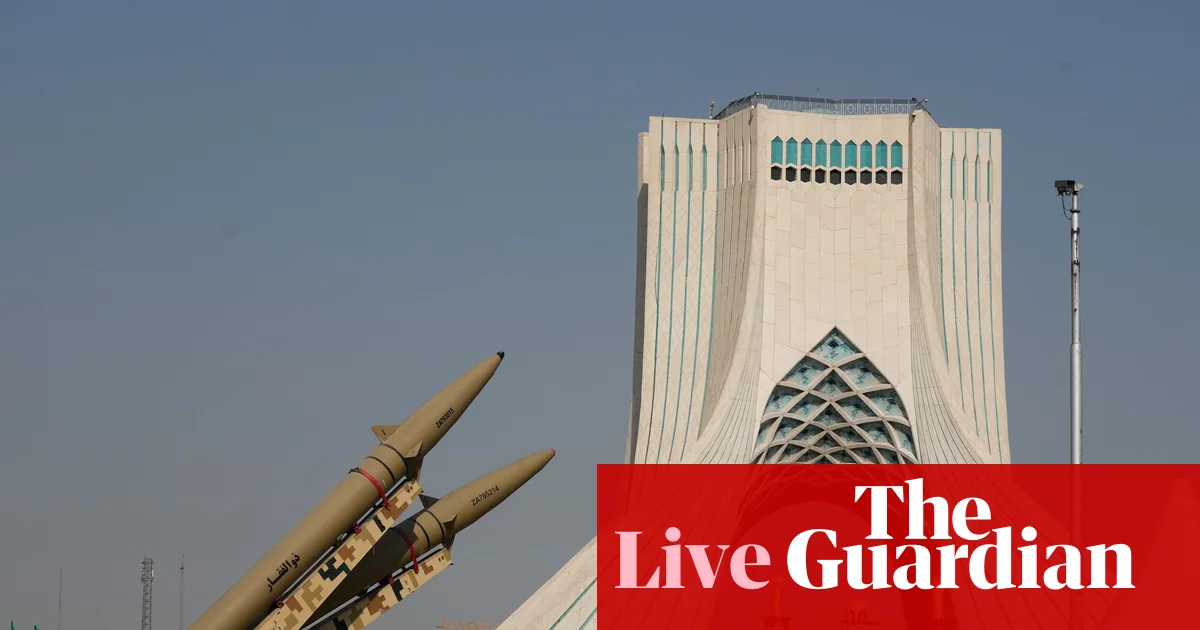
Jordan says it has foiled Iranian missile attack
Jordan’s military is saying it has foiled an Iranian attempt to target the kingdom with five missiles, the state news agency reports.
The agency quoted the armed forces as saying “interception measures” were carried out and there were no casualties.
The military said it maintained “the highest levels of readiness to deal firmly with any threat” targeting the country’s security and its citizens, the Jordan News Agency posted on social media.
Earlier today the US military launched a “heavy wave” of new strikes on Iran in response to Tehran’s attack on American military installations in Jordan on Wednesday.
Key events
To recap on their closed-door meeting earlier at the White House, Donald Trump and Benjamin Netanyahu explored all possible paths to curb Iran’s nuclear program, including diplomacy, economic pressure and force, a senior Israeli official has told Reuters.
The Israeli prime minister did not tell Trump that Israel’s preference now was for further attacks on Iran, the official said in briefings with reporters after the meeting on Tuesday. “In the end, it’s his decision,” the official, speaking on condition of anonymity, said of Trump.
The US president has three options and all were discussed at length, said the official, listing them as “a [negotiated] deal, continuing the blockade and economic pressures, and a massive strike”. Netanyahu also added unspecified new ideas to the mix, the official added.
Trump had voiced irritation with Netanyahu ahead of their meeting, complaining that details had surfaced publicly about Netanyahu’s plans to talk about new intelligence on Pickaxe Mountain, a deep-underground, nuclear-linked facility that Trump has threatened to bomb.
Pushing back against any notion of tensions over the issue, the official said the two allies readily share intelligence, denied that Netanyahu had pushed Trump to escalate militarily against Iran and left open the possibility of a diplomatic solution.
At the same time, the Israeli official acknowledged that Trump is the “senior partner” while Netanyahu is the “junior partner” in the allies’ conflict with Iran.
Oil prices erased some of their previous gains on Thursday despite the escalating attacks around the Gulf as investor focus shifted to supply flows through the key chokepoints in the region.
Brent futures fell 1.06% to $89.78 a barrel as of 0418 GMT. US West Texas Intermediate (WTI) crude fell 0.76% to $83.82 a barrel.
Brent settled up 7.91% in the previous session and WTI up 6.56% in one of the sharpest spikes of the Iran war, reversing a 5% plunge on Tuesday after a pause in hostilities in the five-month conflict, Reuters reports.
Prices surged as Donald Trump threatened on Wednesday to hit Iran “very hard” after an Iranian missile attack on Tuesday on a US base in Jordan. The US on Thursday said it carried out two hours of reprisal attacks on Iran.
“Trump’s ‘hit hard’ rhetoric caused the price spike immediately but looks like the market has fully priced [that] in and [is] considering the ‘Taco’ possibility right now,” said Lin Ye, vice-president of commodity markets, oil, at Rystad Energy, referring to the acronym “Trump always chickens out”.
Ye said the market was following a pattern: geopolitical headlines were triggering rapid price spikes, but those gains were often short-lived as actual supply flows and parallel diplomatic efforts tended to determine how long those upward price moves persisted.
Rystad Energy estimates about 13m barrels a day of oil from the Gulf is still reaching markets.
Jordan says it has foiled Iranian missile attack
Jordan’s military is saying it has foiled an Iranian attempt to target the kingdom with five missiles, the state news agency reports.
The agency quoted the armed forces as saying “interception measures” were carried out and there were no casualties.
The military said it maintained “the highest levels of readiness to deal firmly with any threat” targeting the country’s security and its citizens, the Jordan News Agency posted on social media.
Earlier today the US military launched a “heavy wave” of new strikes on Iran in response to Tehran’s attack on American military installations in Jordan on Wednesday.
Qatari LNG gas tanker transits strait of Hormuz
A liquefied natural gas tanker controlled by QatarEnergy exited the strait of Hormuz overnight – the first such vessel visible on ship-tracking data to leave the waterway since 11 July, data from analytics firms showed on Thursday.
The Al Areesh tanker, which loaded a cargo at Qatar’s Ras Laffan terminal around 4-6 July, sailed out of the strait overnight on 29 July, according to Kpler and LSEG data.
LSEG data shows it is currently heading to Port Qasim, Pakistan, with an estimated arrival date of 31 July. Its departure marks the first time a QatarEnergy-controlled LNG tanker exited the strait of Hormuz since the Al Rekayyat was struck in early July, Reuters reports.
The previous LNG tanker to exit was the Al Hamra, which left on 11 July carrying a cargo loaded at the United Arab Emirates’ Das Island, according to Kpler data.
Separately, the Mraweh LNG tanker, which was last detected outside the strait of Hormuz in ballast on 24 July, reappeared inside the strait on Thursday, according to Kpler and LSEG data. The vessel – controlled by Adnoc Gas – remained in ballast, Kpler data showed.
Twelve commodity ships passed through the Hormuz strait on Wednesday, with six entering and six exiting, Kpler data showed – an increased number from the previous two days.
The fresh US strikes after the days-long lull in its attacks on Iran came after Donald Trump vowed to hit the country “very hard” in response to its targeting of American forces in Jordan, raising the risk of a return to all-out war in the region.
Iranian state media said two people were injured in attacks on the island of Qeshm in the strait of Hormuz and explosions were also reported in the western province of Khuzestan.
The renewed hostilities sent oil prices spiking, with Brent crude – the international standard – jumping 7.3% past $88 a barrel.
There’s more in our new full report here:
Donald Trump has been considering a US commander’s plan for a punishing air campaign against Iran that could take up to two weeks, the Wall Street Journal has reported, citing people familiar with the matter.
It says the plan drawn up by Adm Brad Cooper, the head of US Central Command, involved 10 to 14 days of intensive airstrikes intended to cripple Iran’s missile capability, despite warnings that the US is running low on air-defensive munitions.
Or Trump could opt for a more limited military strike in hopes diplomacy could be pursued, said the report, published shortly before the US launched a fresh round of strikes on Iran.
The WSJ said:
The idea behind Cooper’s high-end option is to go beyond the tit-for-tat airstrikes that have done little to deter Tehran from threatening ships in the Strait of Hormuz and lobbing missiles at American forces in the region by sharply escalating the war, according to people familiar with his thinking.
If the U.S. wants military action to be effective, Cooper has said, the U.S. must step up its air attacks, significantly blunting Iran’s missile threat, to try to break the stalemate. This “go big” approach, which is among a series of options he has developed, would reduce the need for the U.S. to use defensive munitions because Iran would have less capability to attack.
US says ‘heavy wave of strikes’ against Iran completed
The US military is saying is has finished its “heavy wave of strikes” against Iran.
Central Command said in a statement posted on X that it struck “dozens of Islamic Revolutionary Guard Corps (IRGC) targets in Iran, including military command centers, missile and drone facilities, coastal surveillance and defense sites, and maritime capabilities”.
It said the two hours of strikes were in response to Iran’s attempted missile attacks on US forces in the region and “aimed to further diminish threats posed by Iran and its proxies to American forces, commercial shipping, and neighboring Gulf countries”.
Centcom also recapped that IRGC forces had launched multiple ballistic missiles from Iran in “an attempted surprise attack” on US forces on Tuesday, US time, adding: “All Iranian missiles were successfully intercepted.”
US-Saudi strikes in Iraq push region into ‘uncharted territory’
Before this new round of American strikes against Iran, Saudi Arabia joined the US in hitting an Iranian-backed militia in Iraq – a move that has pushed the Middle East region into “uncharted territory”, analysts are warning.
Riyadh’s decision to publicly join the US in striking sites associated with Iraq’s Popular Mobilisation Forces – killing at least 20 fighters – has added another complicating dimension to a war being seen as increasingly unpredictable and in danger of widening.
While Saudi Arabia has reportedly been involved in a handful of secretive strikes on Iran as part of the war, Riyadh’s overt involvement marks a new turning point in the conflict, reports Peter Beaumont.
Wednesday’s flare-up in fighting followed days in which Tehran and its proxies have targeted bases and facilities of the US and its allies, including in Saudi Arabia, despite the brief US pause in attack on Iran.
The sense of growing chaos in the Middle East was summed up by Sanam Vakil, the director of the Middle East and north Africa programme at the Chatham House thinktank, who said:
Everyone is trying make sense of something that is increasingly senseless. One view is that the informal [US] pause in direct strikes on Iran saw a shift from Tehran to its proxies to maintain pressure [on Washington]. But there is no longer any plausible deniability because everyone knows how the relationships are intertwined.
The full report is here:
The US military has hit the south-western Iranian city of Abadan as well as Qeshm Island, Iranian media is saying, citing regional authorities.
The US attacked “a point near Qeshm” at 4am local time (0030 GMT), the deputy governor of the southern Hormozgan province said, according to the Mehr news agency.
The deputy governor of Khuzestan province said US missiles attacked “points around Abadan city”, the Fars news agency said.
State TV said several loud explosions were also heard in Ahwaz, Khuzestan.
A missile strike has hit a residential area of Qeshm island, Iran’s Tasnim is now also saying.
The US military earlier said its new strikes against Iran began at 8pm Eastern Time (midnight Thursday GMT).
Blasts heard on Iran’s Qeshm island – report
Three explosions have been heard on Iran’s Qeshm island, Iran’s semi-official Tasnim news agency is saying.
The Gulf island near the strait of Hormuz is a storage location for Iranian attack craft, drones, sea mines and other materials used to disrupt shipping through the vital energy route.
Before Wednesday’s flare-up of hostilities, mediators had expressed optimism about bringing the US and Iran back to the negotiating table following the collapse of an interim agreement amid renewed fighting over the strait of Hormuz.
A regional official quoted by the AP said mediators were “still trying with both sides” to restore calm and get the ceasefire back on track. He gave no details on whether progress was being made.
Another official said regional countries would continue to push to de-escalate the situation, but that prospects for successful mediation were slim as both sides continued to attack each other and shown no inclination to stop.
“We’re in a very bad place right now,” the unnamed official said.
Opening summary: US launches new strikes on Iran
Welcome to our live coverage of the continuing crisis in the Middle East.
The US has said it is conducting airstrikes in Iran, after a lull of several days in direct US attacks on targets in Iran.
Donald Trump said America would strike Iran hard, telling reporters in the Oval Office on Wednesday: “We’re going to be hitting them very hard, because it’s our turn to hit them. They know it’s coming.”
The US military said its attacks were a “powerful response to yesterday’s attempted Iranian attacks on US forces based in the Middle East”.
On Wednesday Iran launched a barrage of missiles at American military installations in Jordan – its first attack in the region since the pause in fighting – meanwhile the US partnered with Saudi Arabia to strike Tehran-backed militias in Iraq, killing at least 20 fighters and six Iranian advisers.
Elsewhere, drone strikes ignited fires on two natural gas vessels at the Egyptian port of Damietta, according to Ambrey, a British maritime security firm. It was not immediately clear who was responsible for the strikes on a US-owned floating storage facility and a Greek-owned tanker. No injuries were reported.
A strike on Egypt by Iran or its allies, if confirmed, would mark a significant widening of the conflict. Asked during an Oval Office event if Iran was responsible for the strikes, Trump responded: “It’s a little more of the same.”
The flare-up on multiple fronts after several days of relative calm raised the risk of a return to all-out war. It also underscored the difficulty of winding down a five-month conflict.
The US-Saudi strikes came hours after Israel’s prime minister, Benjamin Netanyahu, departed his first meeting with Trump since they launched the war against Iran on 28 February.
In other news:
-
The renewed hostilities sent oil prices spiking. Brent crude, the international standard, jumped 7.3% to $88 a barrel.
-
The office of the Iraqi president, Nizar Amidi, called the US-Saudi airstrikes on multiple logistics and weapons sites in eastern Iraq “a blatant violation of Iraq’s sovereignty”.
-
An oil refinery in Jazan, on the Red Sea coast, had temporarily shut down due to “relatively significant” damage from a Houthi attack on Saturday, a Saudi official told the Associated Press.
-
Saudi Arabia is seeking to build an international coalition to protect shipping in the Red Sea from Houthi attacks, Reuters quoted two people familiar with the deliberations as saying.
