


This story was originally published by our partner The San Diego Sun. Sign up for its newsletter.
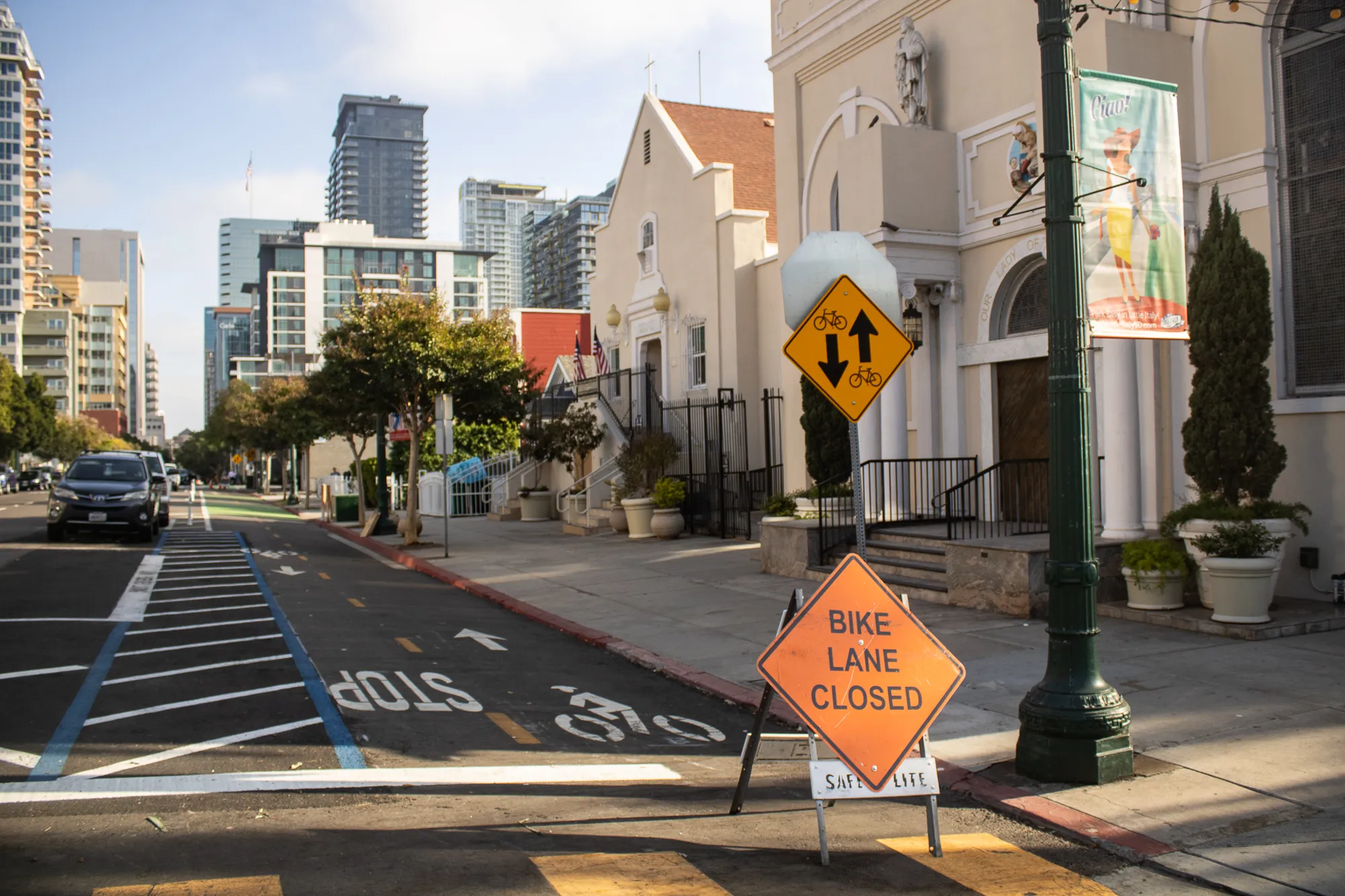
An unfinished bike lane project that passes in front of Little Italy’s 100-year-old Our Lady of the Rosary Church is still unsatisfactory to locals despite recent reconfigurations by the city.
The church lost its long-held curb access in April when a two-way cycle track was drawn onto State Street. Limousines and hearses could no longer unload next to the sidewalk for weddings and funerals, and an accessible parking spot was removed to make room for the bike lane.
The neighborhood pushed back and was met with resistance from the city.
While some adjustments have since been made to the road design, it remains unlikely the community will get the further changes it deems necessary for pedestrian and bicyclist safety.
“I feel like we’re at a stalemate,” Little Italy Association Executive Director Chris Gomez told The San Diego Sun. “I think that there was an opportunity for conversation and, unfortunately, once the decision was made, the vault sealed up and all communication coming out had stopped.”
Here’s the latest:
- City workers redrew a floating space in front of the church to re-include an accessible parking spot behind the loading zone.
- The bike lane remains at the curb since the city installed it in the spring.
- Additional project steps still need to be completed, and it is unknown when the bike lane will open.
The project is part of the Downtown Mobility Plan passed in 2016 to build out a network of bike lanes and encourage bicycle commuting. On State Street, plans were to outfit the length of the west side of the road — in front of the church — with a buffered, two-way cycle track.
Early on, the neighborhood petitioned instead for a “sharrow,” a shared lane for vehicles and bikes with an arrow painted on the road, on the church’s block.
From the Documenters
This story was written by Brisa Karow, a San Diego Documenter. The Documenters program trains and pays community members to document what happens at public meetings. It’s run by inewsource, a nonpartisan nonprofit newsroom dedicated to investigative and accountability journalism. Read more about the program here.
With the church being a hub for crowds and events, parishioners regularly spill out into the street, and there were concerns about collisions in the bike lane.
The San Diego City Council did not vote for the neighborhood’s shared lane suggestion in 2016, but the Downtown Mobility Plan included an alternative design for the location that would keep the parking and loading zone at the curb, rather than floating it between a bike lane and the road.
The LIA’s Gomez said city staff promised they would seek additional feedback on the final design and inform the community of the work before it was implemented, but that never occurred. They were provided few updates through the construction process, he said.
Upon an inquiry by The San Diego Sun, the city made no reference to the alternative design in the Downtown Mobility Plan. Senior Public Information Officer Anthony Santacroce only stated the city prioritizes separated cycle tracks where they can.
When the church community rallied against losing curb access, they called for the San Diego Mayor’s Office to reconsider a shared lane or a design that would reinstate curb access.
“It got to a point where we had several conversations with … various members of his office,” Gomez said. “And everybody was just like, ‘Well, we were presented three design plans from [the Transportation Department]. None of them work, so we’re not going to move forward with it.’”
Bike San Diego, a nonprofit that advocates for a connected network of protected bike lanes throughout the city, has opposed the church’s calls for a redesign.
Board member Monica de la Cruz said a shared lane on the block would create a gap in the network and pose safety risks for bicyclists.
“We have heard calls from [Our] Lady of the Rosary to redesign this project to sharrows, which would create unsafe conflict points where cyclists would be forced to ride through car traffic to exit the bikeway and re-enter the bikeway just for this block,” she said.
City spokesperson Ramon Galindo said in response to the church’s pushback, they reconfigured the striping in front of the church, noting they put an accessible spot back in. It floats in the road rather than flush with the sidewalk like before.
“We did our best to accommodate the Our Lady of the Rosary Church’s request by changing the striping plan,” Galindo said.
The church doesn’t agree.
Our Lady of the Rosary representative Mary Elizabeth Novell pointed a finger in Mayor Todd Gloria’s direction, saying he neglected the neighborhood’s needs in favor of pushing forward the project.
“Gloria used to live two blocks from here,” Novell said. “He knows exactly what is in front of this church. He knows exactly how it’s laid out.”
“He doesn’t care about this,” she added. “He doesn’t care about anybody who lives here. He cares about his project.”
The Mayor’s Office has not had a representative in attendance at Little Italy Association board meetings this year, according to board minutes. Novell lamented that the city’s communication regarding the project has lacked.
A mayoral spokesperson did not respond to a request for comment about attendance at downtown neighborhood meetings.
Bottom line, Novell said, they still don’t have access to the curb and she’s concerned about parishioners’ safety.
People unloading in the new accessible spot will have to travel along a roughly 40 foot loading zone to access the ramp in the curb in front of the church.
Hearse and limo drivers have been continuing to pull into where the loading zone used to be (currently the unopened bike lane).
Gomez said the LIA will continue to advocate for the community’s needs but it may “fall on deaf ears.”
“We will see what happens over the next period of time, whether it’s a year or two years,” he said. “Let’s hope that there’s no injuries or fatalities that happen because of this negligent act.”
Brisa Karow is an independent journalist living in San Diego. She is part of inewsource’s San Diego Documenters program and regularly reports on local government throughout the county.
