


Close Menu
NCIJ Network NCIJ Network
    What's Hot

    Naga Munchetty to leave BBC Breakfast after 17 years for Radio 5 Live | BBC

    July 28, 2026

    Zelensky in US to press Trump on air defences

    July 28, 2026

    Senate Democrats Press Blanche on Times Subpoenas

    July 28, 2026
    Facebook X (Twitter) Instagram
    Trending
    • Naga Munchetty to leave BBC Breakfast after 17 years for Radio 5 Live | BBC
    • Zelensky in US to press Trump on air defences
    • Senate Democrats Press Blanche on Times Subpoenas
    • Can the New York Times Save Journalism From Our AI Overlords?
    • Armenia’s AI Bet Is Not Chip Manufacturing. It Is Compute Sovereignty 
    • Hush Security Raises $30 Million for AI Agent Governance
    • ‘Running Away Balloon’ Artist Sues AI Meme Generator Over Ad Templates
    • Federal Judges Criticize Trump’s Justice Department for “Unethical” Conduct — ProPublica
    • About
      • Our Team
      • Editorial Policy
      • Editorial Independence
      • International Support
    • Trust & Standards
      • AI Usage Policy
      • Conflict of Interest Policy
      • Corrections Policy
      • Ethics Policy
      • Fact-Checking Policy
      • Source Protection
    • Get Involved
      • Guide for Sources
      • Support Independent Journalism
    • Legal
      • Cookie Policy
      • Privacy Policy
      • Terms of Use
    Facebook X (Twitter) Instagram
    NCIJ Network NCIJ Network
    Tuesday, July 28
    • Home
    • World
    • Ai
    • Business
    • Politics
    • Health
    • Crypto
    • Science
    • Technology
    • Cybersecurity
    • Defense & Security
    • Economy
    • Energy
    • Europe
    • More
      • Fact Check
      • Investigations
      • Opinion & Analysis
      • Environment
    NCIJ Network NCIJ Network
    Home»Cybersecurity

    New Dysphoria DDoS botnet spreads to 200k devices worldwide

    NCIJ NETWNCIJ NETWORKBy NCIJ NETWNCIJ NETWORKJuly 28, 2026 Cybersecurity No Comments3 Mins Read
    Share
    Facebook Twitter LinkedIn Pinterest Email

    A botnet called Dysphoria has compromised around 200,000 devices across the world and is using them for distributed denial of service (DDoS) attacks and traffic relay operations.

    According to QiAnXin XLab cybersecurity researchers, Dysphoria evolved from the ‘jackskid’ and ‘fbot‘ malware by adding a covert blockchain-based command-and-control (C2) resolution mechanism.

    Specifically, the botnet uses Ethereum ENS and Solana SNS domains to retrieve infrastructure information, while C2 addresses are concealed inside fake IPv6 strings and recovered using a custom byte-transformation algorithm.

    image

    The researchers first spotted Dysphoria on March 25 and identified multiple iterations that added meaningful updates, such as a C2 acquisition algorithm, multi-chain support, new domains, and functional separation between the relaying and DDoS variants.

    “Since the first quarter of 2026, XLAB has continuously tracked an emerging botnet family named Dysphoria, whose bot count exceeds 200,000,” reads XLab’s report.

    “In just a few months, the family has undergone frequent variant updates and technical iterations, demonstrating extremely strong resilience.”

    The use of blockchain in C2 operations makes the overall infrastructure harder to trace and dismantle.

    Based on the researchers’ analysis, infected clients send a fixed 78-byte login and heartbeat packet back to the C2 and receive from the operator DDoS attack commands that include duration, type, targets, and configurable flags.
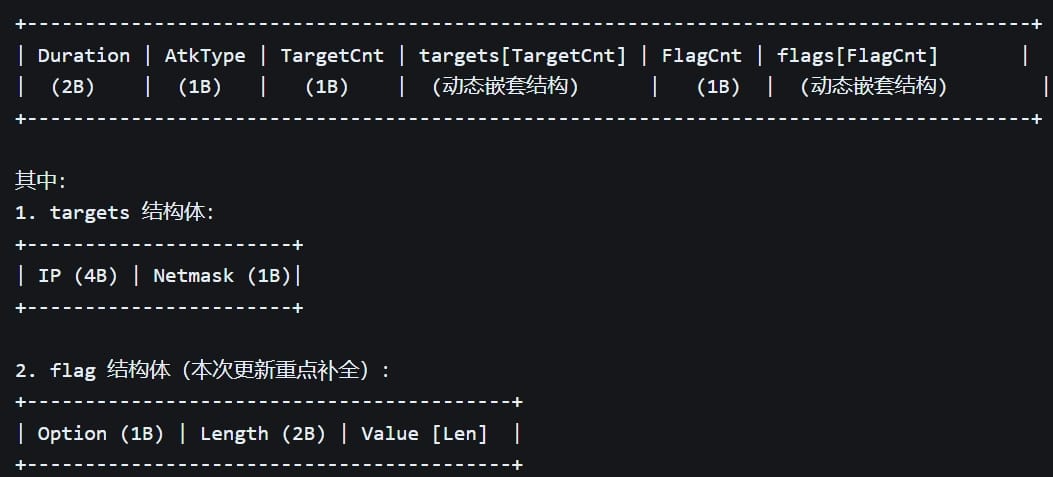
    DDoS attack commands
    DDoS attack command
    Source: XLAB

    In late June, XLab observed a variant that focused only on transforming infected devices into network proxies, and completely discarded the DDoS functionality.

    The malware abuses UPnP (Universal Plug and Play) on the compromised device to create 155 port forwarding rules to expose internal services to inbound internet connections.

    XLab’s report notes that the botnet spreads through weak Telnet and SSH credentials and known vulnerabilities in routers, cameras, and various IoT devices.

    Among the more recent flaws exploited are CVE-2025-55182 (“React2Shell”), CVE-2025-34152, CVE-2025-28137 (Totolink), and CVE-2025-9528 (Linksys). However, Dysphoria also targets older weaknesses that still persist in many devices, like CVE-2017-17215 (Huawei) and CVE-2020-8515 (DrayTek).

    XLab monitored the botnet between July 14 and 20 and recorded a peak of 740,000 daily pings from infected hosts, 239,000 connections from overseas clients, and 1,800 from China.

    The researchers confidently estimate that the number of infected devices is around 200,000 at this time.

    Concerning the botnet’s firepower, its operators claim a maximum DDoS capacity of 4 Tbps on their clearnet site, which promotes the service as a legitimate stress-tester.

    Dysphoria website
    Dysphoria service website
    Source: BleepingComputer

    Despite being significantly lower than the current record figure of 31.4 Tbps achieved by the Aisuru/Kimwolf botnet in December 2025, it is still enough to cause notable disruptions.

    Users can protect against botnet infections by keeping their devices’ firmware up to date, changing the default administrator password, disabling remote access if not necessary, and strengthening the security settings where available/possible.


    article image

    Security teams log 54% of successful attacks and alert on just 14%. The rest move through your environment unseen.

    The Picus whitepaper shows how breach and attack simulation tests your SIEM and EDR rules so threats stop slipping by detection.

    Get the whitepaper

    200k Botnet DDoS devices Dysphoria spreads worldwide
    NCIJ NETWNCIJ NETWORK
    • Website

    Keep Reading

    Hush Security Raises $30 Million for AI Agent Governance

    Google Adopts New Threat Actor Naming System

    Coca-Cola confirms data theft in Fairlife ransomware attack

    New Certighost PoC exploit lets attackers hijack Windows domains

    Microsoft Says New Cybersecurity AI Model Helps MDASH Hit 95.95% at Half the Cost

    NVIDIA Forms 37-Member Open Secure AI Alliance and Open-Sources NOOA Framework

    Add A Comment
    Leave A Reply Cancel Reply

    Editors Picks

    Naga Munchetty to leave BBC Breakfast after 17 years for Radio 5 Live | BBC

    July 28, 2026

    Zelensky in US to press Trump on air defences

    July 28, 2026

    Senate Democrats Press Blanche on Times Subpoenas

    July 28, 2026

    Can the New York Times Save Journalism From Our AI Overlords?

    July 28, 2026
    Latest Posts

    The Western Myth of Russian Greatness – Foreign Policy

    July 21, 2026

    Defence stocks rally as John Healey appointed chancellor; UK borrows less than expected in June – business live | Business

    July 21, 2026

    You Pay for Internet Service in Empty Buildings on Alaska’s Adak Island — ProPublica

    July 21, 2026

    Subscribe to News

    Get the latest sports news from NewsSite about world, sports and politics.

    NCIJ Network is an independent digital news platform delivering trusted investigative journalism, European and global news, in-depth analysis, and fact-based reporting with accuracy, transparency, and integrity.

    Facebook X (Twitter) Instagram Pinterest YouTube

    Naga Munchetty to leave BBC Breakfast after 17 years for Radio 5 Live | BBC

    July 28, 2026

    Zelensky in US to press Trump on air defences

    July 28, 2026

    Senate Democrats Press Blanche on Times Subpoenas

    July 28, 2026

    Subscribe to Updates

    Get the latest creative news from FooBar about art, design and business.

    Type above and press Enter to search. Press Esc to cancel.