


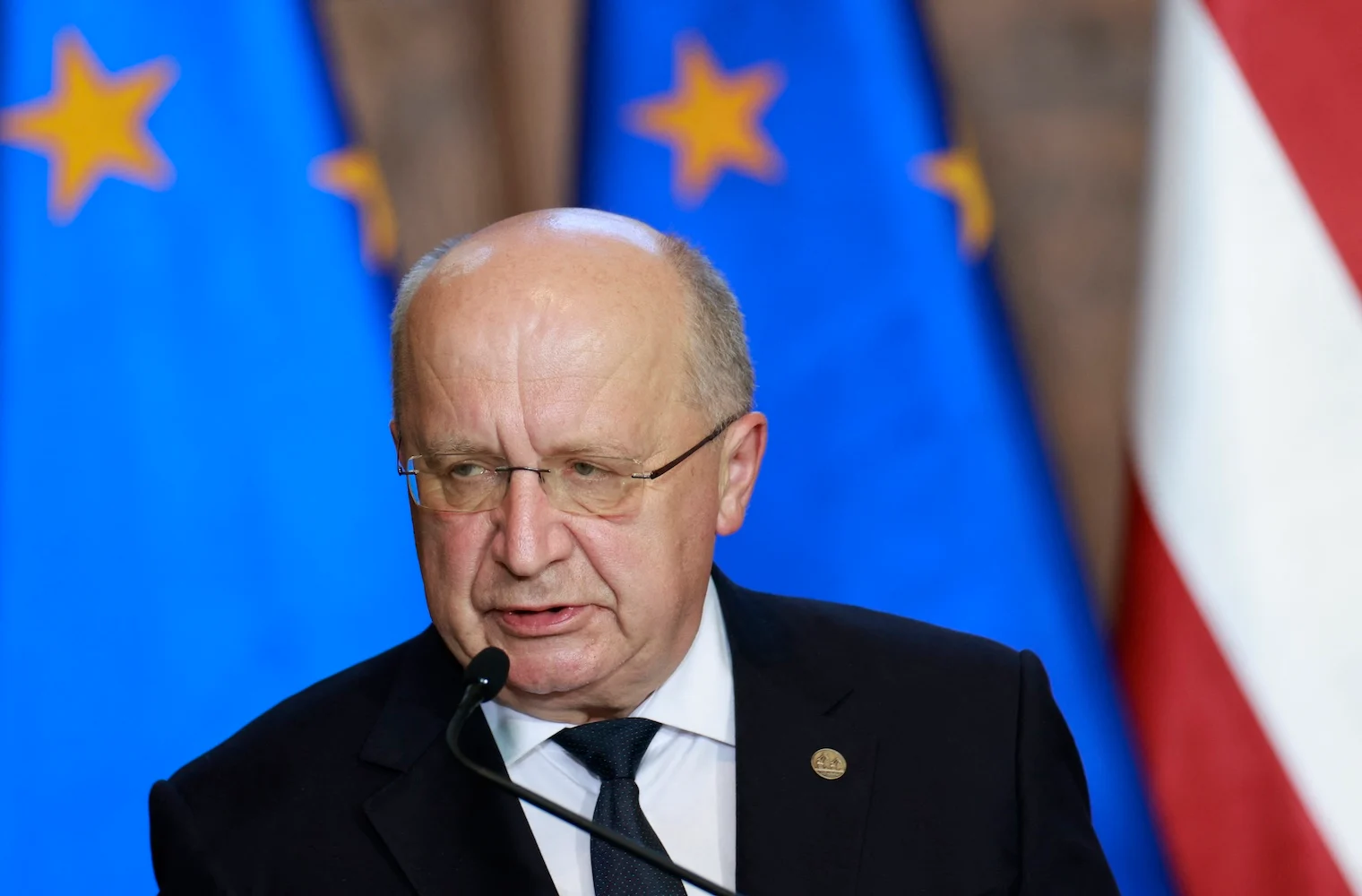
Andrius Kubilius, the European Union’s commissioner for defense and space, is facing a challenge not seen in 100 years or more, he says.
On the geopolitical stage, the EU must regain its balance atop shifting tectonic plates: Russia is again a threat, powers like China are rising, and the United States is reducing its commitment to the defense of Europe under a new program dubbed “NATO 3.0.” On the battlefield, the rise of drones and autonomous warfare is calling into question the viability of the traditional weapons and tactics in use for decades.
In response, the EU is wielding its vast financial power to solve the problem: $68 billion to help Ukraine’s defense industries, $170 billion in defense loans offered to EU members, plus billions more for other initiatives. It’s also tying its fate closer to Ukraine through joint-production agreements, seeing the country’s now powerful military as a new asset for Europe.
But allocating money is only half the battle—next comes the political fight over what weapons to buy, whom to buy them from, and how to use them. Each choice comes with a complex political calculus, from facing U.S. pressure to buy American weapons to navigating a defense industrial complex that favors buying tanks, not drones.
In an interview on July 23, Kubilius outlined his thinking on balancing U.S. pressure with EU needs, how the EU can learn from Ukraine, and where EU defense acquisition needs to go.
This interview has been edited for clarity and length.
Foreign Policy: What does the NATO 3.0 plan mean for you? Or are you ignoring it?
Andrius Kubilius: We are not ignoring it—we were talking about that from the very beginning.
We have two challenges in Europe: One is that Russia can test [NATO’s collective defense], and we need to be ready. And second is that because of geopolitical changes, because of China’s rising power, the Americans will start to move their resources to the Indo-Pacific, and we need to be ready for that.
I do not have any rational arguments against this strategy of NATO 3.0, which means that we Europeans need to take primary responsibility for conventional European defense.
The only question is how to do it. I mean, it would be good to know much more clearly [what the] American plans [are]—how, what, and from where they will withdraw—for us to be ready to invest into those capabilities.
FP: There’s a bit of a contradiction within the U.S. plans: Washington is pushing Europe to take more responsibility, but it’s also sending the message that Europe should buy American weapons. How do you navigate that?
AK: We would like Americans to buy European weapons. Our procurement is 40 percent American weapons, [but] Americans are buying only 1 or 2 percent from Europe. Second, especially after the war in Iran, stockpiles are empty—so it’s not a question of who will buy from whom. The question will be what to buy. Who is able to produce?
FP: So you don’t feel pressured by the United States despite the rhetoric from Washington?
AK: We know what the reality is—I am not surprised that Americans of whatever administration are asking Europeans to buy more American [weapons]. I think that we as Europeans are also looking at how to convince Americans to buy more [European weapons].
FP: You said earlier that there’s no clarity yet on what American weapons or forces will be withdrawn from Europe, and on what timeline. Are you pushing for clarity?
AK: Yes, I am raising that issue now in each meeting that we have with Pentagon officials. We want to have very clear plans. What do we need to develop? Of course, we know more or less what we need to develop, where we were dependent on so-called strategic enablers. It will take time; it will take money. But it would be good to have a much more practical understanding of what the Americans are removing, and then to fill the gaps in advance to develop some of those capabilities.
FP: One argument is that you just replace exactly what the Americans have. Another argument from the Ukrainian experience is that you invest in as many drones as you can. Where do you land on that debate?
AK: What is now going on [happens] once in 100 years. Trans-Atlantic collective defense is shifting toward more of European collective defense of Europe. So, this is one thing. The second thing, of course, is big technological changes.
We have a very clear division of labor with NATO: NATO is military might, [and the] European Union is industrial might. We are coming with our instruments: how to support industries, how to support member states to develop those capabilities, how to build stronger European industry.
But it also demands transformation on both sides. What I call the transformation on the supply side, what industries are producing, and transformation on the demand side, what militaries are buying. In some ways, Ukraine here is a very clear story.
When we met with [then-Minister of Digital Transformation] Mykhailo Fedorov at the beginning of last year, I said, “Well, we are waiting for military advice [on procurement].” He said [that] if they had listened to [the] generals at the very beginning of the war, they would not [have] create[d] a drone army.
In Europe, we are moving ahead. Some countries, maybe more. Some countries are still looking around. We have this historical legacy that we have 27 armies, 27 defense policies, 27 budgets. Not always that easy to coordinate.
But things are moving. I was very much impressed last year by the United Kingdom’s Strategic Defense Review, where I saw very clearly that they really took this Ukrainian experience directly.
FP: There’s a lot of incentive for you to encourage traditional defense industries, which many countries in Europe already have. But what I’m hearing you say is that you see the future of defense as innovation—that it’s OK not to spend money on tanks.
AK: We need to not let ourselves be arrested by traditional industries’ interests and the fact that in some cases there is a lot of national willingness to protect their own industries.
What is now our biggest threat? The biggest threat, of course, is an aggressive Russia.
What we shall face is the Russian capability to use 10 million drones per year. And that means that we need to be ready to defend ourselves against that.
The question is, are we ready? At the moment, I would say, if I compare ourselves with Ukrainians, we need to learn a lot. So that is why we are really looking at how to [integrate] Ukrainian industry with the European defense industry. Till last year, mainly we were looking at how to support Ukraine—now we are also looking at how Ukraine can support us.
Member states are starting to understand that defense production of drones is one thing—but we need to understand that we shall not resolve all the issues just by looking into production numbers.
Drone [technology] is becoming obsolete in two months’ time. So if you will build now in Europe 10 million drones, and you will put them into stockpile, after two months you will throw them out in the garbage.
We need really to have capabilities, industrial capabilities, to scale up production immediately. Which means we need to have manufacturing capability in reserve, we need to have components in stockpiles. We need to have people ready, both to produce and to operate, and then really to have contracts with those industries and to pay for those contracts.
FP: European nations and Ukraine are also working on the FREYJA anti-ballistic missile system. Are you able to share anything specifically on how the EU will support this?
AK: We still do not know exactly. We met with [FREYJA developers] Fire Point leadership and we talked about how they see the situation. They were quite optimistic. Now they are producing missiles for that anti-ballistic system. To have the system, they want radars from Europeans.
As I understood, they are ready to build quite an open system. They will build missiles, but radars can be from different producers. And then they also need seekers, which again Europeans are producing. The whole project will depend on how much this matching exercise will be successful.
FP: Ukraine’s pro-technology defense minister, Mykhailo Fedorov, is out. But Mykhailo Drapatyi, a Fedorov ally, has replaced Oleksandr Syrskyi as the top Ukrainian military commander. What is your reaction to all this news?
AK: We shall see. We need to recognize that Syrskyi did a very important job in all those different stages of the war. But now, it looks like all the changes are really bringing [in] those military leaders who can continue this technological change.
FP: Ukraine is a democracy, but it does still have a corruption problem. How do you both support Ukraine and navigate potential irregularities or corruption risks?
AK: Ukraine is facing some corruption challenges, which are not unique if you look into post-Soviet countries. But from another side, what we can see is that institutions which are established in Ukraine to fight against corruption, they are becoming really effective, agile, and independent.
So it shows that they are working. Second, definitely, we as the European Union, we have all the established procedures, all the established institutions to supervise very transparently how European Union money is used.
