


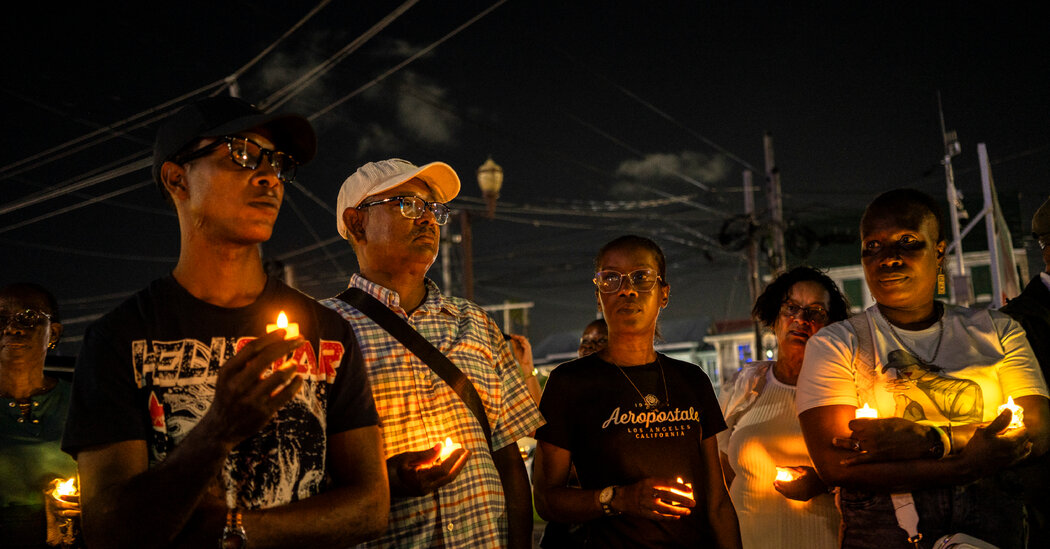
The sinking of a state-run ferry, which killed an estimated 100 people this month, is deepening political fault lines in Guyana, an oil-rich country and a top U.S. ally in South America.
The tragedy was Guyana’s deadliest event since the 1978 Jonestown mass murder and suicide, which left more than 900 dead. Many Guyanese are asking how this new disaster could happen in what is now one of the world’s fastest-growing economies.
When the ferry sank, I was in Guyana to report on something completely different: the nation’s oil boom. But everywhere I went, the tragedy suddenly dominated conversations, reflecting how the sinking had unleashed tensions in this former British colony.
“Our leadership paints Guyana as the next Dubai, but this debacle shows how absurd that narrative is,” Cathy Hughes, a former member of Parliament, told me at a nighttime vigil in the capital, Georgetown.
The ferry capsized on the night of July 18, when it was overloaded with excess passengers and cargo while making a routine run from Georgetown to the gold-mining outpost of Port Kaituma, deep in the hinterlands near Venezuela.
Gripping the country with nightmarish accounts, survivors said they were awakened in the middle of the night when the vessel began keeling. They grasped whatever floating debris they could find, waiting hours before rescue crews arrived.
Some survivors described seeing children being swallowed by the sea, and several of the 73 bodies recovered so far are children’s. The ferry was carrying an estimated 179 passengers, dozens more than it should have been, according to survivors and the official manifest, which listed 133.
About 30 passengers are still missing. Senior Guyanese officials including the minister of public works, Juan Edghill, who is responsible for state-run transport services, have asserted that the vessel was operating within its approved limits and that mechanical failure was not to blame.
Mr. Edghill did not immediately respond to a request for further comment.
The loss of so many lives has had an outsize impact across Guyana, which has a population of only about one million spread across a landmass about the size of the United Kingdom, which has nearly 70 million people.
Roy Henry, 21, said he lost his mother, Rona Mendoza, 40, in the tragedy. Mr. Henry said his brother, Jason Henry, 25, was also on the ferry but survived by holding on to a floating ice chest for hours.
“I am just trying to get my mind off of it and not study her too much,” Mr. Henry, a wood craftsman, said about his mother, who sold groceries in the region around Port Kaituma, using an idiom about having her on his mind. “If I study her, I would not eat.”
As grief resonated across Guyana, it became clear that the tragedy was exposing tensions over government accountability and glaring inequality in a country that experienced mind-boggling economic growth of 19.3 percent last year. That outstripped by far other booming economies in the region, such as Paraguay’s, which grew 6.6 percent the same year.
This boom is reshaping Georgetown, a once-sleepy outpost. New high rises are going up. Migrants from Cuba and Venezuela are flocking to the city. Chinese work crews are building highways. Luxury SUVs clog the city’s streets.
The ferry was a preferred option for many. Most aboard could not afford a $140 plane ticket to Port Kaituma, which would have enabled them to avoid taking the 24-hour boat trip. They were among the many Guyanese who have been left out of the boom.
It is still not clear what caused the ferry to capsize. It was built in 1939, decades before Guyana gained independence in 1966, and was scheduled to be inspected for potential repairs later this year, the authorities said.
A new ferry from India was recently acquired to replace it, the authorities said, but officials were waiting for port upgrades to be completed to put it into service.
Guyana’s government has hit back aggressively at criticism of its handling the episode.
President Irfaan Ali, who handily won re-election last year to a new five-year term, has made repeated trips to the area of the disaster to speak with family members who lost loved ones. He also vowed to investigate what caused the vessel to sink.
Senior officials have rejected claims that rescue efforts were too slow, or that negligence or corruption may have played a role in allowing the aging ferry to transport more passengers than it should have.
“This is not the picture of a government caught flat-footed,” the state-run Guyana Chronicle newspaper said in an editorial excoriating people who posted images of those who died. “This is a moment that demands unity, competence and restraint.”
Still, the reactions to the tragedy are showcasing Guyana’s sharp political divisions.
Azruddin Mohamed, the leader of Guyana’s opposition, mounted his own rescue efforts in the waters where the ferry capsized, and he shared video on social media of bodies floating in the sea while assailing the government’s response.
Few in Guyana view Mr. Mohamed’s motivation as purely altruistic. The scion of one of Guyana’s wealthiest families, he was placed under sanctions in 2024 by the United States for gold smuggling and bribery schemes.
While Mr. Mohamed was scouring for survivors, the authorities executed a search of his home. It was connected to an investigation into the execution-style killing of a gold dealer in 2021 outside a popular Georgetown nightspot.
Some Guyanese suggested that this could end up bolstering Mr. Mohamed. He has denied involvement in the murder and cast the inquiry, as he did with the U.S. sanctions, as a politically motived hit job aimed at taking him out of politics.
But the government did not stop there.
The authorities also arrested Sherod Duncan, an opposition member of Parliament, after he traveled to the site of the disaster and launched a drone to capture aerial footage of recovery vessels and the gathering of families at the waterfront.
The government, in what it described as an effort to bring a divided country together, also organized an interfaith prayer service one evening along Georgetown’s sea wall overlooking the Atlantic.
On a stage equipped with state-of-the-art sound equipment, a master of ceremonies politely welcomed those gathered, before Christian, Muslim and Hindu religious leaders recited prayers for the ferry’s victims.
Dressed in crisp white guayaberas, political dignitaries aligned with the government sat solemnly under a tarpaulin carefully rigged for the occasion, surrounded by throngs of security personnel.
But this event could also not escape Guyana’s fractious politics. Near the tarp, protesters quietly held placards demanding accountability and the firing of the public works minister.
“This country’s leaders simply cannot read the room,” said Sherlina Nageer, 49, a protester. “We don’t need them to hold fancy events to make it seem like they’re doing something. We need them to be accountable for their own negligence.”
After I left the prayer service, other Guyanese I had interviewed began sending me reports that Ms. Nageer and other protesters had been arrested by the police and were being charged with unlawful assembly.
An outcry ensued; the police released them and dropped the charges. But by then a new cycle of recrimination was flaring.
Denis Chabrol contributed reporting.
