


It seems as though every week brings another news story on declining global birthrates. A number of political leaders have been panicking for a while, of course, instructing citizens to reproduce in tones so beguiling, who could possibly resist? JD Vance: “I want more babies”; Jacob Rees-Mogg: “We need more babies”. While in France this year, a government direct-mailing campaign urged 29-year-olds to have a baby before it’s too late.
People are busily scratching their heads and trying to work out why this is happening. The trend is described as a catastrophe for civilisation, with leaders drumming up incentives and policies in response, from medals (Russia) and a €1,000 birth bonus (Italy) to expanding access to IVF (the US, with Donald Trump crowing – and if you’re eating you may want to skip the rest of this sentence – he’ll be known as the “fertilisation president”).
We hear ever-multiplying theories, from housing costs, contraception, education for women and smartphone addiction to lower rates of hooking up, problems with car seats, global heating and urbanisation. But something is missing in these discussions. Here’s a clue. It begins with M and it has seven letters.
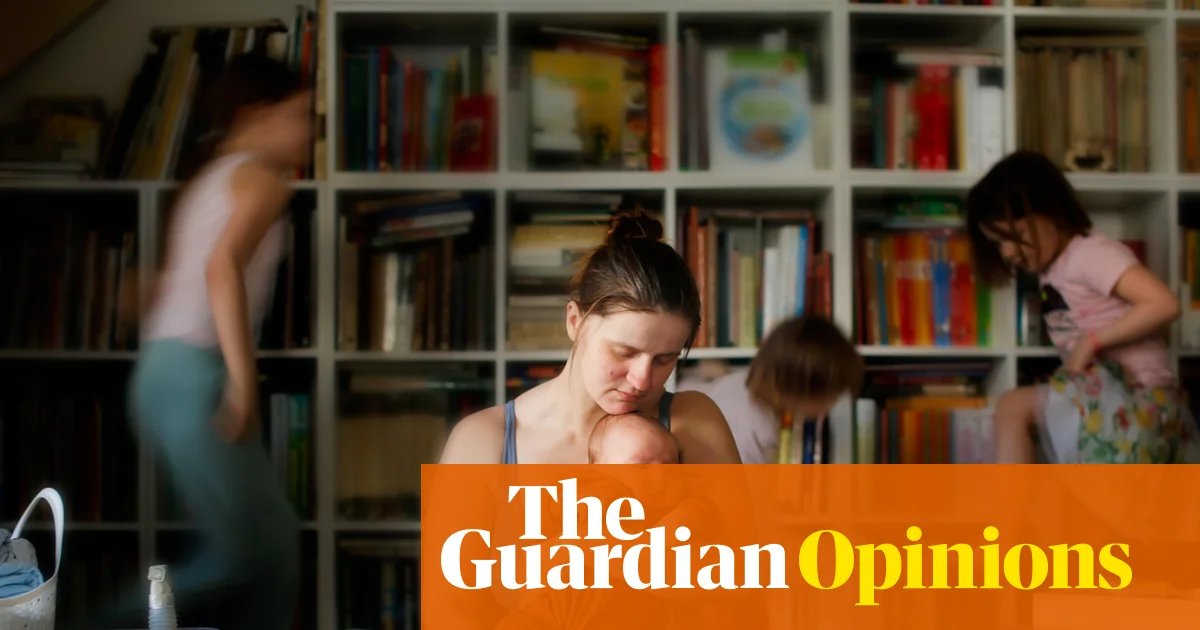
In all the panic about falling birthrates, the experiences of the people actually doing the births and those parenting infants – most often mothers – are strangely absent. We hear about the ruinous effect of low birthrates, but comparatively little of the difficulties mothers face, such as maternity discrimination and mental health issues. It’s as though there is something about the way we organise society that means new mothers, caregivers, are unseen.
Thank goodness, then, for a major new report from the thinktank Theos – for which I wrote the foreword – which aims to make the experience of becoming a mother more visible. It is rich, fascinating and in depth, covering subjects such as mortality and tax, sleep and debt, the body and politics. While the experience of becoming a mother is obviously individual, there are recurring themes that should make us, as a society, take notice.
One of the most striking findings is that many mothers feel “undervalued”. What does it mean to organise society in a way that people who are growing and raising new humans feel like this? It can’t be good. But perhaps it is convenient. While most people in the study thought that childcare was as vital to the economy as paid work, the maximum state maternity pay in the UK – from six weeks to 39 weeks after giving birth – is £6,412.56, far below the minimum wage. It is no surprise, then, that in a society where value is priced against profit mothers feel undervalued.
What is it like to be a mother today? While many found childcare rewarding and enjoyable, the study also points to data showing that 48% found it stressful and 40% found it overwhelming. Perhaps this has something to do with the finding that mothers with young children carry an expectation to “do it all”: to work, manage the household and raise children. Many mothers also felt “invisible” once they had their babies. “You sort of cease to exist as a person, and you just become a mum,” said one.
Another talked about people giving up their seat on the tube when she wore a badge in her pregnancy. But “it’s very rare for people to offer you a seat once you have a baby and a pram, which is funny, because I actually feel like, particularly after my C-section, I probably needed it a bit more”. This oversight should be easy to address, with a fuller rollout of priority seats on public transport for parents travelling with babies and young children, or even – as many European countries have – specific areas on trains for prams and families.
What was birth and its aftermath like for the women in the study? Many described it as a time of “overwhelming exhaustion, sleep deprivation and anxiety”, with some finding postnatal visits rushed and “tick-box”, overlooking the mother, with the same at the routine six-week check. Experiences of maternal healthcare during birth and post-partum support were mixed: one woman spoke of “being handled like a piece of meat”.
after newsletter promotion
The study found that the interviewees were nervous or scared of sharing feelings of overwhelm after giving birth, because of the stigma attached to struggling in new motherhood. The focus on perinatal mental illness is obviously important, but it’s not the whole story. A better understanding about the dimensions of ordinary matrescence would help. The report’s recommendations also include enhancing the six-week check and improving care for new mothers in the immediate hospital stay.
When we had our first child, I had never really thought about “motherhood”. I imagined my body – because I carried our kids, though of course not all mothers do – would be like a box or a flowerpot, and that when she was born I’d return to who I was, more or less. Instead, I soon realised the biological, socio-political and psychological experience of becoming a mother was a lot more complicated and intense than I’d been led to believe, from the messaging of antenatal care to the philosophy, politics and culture I had absorbed through my life.
There are two intersecting problems. First, there is a lack of recognition of the heft of the experiences of pregnancy, birth and new motherhood. Second, there is a lack of social support in the perinatal period. Both are needed to improve the experience of people becoming parents.
More widely, we need to understand how and why new mothers are feeling like this, what it reveals about our current value system, and how we might evolve a culture and society that is able to value birth and care, for all people. No need for any medals.
