


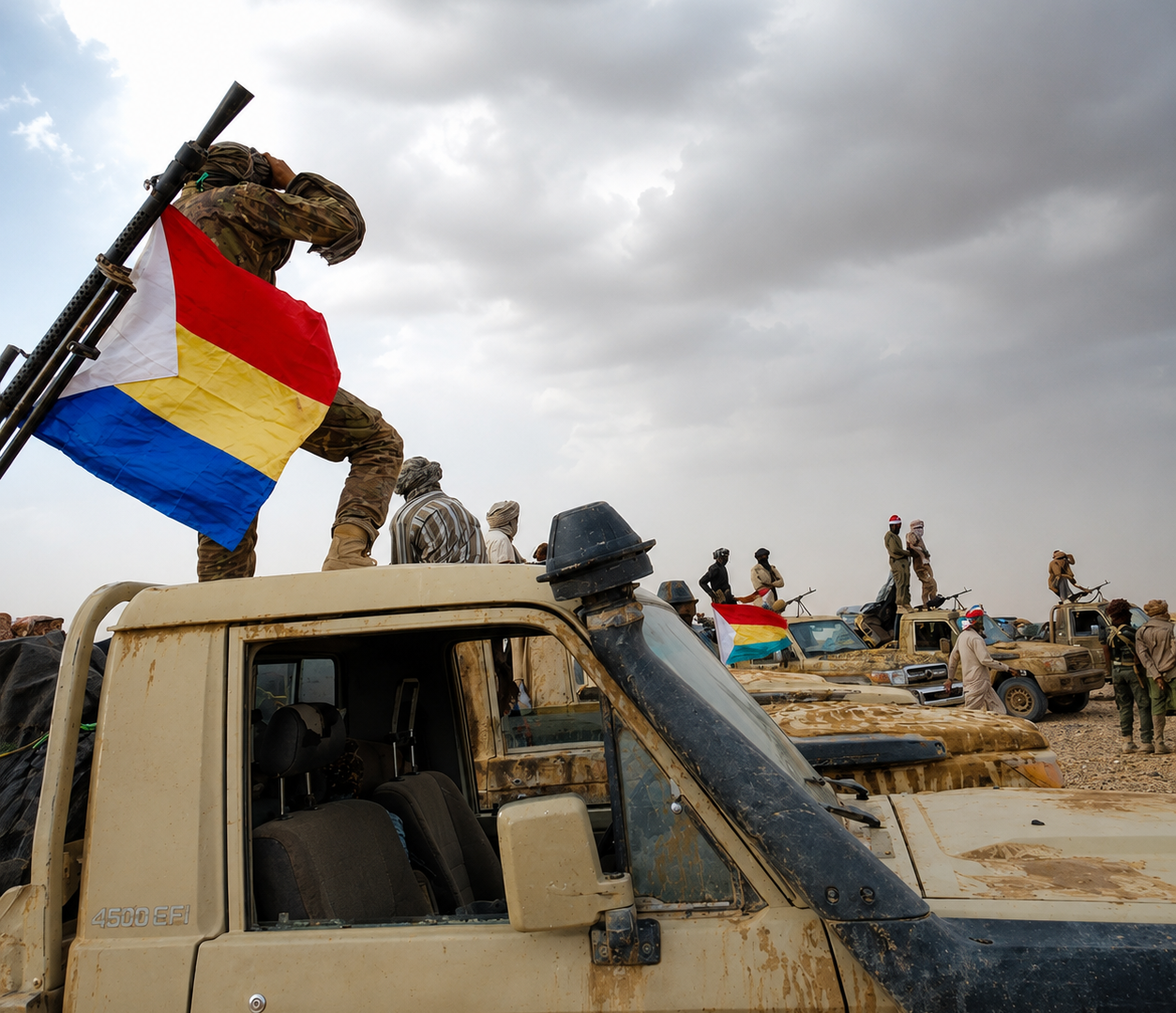
Bamako, Mali – An unprecedented battlefield partnership between a separatist movement and an al-Qaeda affiliate has transformed the conflict in northern Mali, shifting the military balance and deepening divisions over how, if at all, the war can end.
When the Azawad Liberation Front (FLA) and Jama’at Nusrat al-Islam wal-Muslimin (JNIM) launched a joint offensive on April 25, 2026, the conflict entered a phase unlike any before.
A war that had long pitted the Malian state against multiple armed groups gave way to a coordinated campaign stretching from Kidal and Anefis to Tilemsi, Gao and Sevare, posing the most serious challenge to the Malian army in years and to Russia’s Africa Corps, the Kremlin-backed force that replaced the Wagner Group in Mali.
Since then, the fighting has been marked by simultaneous assaults, ambushes, drone strikes and attacks on military convoys, with all sides claiming significant battlefield gains.
Bamako says it is working to restore state authority and dismantle what it calls a “terrorist alliance” between the FLA and JNIM.
The FLA says it remains committed to independence for Azawad, the name separatists use for northern Mali, while JNIM portrays the war as part of a campaign to “liberate” Mali and overthrow the government, which it accuses of relying on Russian forces.
More significant than the offensive itself, however, is the unprecedented military cooperation between a nationalist separatist movement and an al-Qaeda affiliate.
Their political ambitions remain fundamentally different, yet their cooperation has already reshaped the conflict and could have far-reaching implications for security across the Sahel.
The partnership emerged after the collapse of the 2015 Algiers Peace Agreement, which sought to end years of fighting between Bamako and northern armed groups through greater decentralisation and political representation, but whose implementation repeatedly faltered.
Successive military coups after 2020 reshaped Mali’s political leadership and security strategy. The Economic Community of West African States (ECOWAS) suspended Mali and imposed sanctions, while Russia deepened its military role by deploying the Wagner Group in late 2021.
After Russia folded the Wagner Group’s operations into the state-controlled Africa Corps, renewed fighting left neither the government nor northern armed groups able to impose a lasting settlement.
How the alliance took shape
On paper, cooperation between the FLA and JNIM appears unlikely. The FLA traces its roots to northern separatist movements that declared the independence of Azawad during the 2012 rebellion, a claim never recognised by the Malian state or the international community.
It presents itself as a secular nationalist movement seeking independence for Azawad, while JNIM seeks to overthrow governments it considers illegitimate and establish governance based on its interpretation of Islamic law.
Yet senior officials from both groups told Al Jazeera those ideological differences have been set aside to confront a common enemy.
Colonel Mohamed Issa, a senior FLA officer, said the movement remained committed to an independent Azawad, arguing that previous peace agreements repeatedly collapsed because successive governments in Bamako failed to honour them.
Negotiations, he said, would only be acceptable if they recognised Azawad’s right to separate.
Issa rejected suggestions of an ideological alliance, describing the relationship as a battlefield arrangement against a common enemy.
He said the JNIM-affiliated fighters operating alongside the FLA were exclusively Azawadis rather than members of the group’s wider regional network, arguing they were motivated primarily by defending their communities against the Malian army and what he described as Russian “mercenaries”.
Suleiman, a senior JNIM field commander who requested that only his first name be used for security reasons, described the relationship in broader terms.
He said the group approved operational coordination with the FLA after internal consultations because fighters on both sides largely came from “one people” caught up in the same conflict and because their liberation goals had become “relatively unified”.
He also claimed the FLA had accepted Islamic legal arbitration by local religious scholars, one of JNIM’s core objectives, a point the FLA itself did not raise. Bamako, meanwhile, has described the relationship as a “JNIM/FLA terrorist alliance” that threatens Mali’s sovereignty.
The differing accounts illustrate both the strength and the fragility of the arrangement. For now, shared battlefield interests appear to outweigh ideological differences. Whether that remains true as the conflict evolves is far less certain.
A shifting balance of power
The partnership has altered not only the battlefield but the way the war is fought.
FLA officials say working alongside JNIM has enabled both groups to divide responsibilities and pool expertise in attacks on military bases and supply convoys.
![A destroyed vehicle at the site of recent fighting in northern Mali [Photo: Courtesy of the Azawad Liberation Front (FLA)]](https://www.aljazeera.com/wp-content/uploads/2026/07/Mali-army-3-1785041272.jpeg?w=770&resize=770%2C578&quality=80)
Bamako disputes casualty figures released by the armed groups and insists its forces retain the initiative. Even so, the conflict has become markedly more sophisticated, with simultaneous attacks across distant locations, engagements lasting several days and ambushes targeting reinforcements before they reach the front lines.
Drones have assumed an increasingly prominent role, serving not only as reconnaissance platforms but increasingly as strike weapons against vehicles and military positions. Malian forces, backed by Russia’s Africa Corps, continue to rely heavily on air power, yet months of sustained fighting suggest neither side has secured a decisive advantage.
The war economy
Long-established financing and trafficking networks continue to sustain both sides.
JNIM sources describe a funding model built on regional commercial networks, organised zakat collections and resources accumulated over years, including proceeds linked to earlier al-Qaeda kidnapping-for-ransom operations.
The FLA says it relies primarily on donations organised by tribal leaders, traders and community associations.
Officials from both groups also acknowledged that individuals linked to the movements participate in illicit economies, including trafficking across the Sahara, although the extent to which those activities finance the war remains difficult to verify.
Weapons have proved as important as funding. Arms have flowed across the Sahel since the collapse of Libya in 2011, providing armed groups with a steady source of equipment.
The latest fighting has opened another supply channel: weapons and military vehicles captured from Malian forces now form an increasingly important part of both groups’ arsenals.
Can either side win?
There is little to suggest the conflict is nearing an end.
The Malian army retains a clear advantage in air power, backed by Russia’s Africa Corps. Yet the FLA and JNIM continue to mount coordinated operations across much of northern Mali.
![An armed man carries a weapon in a desert area of northern Mali, where government forces and armed groups have been fighting for control of territory [Photo: Courtesy of the Azawad Liberation Front (FLA)]](https://www.aljazeera.com/wp-content/uploads/2026/07/FLA2-1785041279.png?w=770&resize=770%2C1023&quality=80)
The military standoff reflects a wider political deadlock. Bamako remains committed to preserving Mali’s territorial integrity, the FLA insists on independence for Azawad and JNIM continues to seek the overthrow of the government.
None has shifted position since the latest fighting began, and nothing on the battlefield has yet forced any of them to do so.
Those competing objectives also cast doubt on how long the two groups can continue fighting together. Their partnership rests on a common enemy rather than a shared political vision, making its future uncertain.
A war without an endgame
Three months into the latest offensive, northern Mali remains locked in a conflict with no obvious end in sight. The partnership between the FLA and JNIM has reshaped the military landscape, while Bamako continues to reject any outcome that could weaken Mali’s territorial integrity.
What began as a confrontation between the state and separate armed movements has evolved into a conflict shaped by competing visions of sovereignty, separatism, rule by al-Qaeda-linked armed groups and the involvement of external powers.
Unless those competing ambitions – territorial unity, independence and regime change – are addressed alongside the fighting, a negotiated settlement is likely to remain elusive.
Whatever happens next, the partnership forged in April 2026 has already changed the course of the war in northern Mali. Whether it endures or fractures under the weight of its competing ambitions, it has created a new military and political reality whose consequences are likely to extend well beyond Mali’s borders.
