


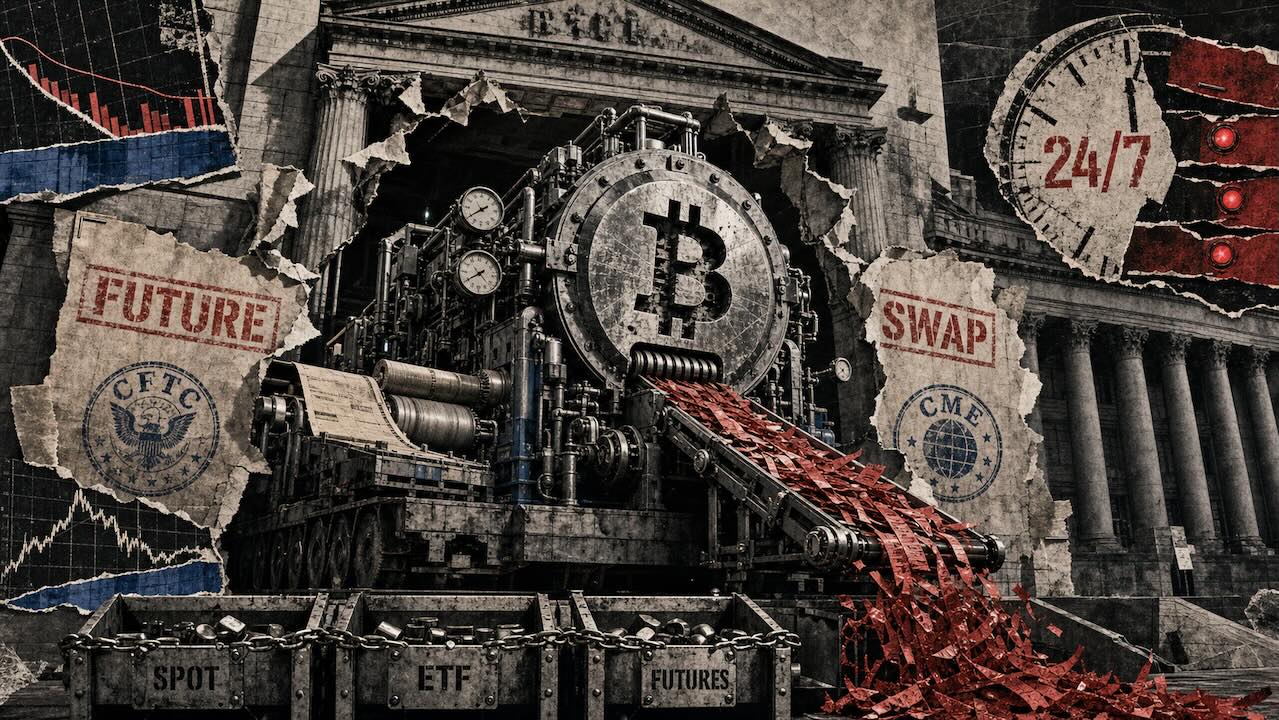
Coinbase began offering US perpetual-style futures on its CFTC-regulated derivatives exchange, starting with nano Bitcoin and Ethereum contracts that track spot prices, carry embedded leverage, and trade around the clock.
This is a financial product that’s responsible for most of the crypto leverage in the world, and it’s now crossed into the US market. Aside from bringing another way to bet on Bitcoin, it’s also bringing the entire machinery that essentially set offshore price discovery for years.
The US market is now importing funding payments, continuous leverage, and automatic liquidations across several exchanges, each one built to different specifications.
Perpetual futures make up the large majority of crypto derivatives activity. Coinbase puts the figure at upwards of 90% of derivatives volume in some measures, with derivatives themselves accounting for roughly 80% of all crypto trading.
For years, all of that activity happened almost entirely on exchanges outside American oversight, and US traders who wanted in logged into offshore platforms through a VPN. The barrier broke on May 29, when the CFTC approved KalshiEX’s BTCPERP as a futures contract referencing Bitcoin’s spot price, and issued a policy statement inviting other exchanges to bring similar contracts through the same door.
On June 12, the CFTC handed designated contract markets a conditional route to strip expiration dates off existing perpetual-style crypto futures and convert them into genuine no-expiry contracts.
The framework that made all of that possible is now being fought over in federal court. The outcome of that legal fight will shape how far perpetual futures can actually spread in the US market.
On June 18, CME sued the CFTC and Chairman Michael Selig in the District of Columbia, asking a judge to vacate the Kalshi order and the policy statement that came with it. With one stroke of his pen, the complaint argues, the chairman overrode Congress’s definition of a swap and sidestepped the regulatory framework Congress built for that kind of derivative.
CME’s position is that perpetuals meet the statutory definition of swaps under the Commodity Exchange Act, which would pull them into a far heavier regime of dealer registration, capital rules and reporting, and would route the benchmark licensing back toward incumbents, like CME. Selig, the agency’s sole confirmed commissioner, had approved Kalshi’s application in a single day.
The CFTC isn’t taking the challenge lightly. A spokesperson said CME had chosen to undertake lawfare against the agency and the administration’s pro-innovation agenda, accused incumbents of fearing competition on a level playing field, and promised to have the suit, which it called frivolous, dismissed.
The commercial stakes of this legal battle are already pretty high. CME’s complaint says Kalshi has self-certified more than a dozen additional crypto perpetuals under the order and that trading in them has already passed $1 billion. The agency has moved to defend its turf on other fronts too, suing Kentucky in late June over which authority governs contract markets. No ruling has come down, and the case is early, so every exchange now building a US perpetual product is doing it on a legal foundation a court could still rearrange.
What do perpetual futures now look like in the US?
A conventional future expires on a set date, and a trader who wants to hold exposure past that date has to close the position or roll it into a later contract. A perpetual future is built to run indefinitely. Because it doesn’t have an approaching settlement to pull its price toward spot, it uses recurring funding payments between traders holding long positions and those holding short ones.
When the perpetual trades above spot, funding generally has longs pay shorts, which makes holding an expensive long less attractive and encourages selling. When it trades below spot, the payment flips, and shorts tend to pay longs.
Two different structures now have the same label in the US. Kalshi’s BTCPERP is a genuine no-expiry perpetual. Coinbase’s contracts are structured as long-dated futures with five-year expirations and an hourly funding rate settled twice a day. That’s close enough to mirror a perp’s price behavior while remaining inside existing futures rules.
The CFTC’s June conversion route is the mechanism that lets those long-dated substitutes eventually drop the expiration and become the real thing, which is why the phrase “perpetual futures” now covers two legally distinct American products.
Crypto runs continuously, with no Friday close and no monthly expiry cycle, and that’s the environment perps were shaped for. A no-expiry leveraged contract lets a trader hold or adjust exposure at any hour without choosing a contract month, and it folds speculation, hedging, market-making inventory and basis trades into a single instrument.
Exchanges like the format because a single contract pools the liquidity that several dated expirations would otherwise split. That concentration deepens liquidity, but it also gives outsized influence to one funding rate and one liquidation engine, so a sharp positioning imbalance travels through the market faster than it would across a ladder of dated contracts.
The US departed quite a bit from the offshore model it’s copying. The country is building several perpetual markets at once: Kalshi lists true perps and has already expanded well beyond Bitcoin into Ether, XRP, and a widening roster of tokens. Coinbase runs perpetual-style futures on its domestic exchange and, separately, opened a regulated channel on May 29 for US clients to reach global perpetual and options liquidity through its Deribit affiliate, the largest crypto options venue, which held more than $31 billion in Bitcoin options open interest in late May.
CME moved its dated crypto futures and options to 24/7 trading on that same day, closing the weekend gap that had separated it from spot markets, on a complex that recorded $3 trillion in notional crypto volume last year and roughly 407,200 contracts of average daily volume this year.
The contract structure, leverage, clearing, collateral, and reference prices of these routes are completely different, which means regulated access can widen at the very moment liquidity, margin, and open interest spread across more places that can’t share collateral efficiently.
Funding, liquidations, and the contest over where price is set
Funding is usually described as a fee, but it’s easier to understand when you look at it like a live reading of where leverage is concentrated and a continuous force pulling the contract back toward spot.
When demand for leveraged longs pushes a perpetual above spot, an arbitrageur can short the perp and buy spot Bitcoin, ETFs, or dated futures to capture that funding, and the hedge itself pushes spot order flow, ETF creations, and the CME basis around with it.
Run that trade at scale, and you see how perpetual positioning can shape the very spot market the contract is meant to follow. A liquid US perp would also produce its own domestic funding curve, a regulated gauge of leveraged demand to sit alongside the offshore rates traders have watched for years. Should that US curve settle at a persistent gap to offshore funding, ot would expose real differences in customer base, leverage limits and how freely capital moves between the two systems, and it would give the US market a better understanding of whether demand is directional or hedged.
Leverage lets a small amount of collateral control a much larger position, and the trade-off is that a modest drop can quickly exhaust the margin behind it. Once an account falls below maintenance, the exchange closes it automatically. A liquidated long becomes a market sell, a liquidated short becomes a market buy, and those forced orders can drive price into the liquidation levels of other traders, which triggers the next wave.
Continuous trading, high leverage, and fragmented liquidity make that cascade especially visible in digital assets. Bringing the machinery onshore could make US price discovery more continuous, and it could also make US prices more reflexive, with Bitcoin moving because positions are being closed under margin pressure, a mechanical push that has little to do with anyone’s changed view of value.
A regulated venue helps with a specific set of risks: segregated customer funds, disclosed contract specs, market surveillance, rule-based liquidation procedures, and US legal recourse. It doesn’t help with volatility, funding costs, leverage, or the possibility that a liquidation engine can’t close a large position without moving the market against the account it’s closing. A perpetual can be fully regulated and still liquidate a trader automatically.
The exchange that eventually wins this may be the one that lets traders use collateral most efficiently across spot, ETFs, futures, options and perps. Today, capital is often separated across spot accounts, futures commission merchants, clearinghouses, brokerage accounts and offshore exchanges, and every separation carries a funding cost, because a position posted in one pool can’t back a hedge in another.
A trader holding a Bitcoin ETF may be unable to use it directly against a perpetual short, and a CME futures position can sit in a different margin pool from a domestic perp.
The next wave of competition in the derivatives market wants to solve that.
Coinbase Derivatives and the clearinghouse Nodal Clear, part of Deutsche Börse’s EEX Group, are working toward accepting Circle’s USDC as collateral for US futures, with Coinbase Custody Trust holding the stablecoin and the plan pending CFTC approval. If it clears, it would be the first regulated use of a stablecoin as margin in the American futures system, and it would let traders post crypto-native cash against regulated positions without converting to fiat first.
Capital efficiency of that kind decides how cheaply traders can close the price gaps between all these platforms, a larger competitive lever than another asset listing.
The real test won’t be how many contracts each exchange lists, because all of them can list as many as they want almost right away. We’ll see the real test during the next bout of Bitcoin volatility, when the US market will see whether domestic perps absorb the move, lead it, or amplify it. We’ll also see perps tested in court, where a judge still has to decide whether the contract behind this entire buildout is actually a future or a swap. That ruling could either cement the onshore market the industry has spent the better part of this year assembling or send it back through the far heavier door CME says Congress built.
