


With more plot twists than a spy thriller, Argentina’s 3-2 victory over Egypt was one of the World Cup’s most unpredictable matches.
But in one living room in Reading, to the astonishment of his 16-year-old son, a football clairvoyant appeared to know exactly what would happen next.
“I told him I was reading the state of the game and I could tell whether there was a goal coming,” says Dode Dahroug, a 51-year-old former RAF pilot. “He bought it, hook, line and sinker.”
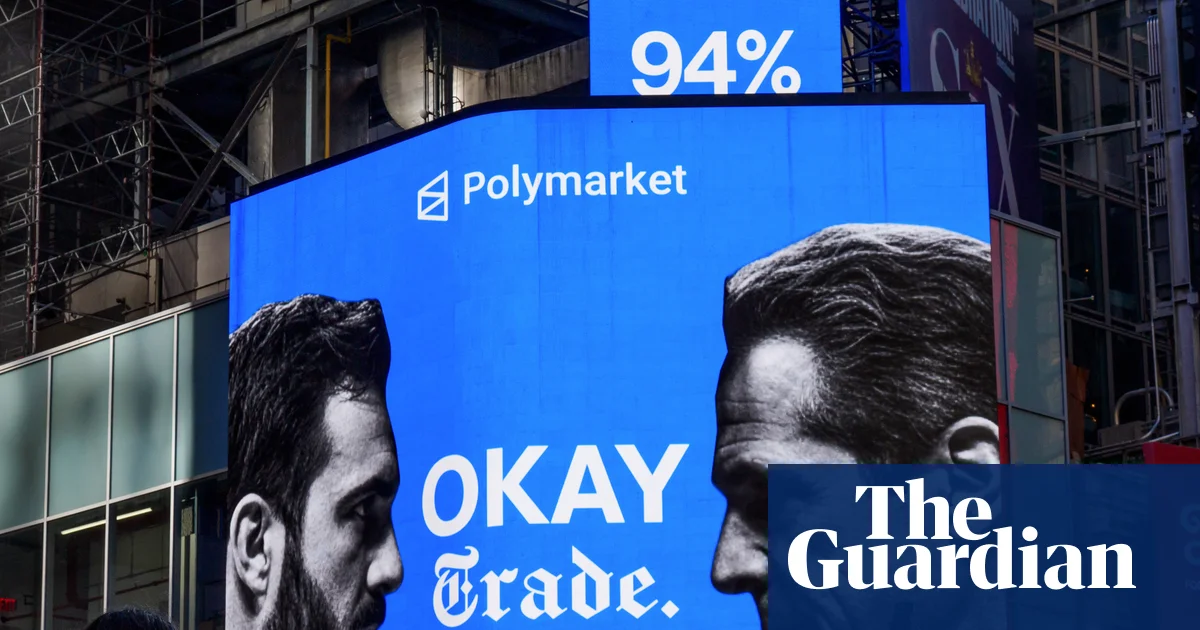
In fact, Dahroug was furtively glancing at a live odds graph on Polymarket, one of the online “prediction markets” that have sprung up in the US, offering betting wrapped in the jargon of financial trading.
The Dahrougs’ TV feed lagged a minute or two behind the split-second data that Polymarket receives from sports events and publishes to its customers.
Moments after a Lionel Messi strike hit the back of the net, the Polymarket graph spiked, giving Dahroug an insight into what was about to unfold on screen.
“I was able to create the illusion that I knew what I was talking about,” says Dahroug. “It was hilarious. When I told him, he said he’d try it with his friends for the semi-final.”
Dahroug, who doesn’t gamble, was doing the opposite of what Polymarket and Kalshi want customers to do: using their data purely for fun.
But millions of people, particularly in the US, do put their money at risk through prediction markets, betting on anything from the World Cup to the next Pope, to the likelihood of nuclear war.
Polymarket and Kalshi have soared in popularity, in part thanks to the uneven pace at which US states have regulated sports betting since the US supreme court lifted a federal ban in 2018.
While the platforms’ bread and butter is wagers placed on sport, they have convinced American regulators that they are financial trading products. This has allowed them to circumvent ongoing prohibition of sports wagers in multiple states, pending several legal challenges.
California and Texas are yet to establish a regulatory regime, giving prediction markets, regulated by the Commodities and Future Trading Commission (CFTC), a free run at states with a combined economy worth about $7tn – one-third the size of the EU economy.
With the wind at their backs, registered prediction markets are estimated to have attracted trading volumes of at least $45bn during the World Cup, according to the market data they publish.
However, there is reason to be cautious about this nascent revolution. First, the markets aren’t as big as the headline numbers that are bandied about make them seem.
One key way in which the figures give a misleading picture is that “trading” positions are little more than open betting slips that can be sold back and forth. Each time a customer trades, the value gets added to the trading volume, but the amount of money put at risk does not necessarily increase by the same amount.
In terms of actual World Cup stakes, analysts at the consultancy Eilers & Krejcik Gaming reckon it’s closer to $5.6bn (£4bn) a month in the US.
That’s only about twice the roughly £2bn that the Gambling Commission says is being wagered via sportsbooks in the UK, in an economy that is approximately an eighth as big.
When it comes to the UK, the commission has been clear that prediction markets would need a gambling licence for sports trading, while the Financial Conduct Authority says betting on financial markets would be covered by an existing ban on “binary option” products.
James Bradley, of the consumer advocacy group Fairer Finance, is concerned that UK customers are betting with these sites nonetheless.
“I’m a terrible luddite, but it took me about 10 minutes to figure it out,” he says. “You get all the warnings that you can’t use a VPN [a virtual private network that disguises your location], but they’re not policing it and they can’t realistically.”
The Guardian was easily able to set up an account with Polymarket using a VPN and deposit cryptocurrency to test out betting on the World Cup and the chances of the US confirming the existence of aliens. (Any profit on the bets will be donated to charity.)
Polymarket said it took compliance seriously and that using a VPN to access the site from the UK was against its terms of service. A spokesperson said it was strengthening its tools to ensure compliance including “on-chain monitoring, third-party compliance tools, and internal review processes”.
The volume of bets that have been placed on UK political events, such as byelections in Clacton or Gorton and Denton, suggest plenty of Britons believe they can vault over such obstacles.
after newsletter promotion
“[Those markets] are in the millions of dollars,” says Bradley. “It’s hard to believe that’s all US people speculating on UK events.”
He thinks it’s just a matter of time before prediction markets go mainstream in Britain.
Alun Bowden, a seasoned gambling analyst at Eilers & Krejcik Gaming, disagrees: “It’s possible, I just don’t think it’s very likely.”
Bowden says prediction markets are almost identical to long-established betting exchanges such as Betfair, which aren’t even as popular as traditional sportsbooks.
“In the US, there’s a huge consumer demand they’re meeting, which is [people who say]: ‘There’s no legal sports betting in my state.’
“Those same needs do not exist in the UK, so prediction markets will have to create a need for their product, whether it’s capturing the zeitgeist, or maybe driven by celebrity or TikTok. That might work.”
So far, says Bowden, there’s no sign of prediction markets eating the bookies’ lunch.
Some smaller UK operators are hedging their bets by borrowing the clothing of their US counterparts. Earlier this year, easyBets – a partnership between easyJet founder Stelios Haji-Ioannou and Australian professional gambler Zeljko Ranogajec – launched itself as a dedicated prediction market.
At around the same time, Smarkets – a small but well-established betting exchange that has a commercial partnership with Bournemouth FC – revamped its user interface to look like an American-style prediction market.
“It’s been positive,” Smarkets’ chief executive, Jason Trost, says of the redesign. “Gambling and betting comes with so many heavy moral and societal connotations, but I always viewed sports betting as a financial asset class.”
Fairer Finance’s Bradley thinks the rise of prediction markets, with their promise to turn every aspect of life into a potential wager, presents a risk not just to gamblers but to British democracy itself.
The UK has already been rocked by one political betting scandal, the subject of an ongoing criminal case that resulted in former MP Craig Williams pleading guilty to cheating. In the US, evidence of insider trading on geopolitical events, such as military action in Venezuela and Iran, is abundant.
So-called traders appear to have attempted to alter markets in their favour, allegedly rigging thermometers used to settle wagers on temperatures in Paris and even by threatening a journalist over their coverage of events subject to bets.
“There’s a real ability to change the outcome of political events by building momentum around a particular story,” says Bradley. “You wouldn’t want to see this stuff catch fire over here, it’s really dangerous.”
Bowden remains sceptical that will happen. “The usability, the feature depth, the speed, the ease of managing your money. The quality of the user experience is just not as high [as UK sportsbooks],” he says.
“As a consumer betting product, they [prediction markets] are just not as good – for now.”
