


Unlock the Editor’s Digest for free
Roula Khalaf, Editor of the FT, selects her favourite stories in this weekly newsletter.
Saudi Arabia has launched a fresh wave of strikes against the Houthis in Yemen after the Iranian-backed rebels targeted Saudi energy infrastructure, in a move that risks expanding the war in the Middle East.
The Houthis claimed to have attacked Saudi state oil company Aramco’s facilities in Jizan and Yanbu on the Red Sea coast on Saturday, using ballistic missiles and drones.
“We will not hesitate to expand our movements and escalate our steps based on the developments of the situation in the coming hours and days,” Yahya Sare’e, a Houthi spokesperson, said in a statement.
The Saudi-led coalition in Yemen had earlier struck Houthi targets in the Houdedia region, acknowledging that it had carried out air strikes for the first time since the warring parties agreed to a truce four years ago.
Hours after those strikes, Saudi civil defence forces warned that Jizan, which hosts a large refinery, and Yanbu, which is home to a key export terminal, were under threat, urging the public to seek shelter.
Greek security officials said that air-defence systems in Saudi Arabia intercepted two ballistic missiles launched from Yemen towards Yanbu on Saturday, while a Greek-operated, US-made Patriot missile battery shot down a drone from Yemen.
Greece has deployed a Patriot air-defence battery in Saudi Arabia since 2021 under a bilateral agreement to help protect the kingdom’s critical energy infrastructure.
After the Houthis’ strikes, government-controlled Yemen TV reported that the Saudi-led coalition had retaliated by hitting Houthi sites in the provinces of Maarib and al-Jouf.
The escalation risks edging Yemen towards the resumption of a decade-old war and expanding the conflict in the Middle East as the US and Iran battle over the Strait of Hormuz.
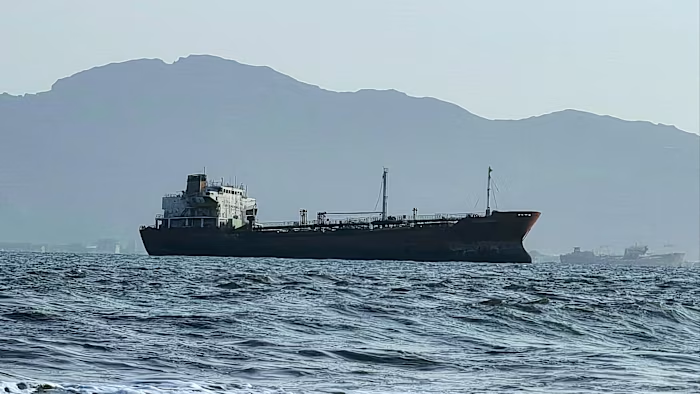
The flare-up between the Houthis and Saudi Arabia escalated this week after the rebels warned that they were imposing a maritime blockade on the kingdom and attacked two Saudi tankers in the Red Sea.
The Red Sea has become vital for Saudi exports and trade after Iran closed the Strait of Hormuz during its war with the US and Israel. The kingdom has been forced to shift its oil exports to Yanbu, making it reliant on an east-west pipeline to ship its crude.
The Houthi attacks on shipping disrupted maritime traffic through the Red Sea after Israel launched its war in Gaza following Hamas’s October 7 2023 attack. But they had not targeted shipping since last summer.
Major General Turki al-Maliki, a spokesperson for the Saudi-led coalition, said the kingdom’s air strikes hit “legitimate military targets that the terrorist Houthi militia uses to threaten commercial vessels in the Red Sea”.
“The coalition has executed a firm, resolute and proportionate military response while preserving the capabilities of the brotherly people of Yemen,” he said in a statement on Saturday.
He added that the Houthi-controlled Hodeidah port had not been targeted and that all Yemeni ports remained open to maritime navigation and were receiving commercial ships.
The Houthi-affiliated al-Masirah television channel said the first round of Saudi strikes targeted facilities belonging to the state telecommunications corporation in Hodeidah as well as Kamaran Island off Yemen’s western coast.
A Saudi vessel, the NCC MASA, sustained minor hull damage from an attack in the Red Sea on Friday, the kingdom’s state news agency reported, citing an official source at the Saudi Transport General Authority. The vessel continued to its destination after checks confirmed that the ship and its crew were safe, the Saudi Press Agency said.
Saudi Arabia intervened in Yemen’s civil war in 2015 to lead an Arab coalition against the Houthis after the rebels seized Sana’a and ousted the internationally recognised government.
The parties reached a ceasefire in April 2022, but the 2023 Hamas assault and the Houthis’ attacks on shipping upended a diplomatic push to end the war on a lasting basis.
The Houthis are one of the most potent members of Iran’s so-called axis of resistance. But they have largely stayed out of the US-Israeli war against Iran, apart from firing several barrages of missiles and drones at Israel in March and early April.
There have been concerns that the Houthis will co-ordinate with Tehran to close the Bab al-Mandab, which connects the Red Sea to the Gulf of Aden, in a bid to pile pressure on energy markets and global trade.
US President Donald Trump on Thursday threatened that the US would take action if the Iran-backed group repeated its attacks in the Red Sea. A “major military punishment will be inflicted upon Iran and, of course, the Houthis, themselves,” he said on his Truth Social media platform.
The latest flare-up erupted after the Houthis opened Sana’a airport to allow Iranian flights to land in the country — the first Iranian flights to the Yemeni capital since 2015. The rebels then blamed Saudi Arabia for an attack on the airport.
Riyadh has been concerned that the Iranian flights could ship weapons, technology and military advisers to the Houthis, who have long received military support from Tehran, analysts say.
Additional reporting by Eleni Varvitsioti in Athens
