


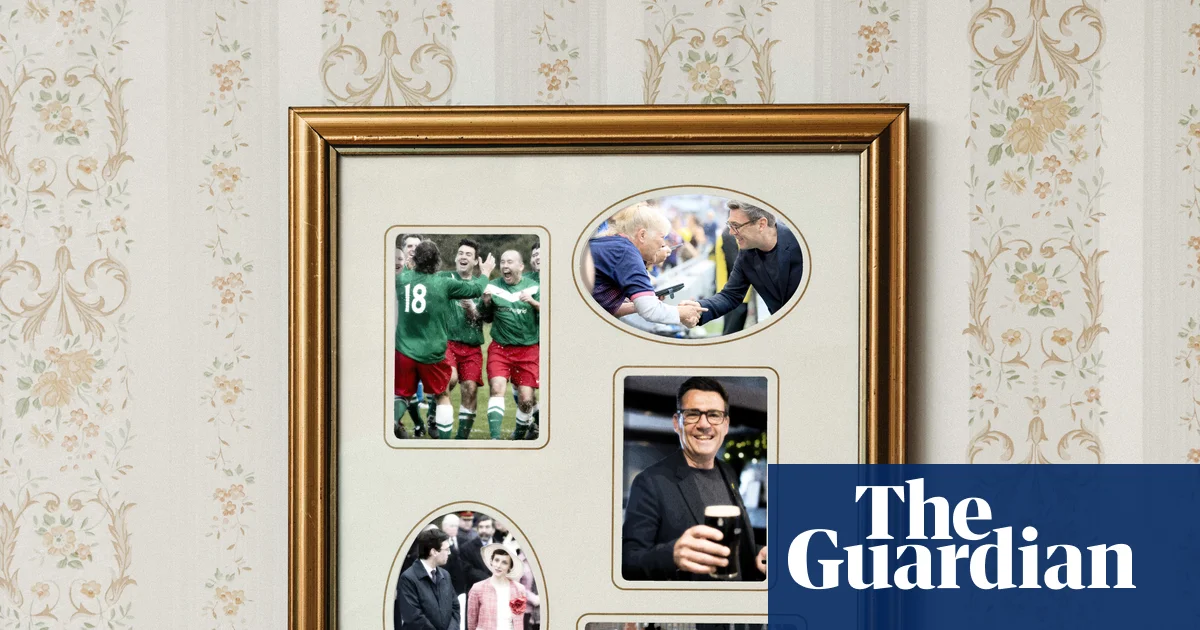
The Cherry Tree pub is an unassuming local. On a busy road in the Cheshire village of Culcheth, it is a chain-run pub where four shots cost £8, every burger comes with a soft drink, and sport is shown all day on the big screens. It is also a favourite of Andy Burnham, the new prime minister.
Many of the drinkers have a story about – arguably – Culcheth’s most famous son.
“I was at school with Andy,” says Mike Hodgson. “He went to our school, he likes the Smiths … He’s got a good northern sense of person, and he’s done a good job in Manchester.”
Janice Fox chips in: “I used to play with him when we were kids.”
The Cherry is in the opening scene of Burnham’s book Head North. One night in April 1989, in its smoke-filled back room, the future leader of the country is recovering from a bout of “impostor syndrome” while home from Cambridge University. Panic, by the Smiths, is playing on the jukebox.
It is also a place I know well: like Burnham, I grew up in this quiet Warrington suburb halfway between Manchester and Liverpool, I have spent many nights at the Cherry, and like many locals, I have my own story about him.
Here is mine: 15 years ago I met the then Labour MP for Leigh while drinking with mates in the Cherry. Labour had recently lost the 2010 election, and Burnham had recently lost to Ed Miliband in the race to lead the party in opposition. Home from London for the weekend, I was struggling to get a job, so plucked up the courage for a chat.
As the then shadow education secretary, he talked me through the impact of the Conservatives’ plan to cut Labour’s Building Schools for the Future programme. That £55bn landmark New Labour policy turned cold, leaky 1960s prefab schools around the country into modern buildings of which teachers and pupils could be proud; it rebuilt my secondary, Culcheth high school.
He gave me his mobile number and invited me for a cup of tea in parliament. I expected to be ghosted. But a few weeks later we were sitting in SW1 picking up the conversation over a brew in Portcullis House. Burnham told me Britain’s media and political landscape needed more northern accents like ours.
On Friday, Burnham opened No 10 North, in Manchester; a first step in his promise to rebalance power away from Westminster to deliver “good growth in every postcode”.
This week I travelled back to WA3 to find out what people make of Burnham becoming the first northern prime minister since Harold Wilson 50 years ago. He has spoken with pride of his roots, and how reversing the decimation of Britain’s industrial communities under Margaret Thatcher is a top priority.
Outside the Cherry, one group of friends say it’s at least nice that someone local is in No 10. One of the women lifts her sunglasses and we are transported back a quarter of a century: it’s my old geography teacher, Mrs Crinion.
“I was quite proud seeing him walking down the street,” says one of her friends. “I felt a bit chuffed. I hope he does a good job.” But does having one of our own in high office change anything? “I very much doubt it,” says another.
Earlier this month, Burnham recorded a video for social media arriving “home” from London at Warrington Bank Quay train station. It is far from the most beautiful spot on the railway, in the shadow of an old Unilever soap factory that is up for demolition.
Once the diggers have finished here there are plans for an AI datacentre – a fact deployed by Keir Starmer last month as a symbol of how a “left behind” community could reinvent itself.
But this description elides much of Warrington’s character. The town has its difficulties – not least the boarded-up shops and crumbling, shuttered nightclubs on Bridge Street – but it is more affluent than many other “red wall” communities in this pocket of north-west England.
As a postwar new town, there are miles of suburbia stretching into the Cheshire countryside. There are good transport links, affordable housing, and opportunities for work in high-paying sectors, such as technology and nuclear energy.
This year, the Centre for Cities thinktank suggested Britain could do with a few more towns like Warrington: local disposable incomes have galloped ahead here, growing 2.2 times faster than the UK average since 2013. Perhaps this could influence the Burnham economic blueprint?
Still, many locals feel let down by Labour. Before Burnham replaced Starmer, Reform was predicted to sweep away the party in Warrington’s two constituencies. But many say the new prime minister’s background could help change things.
John Cross, whose family has run a butcher’s stall in Warrington market for five generations, is among them: “I’m made up. That we’ve got someone from the north, rather than someone from down south. There needs to be more balance, how we’re governed in this country. Don’t get me wrong; he’s got an absolute job in front of him. But I think it’s a good thing [that Burnham is prime minister].”
Support is, however, far from uniform, including in Culcheth. Sitting outside McDee’s cafe, Tom says he has little time for politicians – “all a bunch of thieves”. Net zero, failure to invest in defence and prosecutions of British soldiers are his complaints. “It’s Labour, isn’t it? I don’t believe any of them will do anything different.”
Inside the cafe, others are more positive. Veysel Hazar, the manager, seats me at the table where he has served Burnham and his mother, Eileen. He does not do politics, but says of the new prime minister: “Amazing person. I’m happy for Culcheth.”
Eating lunch on the table opposite, the Ollerton family are from nearby Golborne – where Burnham now lives and where coal mining once dominated. They have seen him out running in his retro Everton shirt, and are friends with his nextdoor neighbour on a road a few streets from his new Makerfield constituency.
“You knew he was going to win. Makerfield would have voted Reform if it wasn’t for him,” says Marilyn Ollerton.
“He’s very relatable, rather than just being somebody on the television; somebody from down south that you’ve probably got nothing in common with,” says Lianne Ollerton.
Some places in Warrington – particularly the terraced streets near the town’s old wire factories – rank among the most deprived in England. Burnham’s former Leigh constituency, and his Makerfield one, are among them. Culcheth, though, is seen as “posh”.
Where Burnham grew up, on Common Lane, many homes have gated driveways and easily sell for more than £1m. Locals jokingly call the area “Upper Culcheth” to distinguish it from the rest of the village, including the postwar social housing estate built for officers at the nearby Risley prison.
There is a golf course, parades of neat shops, a butcher, hair and beauty salons and pubs, as well as two Italian restaurants, both of which I worked in as a teenager.
The presence of SUVs and flash cars has steadily increased – in part the spillover from Manchester’s economic renaissance. I do not remember Culcheth being this affluent. It was comfortable, but not in the same league as the footballer-belt Cheshire villages south of Warrington.
But while it does not fit the media stereotype of Coronation Street-style terrace housing, flat caps and spoil heaps, it is still within touching distance of the industrial decline that has crushed this region.
Growing up, the legacy of industry was obvious. I saw the demolition of Parkside colliery’s concrete winding towers – the last deep mine in the Lancashire coalfield – from my bedroom window. A decade earlier, Burnham would pass here on his bus to school – St Aelreds Catholic technology college, now renamed Hope academy, in Newton-le-Willows – and bang on its window to show support to the picket line at the colliery gates during the 1984 miners’ strike.
Born in 1970 at Aintree hospital in Liverpool, Burnham moved from Merseyside to Culcheth at about age one, after his father, Roy, was promoted to a job in Manchester. An engineer at the Post Office, he had once worked at a telephone exchange in the village – opposite the Cherry Tree – and liked the feel of the place.
Raised Catholic, Burnham went to St Lewis primary school, a short walk down Mustard Lane from Croft primary, where I went. He recalls in Head North a “modest” upbringing. There were no holidays abroad. But his family also “didn’t want for anything”, and he went on to study at Cambridge, where he met his future wife, Dutch-born Marie-France van Heel.
Burnham is often in the village playing five-a-side football with his brothers, who are teachers, and their friends, including relatives of another famous son of Culcheth, Roger Hunt, the Liverpool striker and England 1966 World Cup winner.
In the Lords of the North barbershop in Warrington town centre, hairdresser Nicole Egan tells me Burnham’s brother John taught her at school. “If he’s anything like his brother … 10 out of 10. Top family. I’m made up. He seems to be doing some great things already.”
Egan’s mother, Cheryl Good, is cutting a boy’s hair. She says the prime minister went out with her old boss back “when he was a raver” in an Adidas tracksuit.
“He went to a normal school. He wasn’t privately educated where they were told they were special or better than anybody else. So he’s started from the same starting point as everybody else, and he’s done really well for himself.”
Both are Green voters but see Burnham as moving in the right direction, despite hearing “alarm bells” over the rumours that he could allow more North Sea oil and gas drilling. But first impressions matter: addressing the cost of living has cut through in a way that locals say has raised their hopes.
“Working families are struggling,” says Egan. “So the things he’s done at the moment – the [cutting of the] tax on electricity bills, £2 cap on the fares on buses, and that’s only in his first couple of days. I’m very hopeful – what little we have left of that”
Burnham was in Culcheth after a regular football game with his brothers, in his first fortnight as the mayor of Greater Manchester, when he was told of the Manchester Arena bombing on 22 May 2017. It was a moment that would become a turning point for the city, and for Burnham.
People are full of praise for his ability to empathise. Three years ago, Burnham was at the candlelight vigil in his home village for Brianna Ghey, the 16-year-old transgender girl murdered in Culcheth Linear Park.
They also credit him for the economic turnaround of the city along the M62. Manchester – and its resulting “ism” – is central to Burnham’s political and economic blueprint for Britain; founded in the coordination of the private and public sector, and helped by new powers for local areas through devolution.
Grabbing power from Westminster and Whitehall resonates in these parts.
In the market, Neil Kelly, who leads community engagement for the local rugby league team, Warrington Wolves, is having a coffee with his colleague Adam Leah. “There’s been a lot of fights with Whitehall all of the time. So I think devolution is going to work in that sense for Warrington.
“You’ll see for Warrington what it means, and how it can have a real effect, particularly around on the streets and the towns, and the cultures and the communities.”
There are, however, tensions and undercurrents. Warrington is among the most heavily indebted councils in England, with an outstanding pile worth more than £1.5bn. The town’s Labour leadership argues it needed to borrow to invest, to offset Tory austerity directed from Westminster. But critics fear handing over more powers might not be the right answer.
The bus network in Warrington could also show the opportunities and difficulties of local power. Unlike most places, the town never lost control of its buses in the wave of 1980s privatisation.
Buses have long been a Burnham preoccupation, after he overhauled the network in Greater Manchester. The region’s Bee Network, a system of joined-up, accessible transport, has brought buses under local control through franchising. In Warrington, the neon yellow fleet – close in colour to its Manchester equivalent – is fully electric, and locally controlled, but more expensive than many would like, at £5.90 for a day ticket.
In Culcheth there will be tensions with Labour’s national priorities on housing development; in a semi-rural community ringed by green-belt land, many do not want to see more homes built, despite the climbing house prices pushing young people away.
Still, at a Labour party branch meeting at Culcheth library, there is hope that Burnham can square the circle because he knows these issues. Margaret Webber, the branch chair, and Matt Smith, a local Labour councillor who was once my high school form tutor, say that where the person who leads Britain is from has an important bearing.
“He’s got a lot of good will behind him, because he’s saying what a lot of people think.”
