


Recent testing at Joint Base Andrews found a thick layer of jet fuel beneath the airfield, eight months after a spill was detected near Piscataway Creek. But the Air Force and Maryland environmental regulators remain at odds over basic facts of the spill, such as how much fuel was leaked and whether the base skipped its reporting obligations, while the leak’s source has yet to be found.
At the same time, they are locked in a separate dispute over a golf course renovation, which the base says is beyond the reach of the state’s regulatory authority due to an exemption from President Donald Trump.
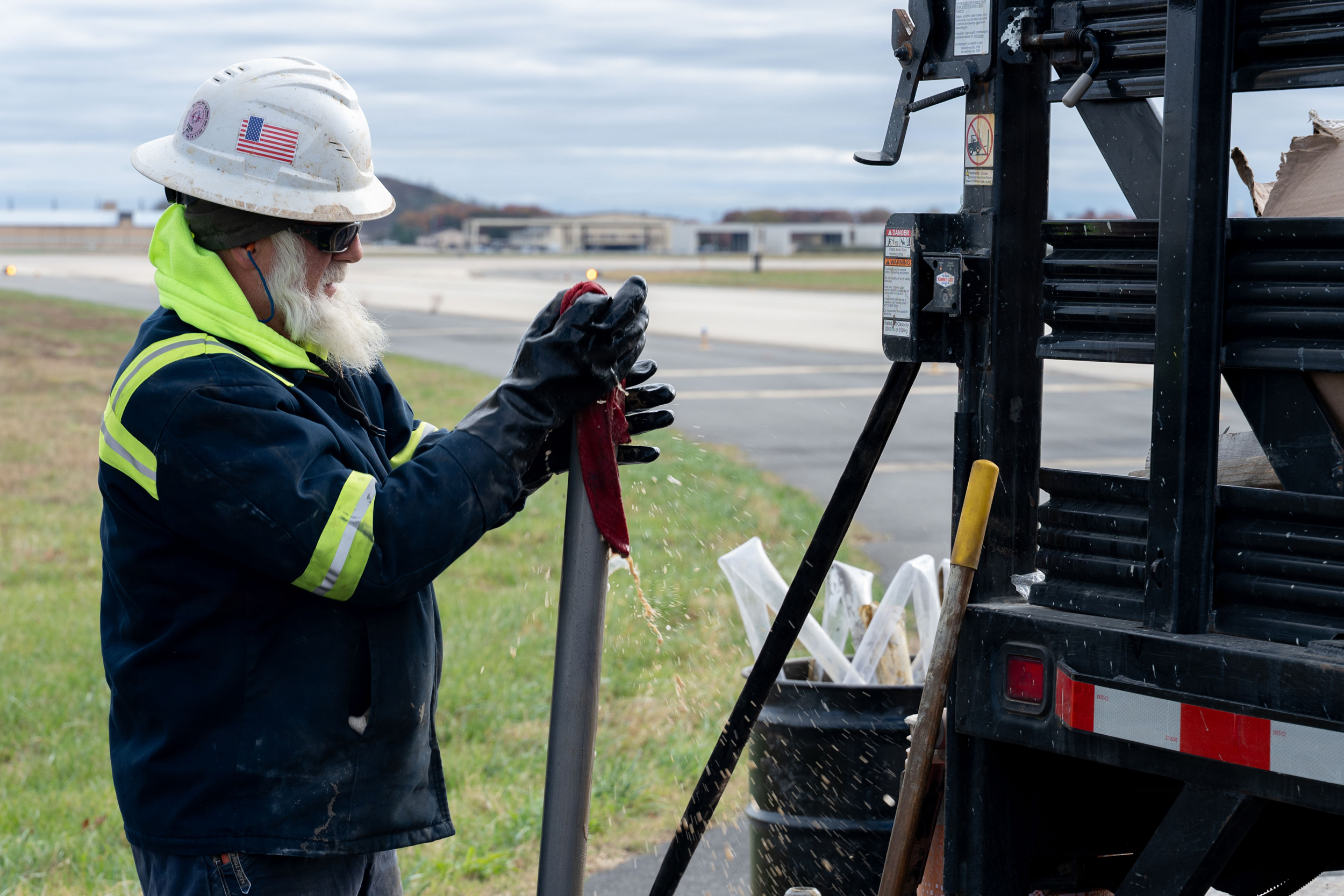
Between Nov. 9 and 13, the Air Force conducted pressure testing and drilled several soil borings along the section of pipeline where the leak was suspected. Maryland inspectors were also on site watching. One boring, along a pipe known as Lateral Row 7, found a layer of fuel 3.32-feet-thick, the Air Force said .
In separate statements, both sides said the finding significantly narrowed the search. But neither can yet determine where exactly the pipe broke. The Air Force said that will require digging the line up or inspecting it directly.
Its next step is to pump the fuel out of the ground and do more drilling to map how far it has spread. That work will begin once contracts are in place, the base said, without giving a start date.
According to the Maryland Department of the Environment’s Nov. 18 report, the agency representatives visited the base to oversee the leak testing of the west-side hydrant loop between Nov. 9 and 13. No leaks were found during the testing, which excluded Lateral Row 7—already isolated from the system—and the above-ground piping inside the pump house. The testing was supposed to be completed by Nov. 12 per the deadlines conveyed by the MDE. The base said both sides agreed to adjust the original date to Nov. 13 due to contracting delays and a federal holiday.
The latest testing came after MDE Secretary Serena McIlwain pressed the base in an Oct. 28 letter to identify the source of the fuel leaks and pinpoint the point of failure, warning that “the pace of that progress has not matched the urgency of the situation.”
McIlwain’s letter also set deadlines for the base to finish its investigations and complete actions between Nov. 12 and Dec. 27. It included correcting JBA’s fuel inventory records and reporting any losses to the state, completing overdue corrosion testing and repairs, and submitting a schedule for repairing or abandoning Lateral Row 7. It also required the base to evaluate whether the storm drain systems were carrying fuel to Piscataway Creek.
“If these deadlines are not met, I will consult with our Office of the Attorney General to determine appropriate next steps to ensure compliance,” McIlwain warned.
In a Nov. 9 response, JBA Commander Col. Karl Seekamp only acknowledged the March fuel spill, contradicting McIlwain’s letter describing “major jet fuel releases” that occurred in December and in March.
“JBA’s operational and environmental records do not indicate or support an environmental release in December 2025,” a JBA spokesperson said in emailed comments. The base said its routine testing on Dec. 11, 2025, found a mechanical leak inside a valve at the pump station for its west-side fueling system, and that all of the fuel stayed within “closed, impermeable piping infrastructure,” with no discharge to the environment.
According to MDE’s timeline, the base’s fuel system failed a precision tightness test on Dec. 11, 2025, and records showed inventory losses in January and February. The department was not notified until fuel odors and a sheen were seen near the Piscataway Creek’s headwaters on March 23. On April 8, the base told MDE that 22,000 gallons of fuel had been released into the environment, out of a total system loss of about 32,000 gallons.
Nine members of Maryland’s Congressional delegation, including Sen. Chris Van Hollen, wrote to Air Force Secretary Troy Meink in May, requesting an accounting of how much fuel had entered the creek and how much remained underground.
After the Air Force arranged a staff-level briefing for Van Hollen in late September, his office requested more information, but has yet to receive a response, a spokesperson said in a statement last week.
In its emailed comments, JBA said it has provided two full years of raw fuel inventory records directly to MDE, and the Defense Logistics Agency is conducting an independent audit of contractor inventory to reconcile accounting figures.
Meanwhile, water testing from Piscataway Creek just outside the base still shows petroleum compounds washing into the waterways. In the most recent results by MDE, an Oct. 21 sample detected diesel-range hydrocarbons, which include jet fuel, at 84 parts per billion, well above MDE’s surface-water action level of 47ppb. Every off-base sample listed since testing began in April has exceeded the agency’s action level.
Late-September samples detected a spike across several fuel compounds.
“We can not verify whether release from the fueling infrastructure have stopped. The most recent sampling results, available on our website, continue to show fuel constituents at the Piscataway Creek off-base location,” MDE spokesman Jay Apperson said in a written response.
As the state and federal agencies clash over fuel spill contamination, another regulatory fight between them has surfaced over renovation of the golf course on Joint Base Andrews.
An MDE report dated Aug. 28 and reviewed by Inside Climate News shows an agency inspector visited the base to investigate a complaint that the golf course renovation might be impacting a nearby stormwater basin built for a separate project.
“Access to the site was not permitted during the complaint investigation; however, I was able to observe the potential impacts,” wrote the inspector, who recorded his observations from the roadside.
The inspector did not report any impacts on the basin but found a gap in a reinforced fence meant to keep loose mud from running off the construction site. “This cut may provide a path for sediment laden stormwater to leave the disturbed area and enter the stormwater basin,” he wrote.
This story is funded by readers like you.
Our nonprofit newsroom provides award-winning climate coverage free of charge and advertising. We rely on donations from readers like you to keep going. Please donate now to support our work.
He recommended additional control measures to keep muddy sludge from leaving the clubhouse renovation area, and noted other cuts in the fence to allow golf carts to move. He also reported active renovation under way at the rest of the golf course on either side of Virginia Avenue.
In an Oct. 22 letter to the base commander, McIlwain cited “serious concerns” about the golf course renovation at the base and “the recent denial of access” to MDE inspectors. She wrote that “significant concerns remain unresolved” despite MDE reviewing multiple site plans, and provided guidance on stormwater management, erosion and sediment control and potential dam-safety issues.
In its latest review of the revised plans for Phase I of the north course, McIlwain said, the agency found unresolved questions about how the course would handle runoff from a 100-year storm and raised concerns about the proposed ponds and dams.
The agency still lacked the plans needed to verify the base’s claim that the project would spare wetlands. Without those plans, she said, MDE could not assess potential environmental harm or determine whether the project would need additional permits or mitigation measures.
“My concerns extend beyond this individual project,” McIlwain wrote, citing decades of concerns over landfill contamination, PFAS and the handling of asbestos during the demolition of a base hospital, as well as the jet fuel release.
Those concerns “affect real communities, including predominantly minority and working-class neighborhoods and members of the Piscataway people, whose ancestral ties to this land extend back generations,” she wrote.
McIlwain asked Seekamp to confirm in writing when state inspectors could visit the site and when the base would provide the missing plans and records for MDE to assess potential effects on wetlands, floodplains and stormwater infrastructure.
In a written response to questions from Inside Climate News, an Air Force spokesperson said a June 26 presidential determination exempts the golf course renovation at Joint Base Andrews “from Federal, State, interstate, and local requirements, administrative authority, and process and sanctions respecting the control and abatement of water pollution.”
The exemption is effective until June 26, 2027, the Air Force said, adding: “The DAF has complied, and will continue to comply, with all other applicable legal requirements.”
The Air Force also said MDE’s inspector “has full installation access during business hours,” with escorts provided for permitted projects. It said the Aug. 28 visit stemmed from a complaint that the clubhouse work might affect the VA Gate project’s state erosion-control permit, and that MDE inspected the surrounding area and found “no issues.”
Jon Mueller, an environmental law professor at the University of Maryland and a former senior Justice Department environmental attorney, said he did not know the exemption’s full scope. But he said the base appears to be arguing that because the golf course work has no permit, “even though it should have one,” the state has no right to inspect it. That “flies in the face” of federal law that lets states like Maryland enforce the Clean Water Act and protect their own waters, he said. “This is the point of cooperative federalism.”
Mueller said Maryland could challenge the exemption, which the law allows only when a project is in the “paramount interest” of the United States. “I highly doubt a court would find that constructing a golf course falls into that category of interest,” he said.
About This Story
Perhaps you noticed: This story, like all the news we publish, is free to read. That’s because Inside Climate News is a 501c3 nonprofit organization. We do not charge a subscription fee, lock our news behind a paywall, or clutter our website with ads. We make our news on climate and the environment freely available to you and anyone who wants it.
That’s not all. We also share our news for free with scores of other media organizations around the country. Many of them can’t afford to do environmental journalism of their own. We’ve built bureaus from coast to coast to report local stories, collaborate with local newsrooms and co-publish articles so that this vital work is shared as widely as possible.
Two of us launched ICN in 2007. Six years later we earned a Pulitzer Prize for National Reporting, and now we run the oldest and largest dedicated climate newsroom in the nation. We tell the story in all its complexity. We hold polluters accountable. We expose environmental injustice. We debunk misinformation. We scrutinize solutions and inspire action.
Donations from readers like you fund every aspect of what we do. If you don’t already, will you support our ongoing work, our reporting on the biggest crisis facing our planet, and help us reach even more readers in more places?
Please take a moment to make a tax-deductible donation. Every one of them makes a difference.
Thank you,

Reporter, Washington, D.C.
Aman Azhar is a Washington, D.C.-based journalist who covers environmental justice for Inside Climate News with focus on Baltimore-Maryland area. He has previously worked as a broadcast journalist and multimedia producer for the BBC World Service, VOA News and other international news organizations, reporting from London, Islamabad, the United Arab Emirates and New York. He holds a graduate degree in Anthropology of Media from University of London’s School of Oriental and African Studies (SOAS) and an MA in Political Science from the University of the Punjab, and is the recipient of the Chevening scholarship from the UK government and an academic scholarship for graduate studies from the Australian government.
