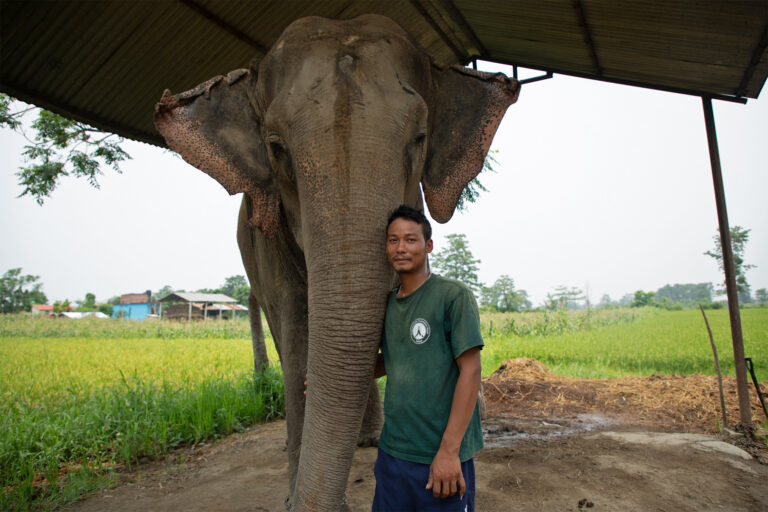
CHITWAN NATIONAL PARK, Nepal — Perched some 3 meters off the ground, or about 10 feet, on the back of Asian elephants, workers traverse Nepal’s dense jungles and grasslands to complete wildlife counts, rescue distressed animals, and manage wildlife such as tigers (Panthera tigris) and greater one-horned rhinos (Rhinoceros unicornis). Working elephants have long played an important role in the conservation of Nepal’s wildlife and wildlands. Their height and sharp sense of their surroundings keep researchers safe from tigers and other predators, and they’re also used on patrols. But dwindling captive elephant populations and opposition to using the highly intelligent animals as beasts of burden are changing the long-term outlook for working elephants and the men known as mahouts who work with them. Dr. Amir Sadaula works closely with elephants and mahouts as a veterinary officer at the National Trust for Nature Conservation (NTNC), which operates a biodiversity conservation center on the edge of Chitwan National Park. There, NTNC employs eight trained elephants and teams of mahouts to aid in wild animal rescue and research work. “Without [the] elephant, we could not do the rescue,” Sadaula says. Mahouts Promod Chaudhary, left, and Upendra Kachadiya enter a river for their elephants to bathe while returning from grazing in Chitwan National Park, Nepal, on May 19, 2026. Image by Henry Doellinger for Mongabay. In addition to elephants that aid researchers, privately owned elephants also walk the streets of Sauraha, a community adjacent to Chitwan. Tourism companies in the gateway community often own…This article was originally published on Mongabay
Trending
- Kommission will 50-Milliarden-Euro-Fonds zur Förderung europäischer Schlüsseltechnologie aufsetzen – POLITICO
- None of UK government’s £2.5bn steel package spent in Wales, figures show
- Photos: Elephants maintain an essential role in conservation in Nepal despite shifting norms
- Why tiny cars are taking off across Europe
- Severe drought dries up rivers, cuts off communities in Brazil’s Amazon
- My family died in Ukraine. My mum blamed Zelensky’s troops – the truth is complicated
- Earth’s next ice age may have already begun. Global warming stopped it
- Ancient rocks from the Moon’s far side rewrite the Solar System’s violent past
Wednesday, November 25
Photos: Elephants maintain an essential role in conservation in Nepal despite shifting norms