


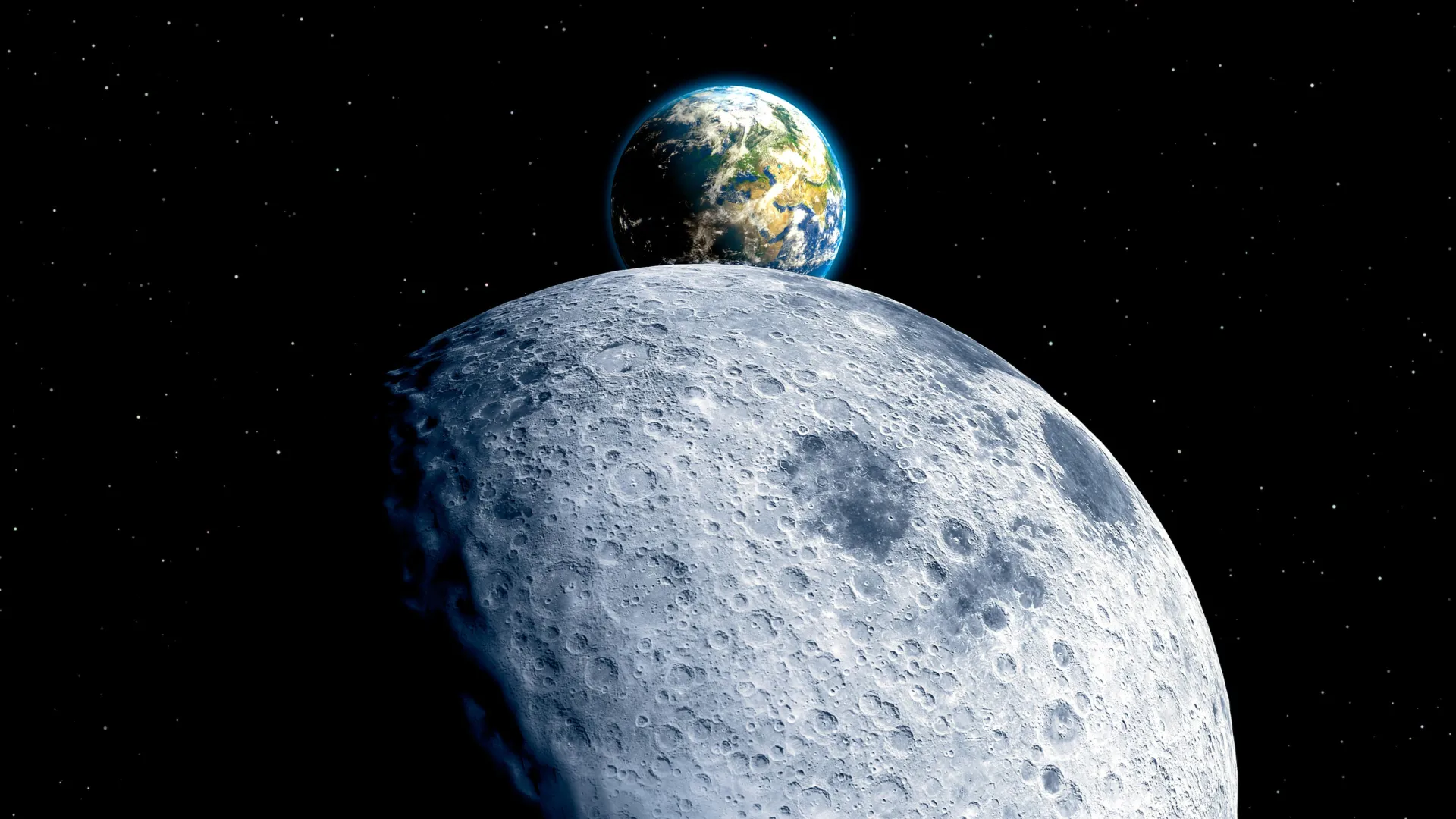
Ancient rocks collected from the Moon’s far side are revealing new details about the violent events that shaped the early Solar System. The discoveries are challenging a scientific theory that has stood for decades and could also provide important clues about the conditions that influenced Earth’s earliest history.
New research suggests that the intense asteroid bombardment experienced by the Moon did not occur primarily during a single, catastrophic period, as scientists previously believed. Instead, evidence preserved in lunar rocks indicates that the frequency of these collisions decreased gradually over billions of years.
The Moon offers a rare opportunity to investigate this distant past. While erosion, volcanic activity, and the movement of tectonic plates have destroyed much of Earth’s earliest geological record, the lunar surface has retained evidence of ancient asteroid impacts dating back billions of years.
Why the Moon’s Far Side Holds Important Clues
Dr. Fred Jourdan, a research co-author affiliated with Curtin University’s School of Earth and Planetary Sciences and John de Laeter Centre, explained that lunar rocks preserve valuable information about the Solar System’s earliest history. These natural records allow researchers to investigate events that took place soon after the planets formed.
“The Moon is like a time capsule — it has preserved a record of events that have been erased from Earth by erosion, plate tectonics and other geological processes,” Dr. Jourdan said.
“Samples collected from the Moon’s far side are particularly significant because they allow us to compare two very different parts of the Moon for the first time. Until now, almost everything we knew came from the side facing Earth.”
“By analyzing these ancient rocks, we can better understand when major asteroid impacts occurred and how the early Solar System evolved. The far side preserves a cleaner record of those earliest impacts because it was much less affected by later geological events than the side facing Earth.
“These samples are helping us rewrite parts of the Moon’s history and suggest the early Solar System experienced a long decline in asteroid impacts rather than a single catastrophic bombardment.”
Reconstructing Billions of Years of Asteroid Impacts
To investigate the Moon’s bombardment history, the researchers examined tiny pieces of lunar rock for evidence of ancient collisions. Their analysis identified impact events dating from approximately 4.33 billion to 1.13 billion years ago, providing a record that spans more than three billion years.
These findings offer a new perspective on how asteroid impacts changed over time. Rather than supporting the idea of a relatively brief period of exceptionally intense bombardment, the evidence points to a much longer process in which impacts became progressively less frequent.
The implications extend beyond the Moon itself. According to Dr. Jourdan, reconstructing the history of lunar impacts can help scientists better understand the events that affected Earth during its earliest stages of development.
What Ancient Moon Rocks Reveal About Early Earth
“The Moon and Earth share a common history, but the evidence of early impacts has largely disappeared from our planet,” Dr. Jourdan said.
“Because the Earth and Moon formed together, every major impact recorded on the Moon tells us something about the conditions experienced by the young Earth.
“Studying lunar rocks allows us to look back billions of years and better understand the events that shaped the environments of both worlds and helps us understand the role asteroid impacts played in planetary evolution and the conditions that may have influenced the emergence of life on Earth.
“The findings come amid a new era of lunar exploration and science, with China’s Chang’e-6 mission being the first to return samples from the Moon’s far side.”
The return of material from the lunar far side has given scientists an unprecedented opportunity to examine a region that was previously inaccessible to direct sampling. By comparing these rocks with samples from the Moon’s near side, researchers can develop a more complete picture of the impacts that shaped the lunar surface and the wider Solar System.
The research was led by the State Key Laboratory of Deep Earth Processes and Resources at the Guangzhou Institute of Geochemistry, Chinese Academy of Sciences.
The findings were published in Science Advances in a paper titled ‘The bombardment history on the lunar farside revealed by 40Ar/39Ar geochronology of Chang’e-6 impact melt rocks’.
