


- Ecuador’s National Bioeconomy Strategy, approved on Oct. 29 and to be implemented through 2036, is billed as a new development model that will “align the country’s biological wealth with production, innovation, science and technology.”
- Right now, the country’s bioeconomy projects are “scattered” and “isolated” compared to others in the region, the strategy acknowledges.
- The plan is to devote the next decade to identifying financing sources and improving intergovernmental coordination, stressing the importance of transitioning away from fossil fuels while relying on the ancestral knowledge of Indigenous communities.
- However, the plan’s stated ambitions appear to clash with existing government policies that continue to fund fossil fuel expansion and overlook or even undermine Indigenous rights.
The government of Ecuador has approved a new 10-year plan to promote economic activities that make use of the country’s biological resources, while also taking steps to conserve the ecosystems that they rely on. It aims to innovate agribusiness, ecotourism, and other industries in rural areas, without threatening the environment or Indigenous communities.
The National Bioeconomy Strategy, approved on Oct. 29 and to be implemented through 2036, is billed as a new development model that will “align the country’s biological wealth with production, innovation, science and technology.”
“Ecuador faces a historic opportunity to redefine the direction of its development, pursuing a model that reconciles natural wealth, territorial equity and innovation with the well-being of its people,” the strategy says.
Other parts of the world already have robust bioeconomy strategies. The European Union generates billions of dollars from sustainable farming practices, biomass management, and biotechnology research. In Latin America, the bioeconomy programs in Colombia and Costa Rica have developed ecotourism with Indigenous communities and improved waste management practices in the private sector, among other initiatives.
By comparison, Ecuador’s bioeconomy projects are more “scattered” and “isolated,” the strategy acknowledges. The next 10 years will be largely devoted to identifying financing sources for future projects and improving coordination between different parts of the government. The plan doesn’t provide an exact financing figure.
“Ecuador aims to have a robust bioeconomy operating within a regulatory framework that promotes its development, with an emphasis on incentives, administrative approvals, sustainable use of biodiversity and biomass, and green jobs and markets,” the strategy says.
For agribusiness, it describes projects to increase local food production and create shorter, more efficient supply chains that allow small-scale producers to access export markets. This includes finding innovative solutions to maintaining soil health, such as creating fertilizers from crop residues and livestock waste.
It also aims to expand protections of coastline and aquatic ecosystems, where food is produced. Some of those policies, which are still in development, will be modeled on the Galápagos Blue Economy Plan set out from 2025. That plan, running through 2040, includes creating new zoning for fishing, improving management plans for marine protected areas, and investing in artisanal fishing projects, in particular ones led by women.
The country will need coastal infrastructure resilient to climate change, the strategy says. El Niño has caused flooding and raised ocean temperatures, which disrupts fish migrations. However, the plan doesn’t include details about what the infrastructure could be or how much it will cost. Instead, it emphasizes research, financing opportunities, and coordination between government agencies.
Some financing sources could include the Inter-American Development Bank and the French Development Agency, as well as BanEcuador and the Development Bank of Ecuador. The strategy also proposes using green bonds and debt-for-nature swaps.
“Access to this financing can accelerate changes in production and sustain the transition toward a comprehensive bioeconomy model,” the strategy says.

Challenges ahead
At times, the strategy’s goals contradict the government’s current economic priorities. It says it wants to reduce fossil fuel dependence and greenhouse gas emissions by investing in bioethanol, biodiesel, biogas, and solid biofuels. But the country’s budget this year still devotes $4.83 billion to the oil and gas sector, $623.88 million of it for exploration and production.
The strategy also says most of the projects will combine scientific research with the participation of Indigenous communities and their traditional knowledge of the environment and local food systems.
“Their traditional knowledge, ancestral practices and worldviews provide a foundation for innovation in developing sustainable production models, bioproducts rooted in local identity and strategies for integrated ecosystem management,” the strategy says.
However, the efforts come at a time when the government continues to face scrutiny about its treatment of Indigenous communities. Oil blocks and mining concessions pollute and deforest Indigenous territory, and community leaders face oppression tactics from authorities.
In the past, observers have said the country’s bioeconomy projects have prioritized economic goals over the needs of local communities.
One 2024 study described a Kichwa community in the Amazon that started sustainably producing and selling tea, with the goal of creating jobs and incentivizing residents to protect the rainforest. In the past, the community had sold the leaves to international tea producers, but eventually opted to process the leaves itself, creating more direct economic benefit without conflicting with its ancestral way of life.
The study argues the government hasn’t taken enough of these kinds of community practices into account and that it’s imperative that Ecuador’s bioeconomy policy be guided by those principles and experiences.
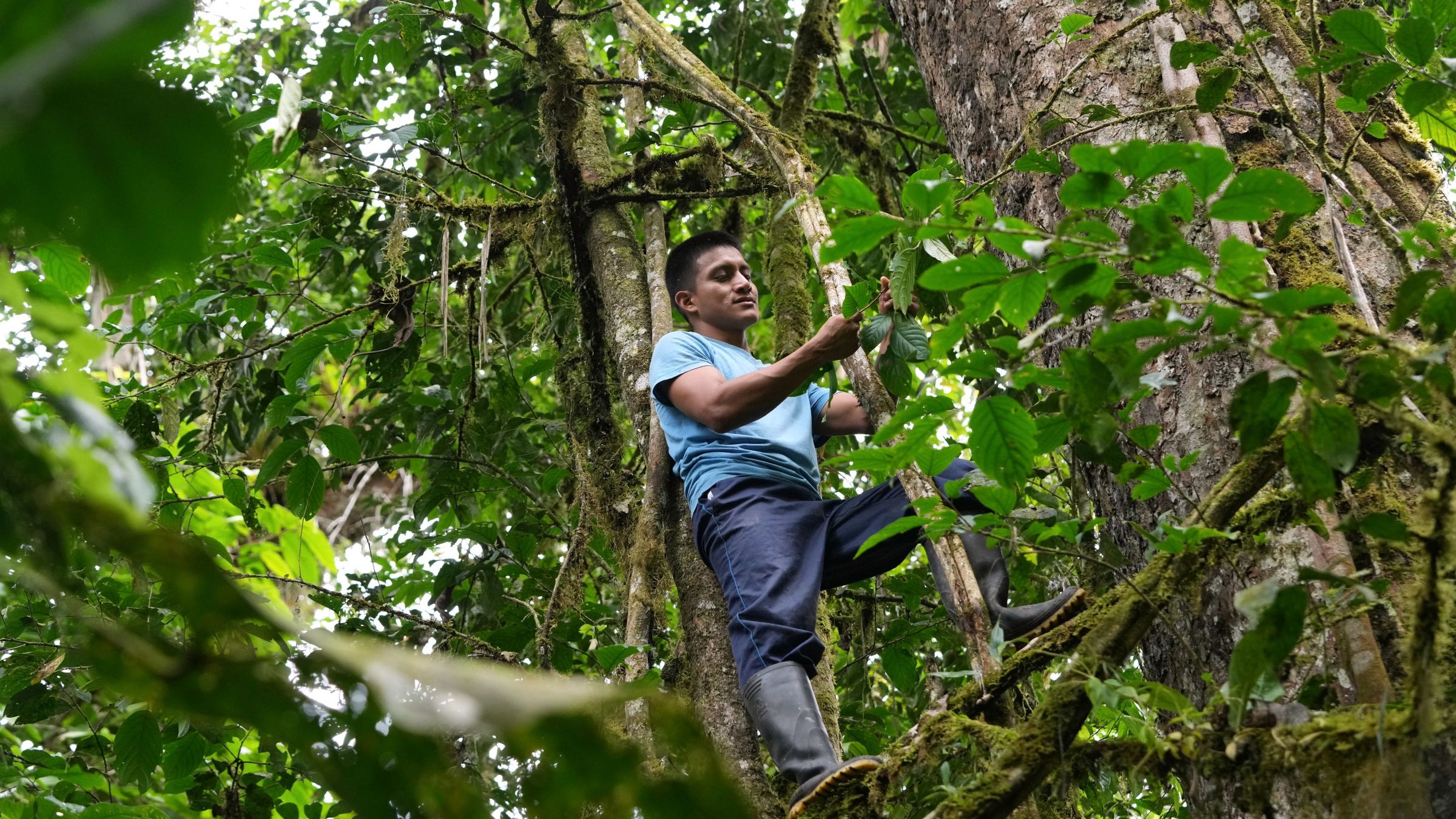
Banner image: Searching for native seeds in the forest near Alto Ila, in Ecuador’s Amazon region. Image by Dolores Ochoa/AP Photo.
Citation: Cuestas-Caza, J., Toledo, L., & Rodríguez, F. (2024). Transcultural bioeconomy governance in a plurinational state: Sumak Kawsay and bio-based production in two Kichwa territories of Ecuador. Forest Policy and Economics, 163, 103227. doi:10.1016/j.forpol.2024.103227
See related from this reporter:
Ecuador copper mine advancing despite opposition from Indigenous communities
FEEDBACK: Use this form to send a message to the author of this post. If you want to post a public comment, you can do that at the bottom of the page.
Cite this article
Maxwell Radwin (2026). Ecuador’s bioeconomy plan vows sustainability, but faces a test of government priorities. Mongabay Conservation news. DOI: https://doi.org/10.66709/news-336888

