


- Double exposure to wildfire air pollution and heatwaves on the same days has become more common globally, according to a 20-year study by Monash University scientists.
- An average of 916 million people were exposed to a day of wildfire haze and heatwaves in two decades, more than half of the global population.
- The top five countries worst affected were the Democratic Republic of the Congo, Indonesia, Mexico, Brazil and Russia.
- Indonesia led with the highest annual average number of people affected, reaching 101 million per year in 2010-2019.
JAKARTA — While the worst of Indonesia’s wildfire and haze season for 2026 may be over with fewer hotspots detected in recent weeks, this wasn’t the only hazard faced by residents in the months-long crisis.
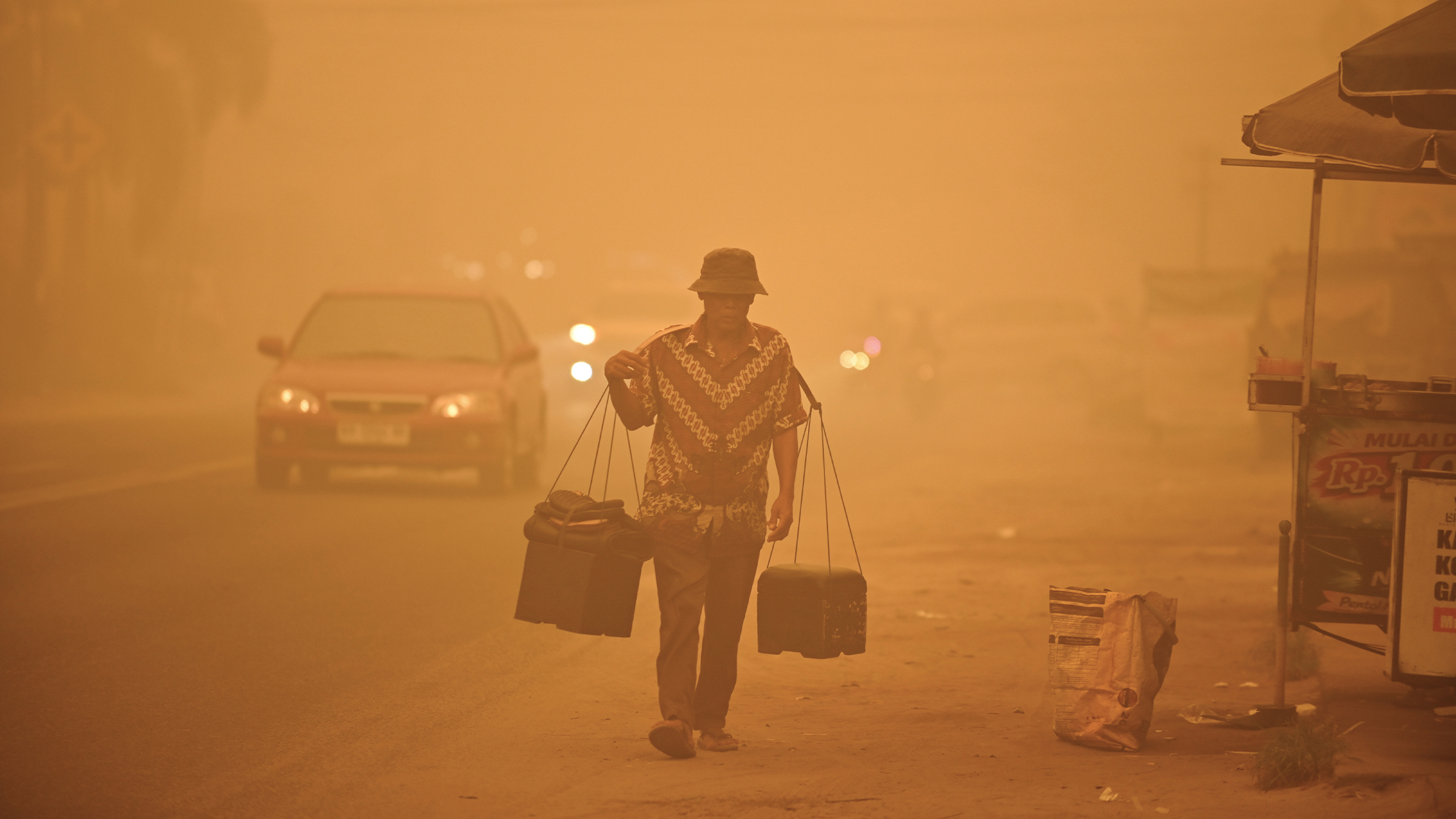
Take, for example, Palangka Raya in Central Kalimantan province, one of the areas worst affected by this year’s wildfires in the country. From August to October 2026, fine-particle pollution in the provincial capital averaged nearly 10 times the 2021 to 2025 level, according to data from Indonesia’s meteorological agency, BMKG. Meanwhile, as haze choked the city in August, its residents also experienced a heatwave, according to data from BMKG.
Exposure to wildfire air pollution and heatwaves on the same days has become more common globally, according to a new study published in the journal Science Advances.
Researchers from Monash University, in Melbourne, Australia, analyzed 20 years of data, from 2000 to 2019, and found that, on average, 916 million people, or 56% of the global population, experienced one co-exposure day annually.
The total number of people increased by 287 million from one decade to the next, according to the study. The top five countries worst affected were the Democratic Republic of the Congo, Indonesia, Mexico, Brazil and Russia.
The study blamed the double exposure on climate change, saying it “has increased the frequency and intensity of concurrent heatwaves and landscape fire events, resulting in more profound impacts.”
Indonesia had the highest annual average number of people affected, reaching 101 million per year in 2010-2019, up from 72 million in the previous decade.
Wu Yao, one of the study’s authors and adjunct research fellow at the School of Public Health and Preventive Medicine at Monash University, Melbourne, said the increase in Indonesia was driven mainly by people experiencing the two hazards more frequently, rather than by population growth.
The analysis showed that in Indonesia, approximately 82% of the increase in total co-exposure was attributable to changes in exposure frequency, while population changes accounted for only about 18%, Wu told Mongabay via email.
Moreover, the average number of heatwave exposure days per person per year in Indonesia had more than doubled, from approximately 17 days in 2000-2009 to 42 days in 2010-2019, Wu added. Meanwhile, wildfire smoke exposure days rose slightly, from about 27 to 28 days.
“This suggests that the increasing frequency of heatwaves may have been an important contributor to the rise in co-exposure, making people more likely to experience extreme heat when wildfire smoke pollution occurs,” Wu told Mongabay.
Co-exposure risks are not evenly distributed across Indonesia. Wu said southern Sumatra and central and southern Kalimantan experienced the combined hazards most frequently, with particularly notable increases in eastern Kalimantan. All of these areas have been prone to recurring wildfires and haze in past decades, including during El Niño in 2026.
Java, Indonesia’s most populated island, had also “experienced a substantial population exposure burden,” she said. Wu added that co-exposure there did not rise steadily but fluctuated from year to year, with particularly high levels in 2015 and 2019 — both El Niño years.

The researchers did note that El Niño can influence heatwave trends in Southeast Asia and Australia. However, the study did not examine the influence of El Niño, peatland conditions or land use on Indonesia’s exposure patterns, Wu said, so it could not identify what drove the changes in particular locations.
Indonesia is not the only Southeast Asian country badly affected. Cambodia, which experienced the highest fire density in the region in 2019–2020, saw one of the sharpest co-exposure increases globally, climbing from 40th place in 2000–2009 to ninth in 2010–2019 for co-exposure days per person. The number of average co-exposure days per year rose from about 1.6 to 12.1, according to the study.
Toll on public health
The study was released in October, when Indonesia was battling wildfires, said to be the worst in 11 years. From January to Oct. 31, 2025, around 65,900 hot spots had been detected — a figure second only to the approximately 85,600 hot spots logged in the same period in 2015, according to data BMKG shared with Mongabay.
An independent assessment by The TreeMap, published on Nusantara Atlas, estimates that around 1.9 million hectares (4.7 million acres) of land across Indonesia were affected by fire between January and September 2026, 38% higher than its estimate for the same period in 2019.
The 2026 haze crisis in Indonesia has taken a heavy toll on public health, affecting at least 40 million people in the country. The Health Ministry recorded 333,470 acute respiratory infection (ARI) cases between Aug. 18 and Oct. 21 in seven Sumatra and Kalimantan provinces worst affected by wildfires.
According to the nonprofit Centre for Research on Energy and Clean Air (CREA), short-term exposure to fine-particle pollution from Indonesia’s wildfires contributed to an estimated 5,200 deaths in August and September in the country.
The haze also traveled across the border, affecting millions more in Malaysia, Singapore, the Philippines and Timor-Leste, forcing school closures and causing increases in upper respiratory tract infection, asthma and conjunctivitis cases.

‘Particularly severe’ health risks
The latest study is part of an emerging research field that looks at the combined effects of double exposure. A 2025 analysis of California medical records from 2006 to 2019 found that the combined effects of wildfire smoke and extreme heat increased respiratory, cardiovascular, and renal hospitalizations more than either hazard alone. A similar 2022 study in the U.S. state estimated that mortality risk tripled on days with both extreme heat and extreme air pollution compared with smoke- or heat-only days.
The Monash University researchers give a similar warning, saying that “simultaneous exposure could increase the risk of multiple adverse health effects,” such as “heat stress, respiratory distress, and cardiovascular complications.”
“Compared with exposure to heatwave or landscape fire-sourced air pollution alone, coexposure to both hazards may exert greater health impacts than the sum of their individual effects,” they write.
Moreover, because of the high likelihood of wildfires and heatwaves happening simultaneously and because smoke can damage cells and tissues, as well as trigger inflammation, the health risks from co-exposure “may be particularly severe,” they add.
Tjandra Yoga Aditama, a pulmonologist and professor at the University of Indonesia’s Faculty of Medicine, who is not involved with the study, confirmed that heat and smoke combined have a greater adverse impact than either one. Children, older people, those with existing conditions and outdoor workers are most at risk, he added.
Tjandra, who researched the health impacts of the 1997-98 wildfires in Sumatra and Kalimantan provinces, said his study, published in 2000, found significant increases in respiratory disorders and lung problems during that period. More than 25 years later, “we have yet to learn from that experience,” he told Mongabay.

Extreme heat, meanwhile, can worsen existing conditions such as heart disease, respiratory disease and diabetes and, in severe cases, cause heat exhaustion or heatstroke, Tjandra said.
Double exposure to heat waves and haze is a global problem. Record heat killed an estimated 50,000 people in European cities in 2026, as a broad swath of Europe grappled with both heat waves and wildfires at the same time.
The risks of co-exposure are likely to continue in the coming year. Although expected to peak in November and December 2026, El Niño is forecast to last into early 2027, with serious impacts continuing through mid-year. According to sources including the U.K.’s Met Office, 2027 is likely to be the hottest year on record, with some predictions at 1.8°C (3.24°F) above preindustrial levels.
As of Oct. 17, NASA satellite observations showed Papua New Guinea’s fire-related carbon emissions already exceeding those of any previous year in the same period, driven by severe El Niño-induced drought.
In South America, scientists warn that the Amazon has entered a long and severe fire season, with NASA satellites detecting sharp spikes in blazes and smoke emissions across the central and eastern region of the rainforest since September.
Australia, still haunted by the Black Summer bushfire of 2019-20, is also bracing for a record El Niño fire season during its summer later this year and early next year.
The Monash University research team plans to update the analysis beyond 2019 to capture escalating recent events, Wu said.
Back in Indonesia, the country’s meteorological agency expects El Niño conditions to persist into early 2027, bringing longer drought and extreme heat.
“The 2026-27 rainy season is predicted to arrive later than normal conditions in most parts of Indonesia,” Ardhasena Sopaheluwakan, BMKG’s deputy for climatology, told Mongabay.
“The start of the rainy season is expected to take place gradually and not simultaneously in all regions.”
In general, most parts of Indonesia are predicted to enter the rainy season from November to December 2026, instead of October as usual, he added.
Banner image: A street vendor walks amid thick haze from wildfires in Palangkaraya, Central Kalimantan, Oct. 24, 2026. Image by AP Photo/Yulianus Stefan Lundju, File.
The world’s children suffer brunt of wildfire smoke health impacts
Experts warn of long-term health risks as Indonesia’s wildfire haze takes a growing toll
Citations:
Wu, Y., Xu, R., Wen, B., Morawska, L., Abramson, M. J., Johnston, F. H., … Guo, Y. (2026). Rising global population coexposure to heatwaves and landscape fire-sourced air pollution. Science Advances, 12(42). doi:10.1126/sciadv.aea9749
Webb, E. L., & Jamaludin, J. (2024). Fire is associated with forest degradation and economic land concessions, but not land conversion in the rapidly transforming Cambodian landscape. Environmental Research Letters, 19(9), 094005. doi:10.1088/1748-9326/ad6678
Jones Ngo, C. G., Schmidt, R. J., Vargo, J., Al Hamdan, M., Monier, E., & Conlon, K. C. (2024). Joint effects of wildfire smoke and extreme heat on hospitalizations in California, 2011-2020. ISEE Conference Abstracts, 2024(1). doi:10.1289/isee.2024.1634
Rahman, M. M., McConnell, R., Schlaerth, H., Ko, J., Silva, S., Lurmann, F. W., … Garcia, E. (2022). The effects of Coexposure to extremes of heat and particulate air pollution on mortality in California: Implications for climate change. American Journal of Respiratory and Critical Care Medicine, 206(9), 1117-1127. doi:10.1164/rccm.202204-0657oc
Aditama, T. Y. (2000). Impact of haze from forest fire to respiratory health: Indonesian experience. Respirology, 5(2), 169-174. doi:10.1046/j.1440-1843.2000.00246.x
Cite this article
Winda Charmila (2026). Study reveals rising ‘double threat’ of wildfire smoke and heatwaves in Indonesia. Mongabay Conservation news. DOI: https://doi.org/10.66709/news-336803

