


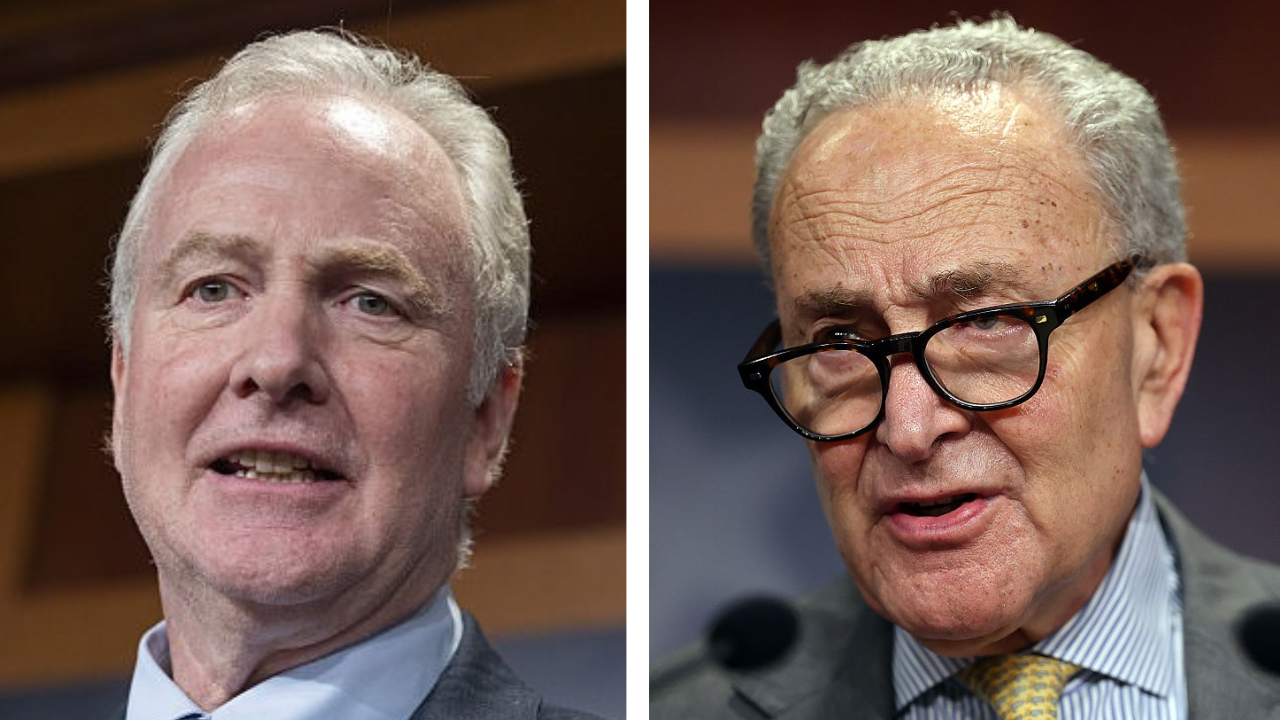
Democrats Chris Van Hollen and Chuck Schumer are competing to be the next Senate majority leader. (Photos by Nathan Posner/Anadolu and Kevin Dietsch via Getty Images)
With Senate Democrats preparing to choose their next leader, the two contenders for the job took notably different approaches with their leadership PAC and joint fundraising committee money.
Senate Minority Leader Chuck Schumer’s leadership PAC distributed a net $252,500 to candidates and party committees during the cycle, according to an OpenSecrets analysis of Federal Election Commission filings. By comparison, Sen. Chris Van Hollen of Maryland directed $262,000 to fellow candidates and party committees through his leadership political action committee and helped four battleground Senate candidates raise more than $421,000 through joint fundraising committees.
The contrast offers a window into their different approaches to political giving ahead of the Dec. 1 vote for majority leader, after Democrats won control of the chamber. Van Hollen wrote more checks directly to candidates and supplemented them with joint fundraising committees, while Schumer’s leadership PAC gave a larger share of its money to party committees.
(function(){function e(){window.addEventListener(`message`,function(e){if(e.data[`datawrapper-height`]!==void 0){var t=document.querySelectorAll(`iframe`);for(var n in e.data[`datawrapper-height`])for(var r=0,i;i=t[r];r++)if(i.contentWindow===e.source){var a=e.data[`datawrapper-height`][n]+`px`;i.style.height=a}}})}e()})();
There was no record of any active JFCs linked to Schumer during the cycle. Instead, the New York Democrat wields much of his financial influence through his longstanding fundraising relationships with Democratic committees and Senate Majority PAC – the super PAC aligned with Senate Democrats that poured millions of dollars into battleground Senate races largely through its contributions to WinSenate PAC.
Leadership PACs may no longer rival super PACs and other outside groups – which may pour unlimited amounts into races – but they remain politically significant because of the relationships they help build, said Eric Heberlig, a political science professor at the University of North Carolina at Charlotte whose research has focused on leadership PACs.
“One way of thinking about campaign contributions is a signal for a desire for a relationship: ‘We want your attention – regardless of whether we have a specific pitch to lobby you on, we want to be on your radar screen, we want our phone calls returned when we make those phone calls,’” Heberlig told OpenSecrets.
Of the five senators and senators-elect whom Newsweek identified as publicly backing Van Hollen’s leadership bid, two received money from his leadership PAC: Sen. Jeff Merkley of Oregon ($10,000) and Sen.-elect Abdul El-Sayed of Michigan ($5,000).
Among the 15 current and incoming senators publicly supporting Schumer, only two – Sen.-elect Sherrod Brown of Ohio and Sen. Jack Reed of Rhode Island – received direct contributions from Schumer’s IMPACT PAC ($10,000 each). Most of Schumer’s public supporters were not on the ballot in 2026, limiting opportunities for leadership PAC giving. One notable exception is Sen.-elect Juliana Stratton of Illinois, whose campaign received $5,000 from Schumer’s PAC but who has repeatedly said she will not support him in the leadership contest.
Heberlig cautioned against viewing contributions to sitting senators as an act of vote-buying. Many incumbents hold safe seats and are not financially dependent on $10,000 contributions from colleagues. Instead, the contributions frequently reflect personal relationships that arise from legislative cooperation, political alliances – and sometimes simple friendships.
Unlike super PACs, which cannot contribute directly to candidates, leadership PACs are controlled by individual lawmakers and can send money directly into a colleague’s campaign account. As a result, those contributions offer a clearer picture of whom potential leaders choose to support and how they build goodwill inside the caucus.
The presence of a contribution carries more significance than the dollar figure “because there are so many different buckets now, so many ways to get money to candidates,” Heberlig said.
Senate Democrats are scheduled to elect their majority leader Dec. 1, a little over a month before the next Congress is sworn in on Jan. 3, 2027. OpenSecrets reached out to the campaigns and Senate offices for Schumer and Van Hollen but did not receive any responses.
How Schumer and Van Hollen distributed leadership PAC money
The two senators’ leadership PACs distributed similar overall amounts, but Van Hollen directed a larger share of its money straight to individual campaigns.
Van Hollen’s Victory Now PAC gave $262,000 to 40 recipients, including $230,500 to 35 House and Senate candidates and $31,500 to five party committees.
By comparison, Schumer’s IMPACT PAC distributed a net of $252,500 to 34 recipients, including $192,500 to 27 candidates and $60,000 to seven party committees, including $30,000 to the Democratic Senatorial Campaign Committee. The total includes a $5,000 refund from retiring Sen. Jeanne Shaheen of New Hampshire.
Fifteen candidates received money from both leadership PACs. Among those who received the $10,000 maximum from each were Sen. Jon Ossoff of Georgia and battleground Senate candidates Roy Cooper of North Carolina, Chris Pappas of New Hampshire and Brown.
“Leaders are going to direct most of the money to the few competitive districts,” Heberlig said. “That’s where the money will make a difference in determining who wins and loses, and thus which party wins majority status. They are not going to ship lots of money to the districts of senior members who have safe districts.”
Both PACs sent maximum contributions to 13 candidates.
Six of Schumer’s 13 contributions went to non-incumbent Senate candidates, including Josh Turek in Iowa, Scott Colom in Mississippi and Mary Peltola in Alaska. Four went to sitting senators and three to House candidates. Van Hollen’s contributions were more heavily concentrated among incumbent senators, with nine of his 13 maximum contributions going to sitting senators.
The biggest differences emerged in competitive primaries.
In Maine’s race, Van Hollen contributed $10,000 to populist progressive Graham Platner, while Schumer instead sent $5,000 to Gov. Janet Mills, Platner’s primary rival. Similarly, in Michigan, while Van Hollen backed El-Sayed with $5,000, Schumer spread his support between El-Sayed and Rep. Haley Stevens, giving $5,000 to each.
El-Sayed has since endorsed Van Hollen in the leadership race.
El-Sayed “can see that Schumer is supporting his opponent [while] Van Hollen’s only supporting him – to me, that’s a clear signal of the relationships that we don’t need to know behind the scenes what’s going on,” Heberlig said. “All things equal, [El-Sayed would say,] ‘Well, Van Hollen supported me when he didn’t have to. He had an incentive to support Stevens – she’s the establishment candidate. He went out of his way to support me, so I’m going to go out of my way to support him.’”
Van Hollen’s JFCs raise another $420K
Van Hollen went a step further in four key Senate battlegrounds by forming dedicated, two-candidate joint fundraising committees.
Those committees allow participating candidates to solicit larger combined contributions and split the proceeds among the participating committees.
Through those partnerships, Van Hollen and the candidates together raised an additional $421,442:
- $125,298 for Ossoff.
- $106,086 for Brown.
- $96,500 for Cooper.
- $93,558 for Sen.-elect James Talarico (Texas).
“Now, more and more money is being raised through joint fundraising committees,” Heberlig said. “That’s a much more lucrative component of leadership’s ability to get money to people than existed 20 years ago.”
But the amount of money flowing through leadership PACs and JFCs represents only a fraction of the outside money steered into battleground states by the Senate Majority PAC, which raised nearly $345 million as of Oct. 24. Largely through its sister super PAC WinSenate, it poured $317 million into key races as part of a broader push by Schumer and his allies to reclaim the majority. WinSenate put $87.4 million into Brown’s Ohio race and $47.7 million into Turek’s race in Iowa. SMP also directed $27.4 million to Texas Forever PAC to back Talarico.
For Senate Democrats, the leadership contest may ultimately come down to whether members prioritize Schumer’s broader role in helping the party win back the Senate or the more direct relationships Van Hollen cultivated through targeted campaign assistance, Heberlig said.
“My guess is that most of them are going to err on the side of the collective good for the party and weigh the personal transactions less,” Heberlig said.
