



In declaring his high tariffs on imported vehicles a success, President Donald Trump often makes false and unsubstantiated claims about auto manufacturing plants in the United States.
For months, Trump has repeatedly made an unsubstantiated claim that “we’re building more auto plants” in the U.S. than ever because of his higher tariffs, while also falsely claiming that no new auto plants had been built in the U.S. in 40 or 49 years.
“Businesses are pouring in in order not to pay tariffs,” Trump said, for example, in a Nov. 2 speech, citing announcements by Audi and Toyota to build auto plants in the U.S. “We went 49 years without building a new one. Now we’re building more auto plants than we’ve ever built before.” (On another occasion in August, he said 40 years.)
We can fairly quickly dispense of the false claim that there have been no auto plants built in the last 40 or 49 years. We found that foreign automakers opened at least 19 new auto plants in the last 44 years, including 17 within the last 40 years, based on our review of company websites and a 2026 report by a group that represents 12 foreign car manufacturers with operations in the U.S.
Four new auto plants started production in the span of four years: Toyota’s Blue Springs, Mississippi, plant in 2011; Volkswagen’s Chattanooga, Tennessee, plant in 2011; Kia’s West Point, Georgia, plant in 2009; and Honda’s Greensburg, Indiana, plant in 2008.
More recently, a Hyundai plant in Georgia broke ground in 2022 and started producing the IONIQ 5 in 2024. Also, Mazda and Toyota launched a joint venture in 2018 to build an auto plant in Alabama that opened in 2021 with the production of the Toyota Corolla Cross.
Jonathan Smoke, chief strategy officer of Cox Automotive, also told us that Trump’s claim about no new auto manufacturing plants “completely ignores EV plants,” referring to electric vehicles.
In the early 2020s, Tesla launched one of its so-called gigafactories in Texas, where the company manufactures the Model Y car and the Cybertruck (which will end production next summer). Tesla selected Texas as its site for a new auto plant in 2020, during Trump’s first term, and officially opened it in 2022, although production started in late 2021.
In December 2021, when Joe Biden was president, Rivian announced that it would invest $5 billion to build a second manufacturing plant in Georgia. In September 2025, Rivian executives and state officials held a groundbreaking ceremony for the new auto plant. Rivian executives told investors this summer that construction is “progressing well” and production will begin in 2028.
Trump’s claim about the lack of new auto plants isn’t new. When he was president the first time, Trump made a similar claim in 2020 that there hadn’t been a new U.S. auto plant in “40 years.” As we wrote at the time, Volvo broke ground in 2015 on its South Carolina plant, which opened in late 2017, and General Motors opened a new assembly plant in 2006 in Lansing, Michigan.
So, Trump’s claim was false then and it still is.
Tariffs and New Auto Plants
Trump’s other claim that “we’re building more auto plants than we’ve ever built before” because of his tariffs requires a close look at the inner workings of specific automakers.
But first let’s quickly recap what Trump has done to date. The Trump administration officially announced a global 25% tariff on imported autos and auto parts on March 26, 2025. The higher tariffs on autos took effect April 3, 2025, and on auto parts the following month.
Since then, the U.S. reached trade agreements with Japan, South Korea and the European Union that reduced the auto tariffs to 15%, as explained in a report by the Congressional Research Service, and 10% on the first 100,000 vehicles imported annually from the U.K.
The president also threatened in August to increase tariffs to 50% on steel and auto imports from Canada, effective Jan. 1. Reuters reported last month that the two countries are in negotiations that could prevent the higher tariff from taking effect.
(An important aside: The Supreme Court ruling in February overturned the tariffs Trump imposed under the International Emergency Economic Powers Act. But that ruling did not affect the tariffs on imported autos, steel and auto parts, which were mandated under a different legal authority.)
Trump credits the higher tariffs on autos for spurring a building boom of new auto plants.
“I don’t know if you saw the numbers; we have more auto plants being built now than at any time in history,” Trump said in a speech in Texas on Oct. 27, prefacing his remark about the auto plants by saying, “Thank you, tariffs.”
We asked the White House to provide information that supports his claim that “we have more auto plants being built now than at any time in history” because of the tariffs. But it did not. Instead, we received a White House statement that said, in part, “no president in the past half century has done more to invest in and build new American auto plants than he has.”
It’s true that automakers have announced new investments in the United States – some of which appear to be in response, at least in part, to Trump’s tariffs, such as expanding capacity at existing auto plants.
In August, the White House released a list of planned U.S. investments announced by auto manufacturers since Trump took office. Most of the announcements were about automakers’ plans to increase capacity at existing U.S. facilities, not building new plants.
For example, GM announced in June 2025 that it would invest $4 billion over two years to increase production at existing auto plants in Michigan, Kansas and Tennessee. Sam Abuelsamid, vice president of market research at Telemetry, which focuses on the automotive industry, told the Detroit Free Press that he attributed the announcement to Trump’s tariffs. “It’s almost certain that they’re moving production from Mexico to the U.S.,” Abuelsamid said of GM.
There was one announcement of a new auto plant in the White House’s August release, which was titled “President Trump’s Trade Agenda Is Rebuilding the American Auto Industry.” Toyota announced in July that it would “expand its San Antonio manufacturing campus with a second vehicle assembly line to support the Tacoma truck” at a cost of $3.6 billion. We asked the White House for an updated list, but we did not receive that, either.
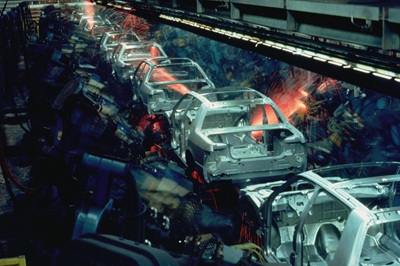
Since August, there have been at least two other automakers that announced plans for new auto plants. Audi announced last month it will build its first-ever U.S. plant in Georgia, and Honda announced this month that it plans to build a new auto plant in Ohio.
But Stephanie Brinley, a principal automotive analyst for Mobility Global, told us in a phone interview that the announcements by Toyota, Audi and Honda cannot be attributed solely to Trump’s trade policies. (Mobility Global, which was a division of S&P Global until July, is an independent company that provides information — automotive data, trends and analysis — to its clients.)
“I mean, we’re seeing investment, but it’s hard to say how much of it is purely tariff driven,” Brinley told us.
“A plant investment is, you know, a 20- to 30-year investment, and it’s not taken lightly,” she said. “Automakers will do everything they can to, yes, incorporate policy as a factor, but it is not the only factor. What the market needs and what they need to perform well in the U.S. market, or any markets they’re considering a plant in, is more important than policy alone.”
That was the case with Toyota, Honda and Audi. All three are building new auto plants to strengthen their position in the U.S. market.
It “can be advantageous” for automakers to make investments or build a new auto plant because of Trump’s trade policies, but “the US policy is not the overriding decision factor,” Brinley said. “It’s just one of many.”
Let’s take Audi first.
Just days before the midterm elections, Trump was joined by Audi Chief Executive Officer Gernot Döllner at a political rally Oct. 24 in Georgia. At the rally, Trump disclosed Audi’s plan to build its first U.S. auto plant in Georgia – which the company officially announced the next day.
But Döllner told the Wall Street Journal a day after the rally that the company started searching for a U.S. manufacturing location about three years ago – which would predate Trump taking office in January 2025.
The Georgia site chosen by Audi was one of more than 70 locations that the company considered, Döllner told the paper.
Wall Street Journal, Oct. 25: The plant will give Audi greater flexibility to navigate trade barriers like Trump’s tariffs, which clipped about 1.2 billion euros—or, $1.3 billion—from its profits last year. But Döllner said the new factory is also meant to fix Audi’s broader “structural competitive problem in America.”
“The tariff situation was not the only issue,” he said.
Similarly, Brinley said that “Honda has said they were talking and thinking about a new plant” for a few years. “The conversation of whether or not to do that started a long time ago,” she said. “So, again, the tariffs have an impact, but they’re not the ultimate driving decision.”
In announcing the new plant in Ohio, Honda said it will be designed to “meet growing customer demand for hybrid vehicles in North America.” Honda has said that its hybrids make up about 31% of its sales in the U.S., and set a U.S. sales record in the first quarter of 2026.
“The market has changed dramatically and it changed very quickly — faster than we could catch up, it seemed, at times,” Bob Nelson, the executive vice president of American Honda Motor Co. Inc., said of the company’s plans for a new U.S. plant. “But we’re quickly developing new products based on the customers, and the hybrid’s very popular now for us.”
Brinley said automakers need to manufacture vehicles close to where they are sold. Honda, for example, said that in 2025 “around 99% of all Honda vehicles sold in the U.S. were made in North America, with about 60% made in America.”
Both Honda and Toyota have “been at a capacity position where they could use another plant [in the U.S.] for several years,” she said. “If they were going to increase sales in the U.S., they would need some other capacity.”
In Toyota’s case, Automotive News, a trade publication, speculated in March that Toyota might build a new U.S. plant. The article cited Toyota executives saying that the automaker’s global capacity is “‘capped out,” and its “plant efficiency” in North America “has gone up to over 90 percent” in 2025.
About three weeks after the article appeared, Toyota announced it would spend $1 billion to increase production capacity at existing Kentucky and Indiana plants. That was followed by July’s announcement that it would transition production of the Tacoma truck from Tijuana, Baja California, Mexico to the new second assembly line at its Texas plant.
In addition to Honda, Toyota and Audi, the Hyundai Motor Group has been aggressively increasing its manufacturing footprint in the U.S. in recent years. As we said earlier in this story, Hyundai opened a new auto plant in Georgia in 2024. It was the South Korean automaker’s second auto plant in the U.S. The first Hyundai plant opened in Alabama in 2005.
In 2022, with Biden at his side, Hyundai Motor Group Executive Chair Euisun Chung announced a $10.5 billion investment over three years on electric vehicle battery plants, which were completed in 2025 in Kingston, Georgia, and 2026 in Savannah, Georgia.
On March 24, 2025, with Trump at his side, Chung announced Hyundai would invest $21 billion in the U.S. over four years in the steel, robotics and automotive industries.
At the time, Hyundai said it would invest $9 billion to expand U.S. auto production at its plants in Alabama and Georgia, as well as $5.8 billion to build a new steel plant in Louisiana and $6 billion on robotics, artificial intelligence and other innovation projects. The announcement came a few weeks after Trump on Feb. 18 floated the idea of imposing tariffs “in the neighborhood of 25%” on imported autos.
Citing Hyundai as an example, Brinley said “a lot” of the new investments announced by automakers are because “each automaker needs them.”
“I mean, Hyundai came out with a $21 billion investment within a couple of weeks of the tariffs,” Brinley said. “There is no way that company decided in three weeks this is what we’re going to do [in response to the tariffs].”
Hyundai three months ago upped that U.S. investment figure to $26 billion, and is reportedly considering further expanding its new auto plant in Georgia.
Clearly, there are plans for new U.S. auto plants on the drawing boards for several automakers, but we can’t say that Trump’s tariffs are the sole or even primary reason. And the White House hasn’t provided evidence that “we’re building more auto plants than we’ve ever built before” because of Trump’s tariffs.
Editor’s note: FactCheck.org does not accept advertising. We rely on grants and individual donations from people like you. Please consider a donation. Credit card donations may be made through our “Donate” page. If you prefer to give by check, send to: FactCheck.org, Annenberg Public Policy Center, P.O. Box 58100, Philadelphia, PA 19102.
