


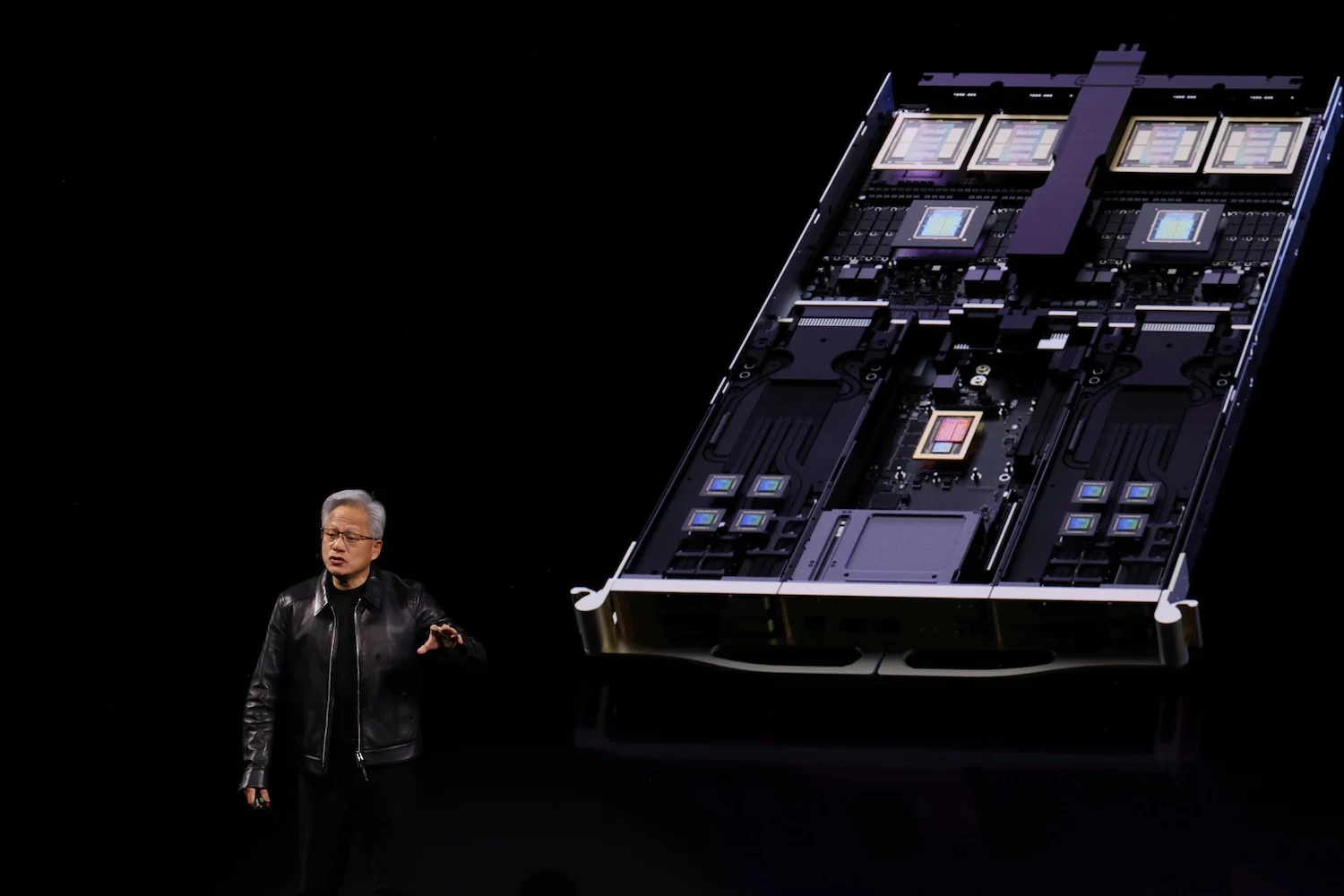
American business has minted a new brand of executive: the CEO who is too big to fire. On Nov. 17, Nvidia’s board declared that it had accepted the resignation of Jensen Huang, felled by an affair with an alleged Chinese spy and a romance with one of the executive’s own subordinates. Six days later, Huang was back, restored after a unanimous vote by the same board. Nvidia’s shares soared. Many investors celebrated the return of the leather-jacketed founder credited with making the company the engine of the artificial intelligence revolution.
Three years earlier, OpenAI’s board had dismissed Sam Altman, citing a lack of candor with directors. Five days later, Altman returned, and most of the directors responsible for his removal were out.
In both cases, directors discovered that formal authority to remove a chief executive does not mean the power to do so in practice. The episodes exposed a three-pronged weakness in corporate governance: the challenge of maverick founders, the extraordinary complexity of AI, and the growing dependence of the U.S. economy and national security on a handful of companies at the technological frontier.
Both Altman and Huang have personas, know-how, and market-moving power that made them unfireable. Yet if the boards of the country’s most consequential technology firms cannot exercise ultimate authority over management, these companies are effectively ungovernable. This reveals a major gap in corporate stewardship, underscoring the imperative of robust regulation to ensure that the vulnerabilities of powerful U.S. companies do not become fatal weaknesses for the country’s democracy and society writ large.
The iconic corporate founder is a hallmark of U.S. business culture. Henry Ford and Andrew Carnegie shaped society-altering industries around their personalities and distinctive working styles. Steve Jobs provides the most celebrated historic example of this type of figure in tech. Forced out of Apple in 1985, Jobs returned in 1997 when the company was in steep decline. His track record of inventiveness helped win back employees, customers, investors, and developers. He also persuaded Bill Gates to invest $150 million in Apple and commit to developing Microsoft software for Macintosh computers, building an ecosystem whose fortunes were intertwined with his own and that has dominated the market for decades.
These bold founders may have as much in common with an artist or creator than they do with fellow CEOs. A great architect or film director works with large teams but puts an unmistakable stamp on their work. Although a studio or tradition can continue after its originator dies or departs, investors, collaborators, and audiences do not always stay on.
This analogy helps explain why succession at frontier technology companies is so fraught. Investors bet on a founder’s judgment about technologies whose commercial potential is unproven. Engineers are inspired by a particular visionary. Customers and business partners invest in the future that the founder promises. As these forces rally, they reify perceptions of an individual’s genius, which attracts still more talent and capital. Confidence becomes self-perpetuating.
Such devotion is measurable. Huang topped Glassdoor’s 2026 ranking of CEOs with a 99 percent approval rating among employee reviewers. Thousands of employees reportedly signed a letter seeking his reinstatement this month. His reportedly cruel behavior toward certain employees seemingly did little to puncture that aura.
OpenAI’s 2023 crisis demonstrated the power of such fealty. After its board fired Altman, more than 95 percent of the company’s employees signed a letter threatening to resign unless he came back. Microsoft, OpenAI’s largest commercial partner, rolled out a red carpet to Altman, promising to allow him to rebuild his team there. Faced with losing the workforce that was OpenAI’s principal asset, the board folded. The employees, investors, and commercial partners whose confidence had helped make Altman successful overpowered those charged with supervising him.
These examples do not prove that founders are irreplaceable. Apple’s revenues more than doubled during the early years of John Sculley’s post-Jobs tenure in the 1980s; more recently, the company has thrived under Tim Cook since Jobs’s death. When Uber’s Travis Kalanick was forced out in 2017, investors worried about losing the transportation innovator’s aggressive founder. His successor, Dara Khosrowshahi, now presides over a company that generated $193 billion in gross bookings and $10 billion in free cash flow in 2025.
Board members are a little like grandparents. They admire and care about the baby, comforted that the parent—the CEO—does the daily grind. When the parent disappears, the board is left holding a crying, demanding infant. Sedate quarterly meetings suddenly turn into frantic round-the-clock Zooms. Having lost the one person who they trusted to raise the child, boards want nothing more than to once again pass the progeny into capable hands.
When it comes to AI companies, the problem is magnified by the extraordinary gap between a CEO’s knowledge of frontier technologies and what even accomplished directors can understand. Nvidia’s 10-person board includes Melissa Lora, the former president of Taco Bell; Stephen Neal, a distinguished trial lawyer; and Dawn Hudson, a former Pepsi-Cola and National Football League marketing executive. Three of the 10 have served on the board for more than 28 years each. Just one is under the age of 60. While several board members have technology backgrounds, the emergence of Nvidia’s chips and financing as lynchpins of AI competition has transformed the demands on a group of directors who were chosen at least in part because Huang trusted them not to get in his way. Alongside bleeding-edge technologies, the board is now dealing with matters of foreign espionage, regulatory capture, securities fraud, and export controls. It’s not hard to imagine Nvidia’s directors feeling out of their depth.
The governance challenges created by Nvidia’s technological complexity are compounded by the company’s centrality to the U.S. economy and national security. A 2026 investment analysis estimated that 42 AI-related stocks accounted for 60 percent of the S&P 500’s gains in 2025. By September 2026, Nvidia alone represented approximately 8.4 percent of the index. Huang’s reinstatement on Monday propelled a broader market rally, underscoring how closely U.S. financial fortunes have become tied to confidence in the AI industry. The national-security dependence is at least as consequential. AI is increasingly incorporated into military intelligence, surveillance, cyber operations, logistics, and command-and-control systems. Access to advanced computing is at the heart of competitive tensions with China.
These dependencies help explain U.S. President Donald Trump’s extraordinary intervention in Nvidia’s leadership deliberations. According to Semafor, the president called into a Nvidia board meeting to press for Huang’s return, suggesting that China might recruit him if Nvidia failed to take him back. Though no investigation has been completed and the allegations of Chinese plotting to compromise Huang are alarming, Trump personally vouched that his return would pose no national security risk. It is hard to know who possesses greater leverage in the Trump-Huang relationship—the president who controls regulatory decisions or the corporate titan whose technology is essential to domestic prosperity and national security.
Reliance on individual technology entrepreneurs for vital national functions can compromise public interests. In October, Ukrainian forces experienced serious disruptions to Starshield satellite communications, impairing military operations. Elon Musk subsequently acknowledged that his company, SpaceX, had restricted certain uses of the service, though responsibility for the disruptions remains contested. Society depends on interconnected technological systems that are vulnerable to malfunction and compromise; the power vested in a handful of tech moguls who control these networks is staggering.
U.S. institutions have failed to reckon with this amalgamation of power. Congress remains divided over how to regulate AI. Federal agencies possess fragmented authority over specific risks and no mandate from the White House to address them. Companies develop capabilities faster than public institutions can assess them. CEOs with immense technical resources and public influence end up guiding the officials responsible for overseeing them.
The consequences of this glaring void will reverberate internationally. U.S. corporate leadership is predicated on the perception that U.S. companies operate within a system of enforceable laws, strong oversight, and credible government institutions. This distinguishes U.S. technology from Chinese alternatives, whose governance remains vulnerable to direct state intervention. But if U.S. boards cannot meaningfully restrain powerful executives, and the president can intervene in their internal deliberations, those differentiators collapse. Governments considering whose AI infrastructure to trust will ask whether U.S. companies offer genuine institutional safeguards.
The obvious response is to strengthen corporate oversight. Some mechanisms already exist. Nvidia has an independent board, audit and governance committees, and a confidential reporting hotline. It has now added a specialized national security committee and is upgrading its compliance function. OpenAI maintains a safety and security committee overseeing its operations. But all these arrangements depend on directors whose authority may be subsumed by founder loyalty, commercial pressure, and technological complexity.
Other highly regulated industries offer more robust, proven oversight models. Under Federal Reserve rules, large bank holding companies must maintain independent risk committees, including directors with relevant expertise; chief risk officers report directly to those committees as well as management. Britain requires senior executives at financial firms to be approved by regulators, makes it clear what each is responsible for, and can hold them personally accountable if they fail to take reasonable steps to prevent wrongdoing. U.S. pharmaceutical regulation provides another precedent. Federal rules give drug manufacturers’ quality-control arms the authority to approve or reject products and manufacturing procedures, so that decisions do not lie simply with a CEO’s commercial preferences.
These models suggest an approach to governing companies whose technologies pose exceptional public risks. Congress should establish an independent federal supervisory authority for designated frontier AI companies, including critical infrastructure providers and developers of exceptionally capable models. Its jurisdiction should depend on the risks and systemic importance of technology companies, rather than their size or public-company status. Now that corporate interests have captured the U.S. executive branch, legislative oversight is essential.
Such an institution would need permanent technical staff with expertise in advanced computing, model capabilities, cybersecurity, and intelligence threats. It would require secure access to proprietary information, the power to inspect governance systems, and the authority to compel corrective action. Its independence from day-to-day political intervention would be essential.
Meanwhile, regulated companies should have dedicated board-level risk committees staffed by directors with technical and national-security competence. Those committees should retain their own expert advisors and receive regular reports from both the CEO and independent risk, safety, and compliance officers. Boards should be required to document how they evaluate consequential decisions, oversee potential conflicts of interest, and prepare for abrupt leadership transitions.
A further priority is genuine protection for whistleblowers. Nvidia’s formal policies prohibit retaliation, yet recent reporting suggests that employees fear speaking openly. In technology companies, confidentiality is increasingly difficult to preserve. Employers can potentially reconstruct a source’s identity from records of device use, badge access, communications, and document activity, even when a reporter or investigator promises anonymity. One shudders to think what this might mean for Nvidia employees who recently spoke out about mistreatment or alleged misdeeds, believing that Huang’s tenure was over for good.
A modern whistleblower regime should offer secure channels outside the company, enforceable restrictions on attempts to identify confidential sources, and meaningful penalties for retaliation. An independent regulator should interview employees and business partners without requiring them to expose themselves to management. Such protections are particularly important during investigations involving a powerful founder.
It may be tempting to conclude that Nvidia’s crisis ended happily once Huang returned and the market rallied. The OpenAI episode invited a similar reaction, especially as the company continued its rapid expansion after Altman’s reinstatement. But neither recovery resolves the institutional weakness that allowed directors’ decisions to be reversed under pressure.
U.S. technological leadership cannot depend on a system in which the most influential executives are effectively irreplaceable. A company that is too big to lose its founder may also be too powerful to govern itself. As AI becomes embedded in the economy, national security, and public life, the United States needs oversight institutions capable of withstanding the demands of employees, investors, politicians, and even the most celebrated innovators. The long-term credibility of U.S. technological leadership will depend on it.
