


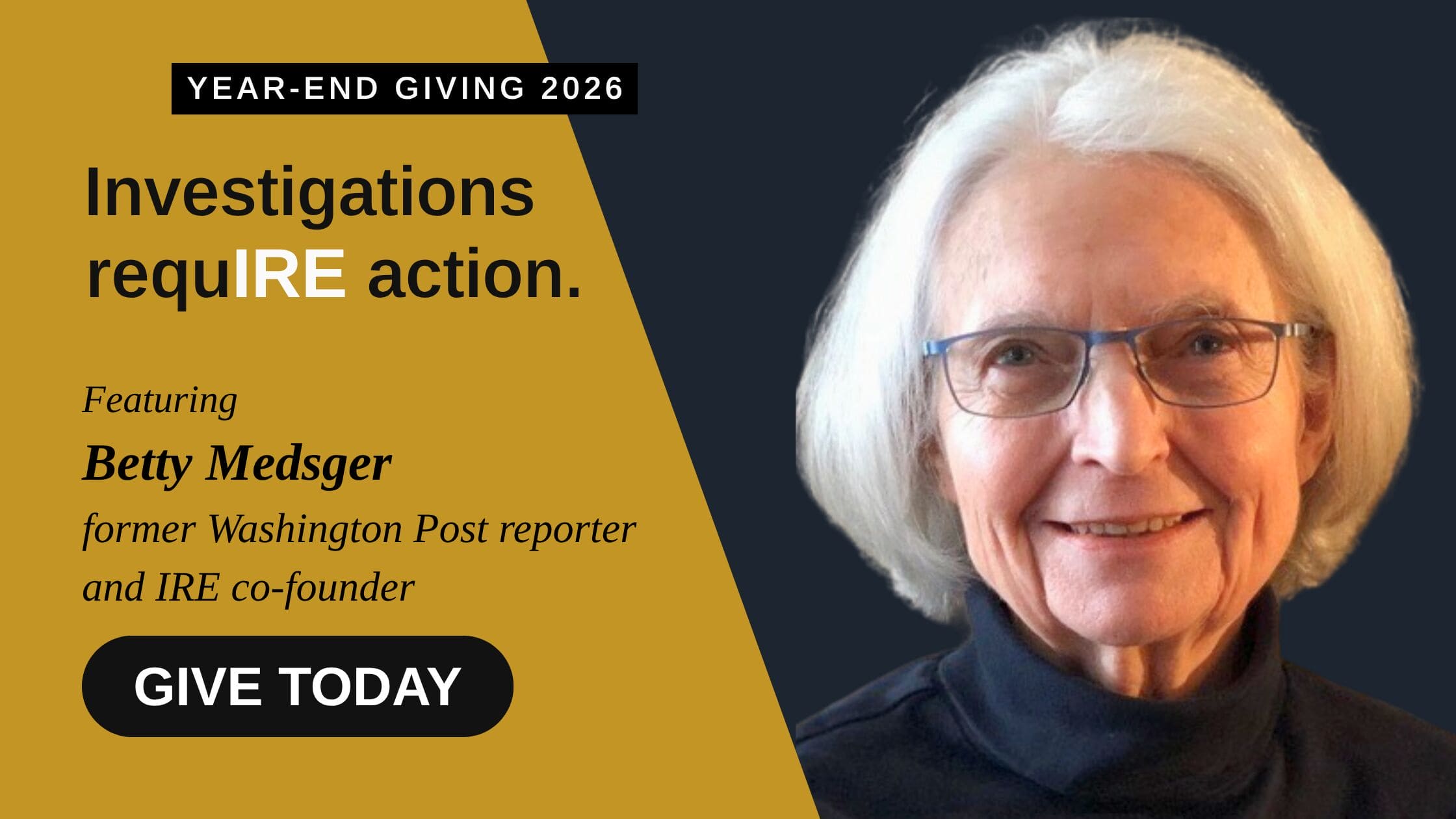
“I never felt afraid…I was very concerned about the people who burglarized the FBI office and sent me the files they had stolen [because their fingerprints might have been on the pages and envelope]…so I destroyed the original copies to make sure that I was in a position to protect my sources if I ever—if what I had ever ended up in the wrong hands,” says Betty Medsger in an interview with IRE.
In March 1971, Medsger, then a Washington Post reporter, received what would come to be known as the Media files. Stolen from the FBI office in Media, PA, the packet of files included a cover letter explaining that the files came from the Citizens Commission to Investigate the FBI. The Commission, risking decades in prison, burglarized the Media office to discover evidence of the FBI’s suppression of dissent, which they considered a crime against democracy. At the time, there was no official oversight for the FBI or similar agencies. The eight members of the self-appointed commission never were caught and remained anonymous until the 2014 publication of Medsger’s book, The Burglary: The Discovery of J. Edgar Hoover’s Secret FBI.
The files revealed massive illegal surveillance operations conducted particularly against Black Americans, who were targeted not due to criminal suspicion but racial discrimination. The FBI’s worst operations, COINTELPRO, were revealed in these files. These secret operations were designed to “disrupt and neutralize” people Hoover regarded as subversive. They ranged from crude to cruel and even included murder.
Of the five people who received the files—two members of Congress, a reporter at The New York Times, a reporter at The Los Angeles Times, and Medsger—only Medsger published the content of the files. The other recipients returned the files to the FBI. The decision to publish was difficult for Washington Post publisher Katharine Graham; it was the first time the Nixon administration demanded she suppress a story.
These revelations by Medsger and the Post led to the first congressional investigations of the FBI and all intelligence agencies, and were part of a shift from journalists protecting the secrets of such agencies to holding them accountable.
When Medsger received the files, she did not consider herself an investigative reporter. “I was just a reporter dealing with what came my way,” she says. That changed by the time IRE was formed. Medsger became a founding member and “…realized that [investigative reporting] was wonderful work.” She says, “IRE expanded what I saw as possible for me and others, including my future students, to do.”
Medsger became a journalist overnight in 1964. Planning to teach high school in the fall, shortly after graduating from college in January, she applied for a job as a filing clerk at the local newspaper. “But when I went in…they said, ‘Do you have a college degree?’” The Tribune Democrat in Johnstown, PA staffed one woman reporter, as a policy. “And they had just lost their one woman reporter right before I walked in…I started work as a reporter the next night.”
Medsger fell in love with journalism. “You covered anything that happened and…for me, it was very interesting to just pay attention to the world around me in a way I never had before.”
That was the beginning of a career that would take her next to The Evening Bulletin in Philadelphia, to The Washington Post, and on to decades as a freelance writer and documentary photographer teaching at San Francisco State University.
“The eagerness of journalists [at IRE] to help the next generation,” has always inspired her. “IRE has had a profound and lasting impact on the quality of American journalism…I doubt that the people who founded IRE in their wildest dreams could have envisioned what IRE became, and the great number of people that learned investigative skills through IRE training…Without IRE, investigative reporting might be done only by large national news organizations. Thanks to IRE training, journalists at small and medium news organizations have been able to do great investigative work.”
