


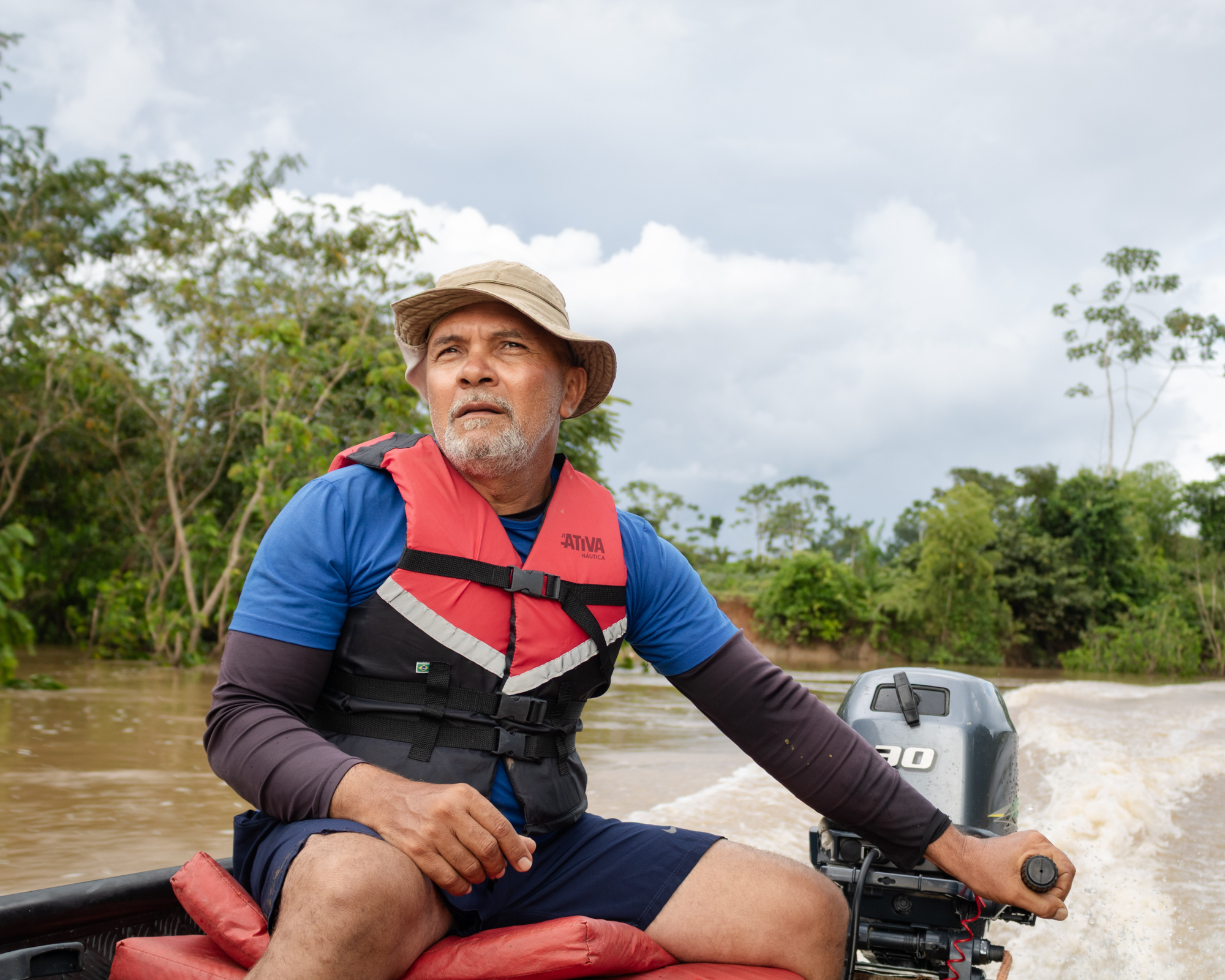
- Despite two decades of successful health outreach that has helped nearly eradicate malaria locally, the future of a riverine healthcare program remains uncertain amid longer droughts and drier rivers in the Brazilian Amazon.
- Giant El Niño, historic droughts and declining rainfall across the region are turning vital waterways into impassable barriers of mud.
- “You know you’ll face rain, sun, thorns, mud,” nurse Alexandra Fernandes said of the grueling medical missions that serve as a vital lifeline for isolated riverside residents.
RIO BRANCO, Brazil — The sun rises as the riverine healthcare crew starts disembarking medical supplies. They pass down boxes and coolers of all sizes from boat to canoe to smaller canoe, from the far end of the ship to the water’s edge, where a staff member with mud halfway up their shin will hand the load to the next on dry land to carry it uphill where the rest of the team is setting up today’s medical outpost.
Every year, doctors, nurses, dentists and community health agents sail along Riozinho do Rôla, delivering medical care to the riverine population of the rural area of Rio Branco, capital of Acre state, in the Brazilian Amazon. Barro Alto, where the fleet is docked, is the first stop.
Across the Amazon, a landscape of forests and rivers poses unique obstacles for accessing healthcare. “There are technical and operational challenges that are characteristic to this region,” nurse Alexandra Fernandes, who oversaw this year’s edition of Rio Branco’s healthcare flotilla, told Mongabay. In riverine communities like Barro Alto, isolated for months during wintertime floods, waterbound medical attention becomes a lifeboat.
But with climate change and increasingly extreme drought seasons, channels that once connected people to the care they needed are now turning into barriers, as water gives way to mud. According to the November bulletin of the Drought and Immobility Risk in the Amazon Basin report, river levels across the Brazilian Amazon are “below or far below average.” In Acre alone, six of its 22 municipalities have more than 20 communities under the threat of drought-induced immobility.
For more than 20 years, crews of up to 70 professionals set sail from Rio Branco and made their way through 11 outreach sites, offering thousands of medical procedures to people from roughly 150 communities.
The scene from Barro Alto plays itself out at each of the stops. Personnel, medicines and gear meet existing structures — schools, churches, barns — that will house a “pop-up clinic” for the day. Once the work is over, it all goes back on the boats, and they set forth to the next site to start all over again.
In other parts of the Amazon, medical attention arrives in the shape of floating primary healthcare units, large boats equipped with hospital-grade facilities, eliminating the need to set up shop on dry land. But Riozinho do Rôla and its tributaries are neither wide nor deep enough to harbor those units.
Instead, Rio Branco’s initiative employs a fleet of five wooden boats of roughly 16 by 6 meters (52.5 by 19.7 feet): One for the crew, one for medical supplies, one for larger equipment, one that houses a kitchen and, at a safe distance, one carrying fuel.
From the third stop on, even those boats get too large for streams that narrow stretch by stretch, so the crew must resort to a handful of motorized canoes known as voadeiras. Once everything is loaded, they sail along a path that, for the most part, a smaller team has cleared ahead with a chainsaw.
Planning logistics for such a detailed enterprise takes months. “From the water we’ll drink over that time, to the fuel we’ll need, to motors and tools to unblock creeks, everything must be calculated,” sanitarist and public healthcare specialist Rejane Almeida told Mongabay. She’s been a part of the flotilla for 13 years, nine of which as its coordinator.
But all planning in the world isn’t enough to dodge climate change’s curveballs. As the riverine healthcare crew starts disembarking medical supplies in Barro Alto, passing down boxes and coolers from boat to canoe to smaller canoe, whether they will make it to the 11th destination this year remains uncertain.

Stranded between too little and too much water
By the time João Batista joined the flotilla as a pilot, he had already been working in the region as an endemic disease control agent, the “malaria guard,” for more than a decade. Back then, dry and wet seasons were more predictable, and “there was more water,” he told Mongabay.
Standing by the shore, he points at a wooden fence some 50 m (164 ft) ahead, at the foot of a hill. That’s where, in previous years, they used to tie up the boats. “We wouldn’t have been able to stay where we are standing now,” he said.
The Amazon is growing drier with every passing day. In Brazil alone, the forest has lost 14.5% of its water surfaces in two decades. It has also seen a 74% decline in rainfall across 35 years. The 2023 record-breaking drought that threw the region into a humanitarian and environmental emergency was only surpassed by the one in 2024. This year, drought and fire outbreaks are sparking fears of another dry spell in the rainforest, this time fueled by a giant El Niño.
In 2024, rivers were so low that Almeida recalls drastic schedule delays: Stretches they used to cross in two hours now took an entire day. The flotilla didn’t reach the 11th stop. As the community saw water levels drop even further, they warned the crew there would be no way through. “We made it as far as we could,” Almeida said.
At the same time, some of the worst floods in the Amazon’s recorded history happened in the past decade. In 2024, the Acre River overflowed in Rio Branco, reaching its highest level since 2015’s historic flood. There was so much damage that the flotilla had to be canceled, as the healthcare crew was needed for emergency response.
Batista says the abundance of water that causes havoc in the city makes it easier for the fleet to reach its destinations. But even then, it doesn’t always mean improved access. In previous years, river levels were so high, people had to swim from their home communities to the medical outpost.
“There are families who lost their children in a strong stream,” Almeida said. So when the choice is between the one chance of seeing a doctor, doing a medical procedure or getting a vaccine and risking the life of a loved one, many choose to stay home. “And I won’t argue with them.”


The river mission that changed healthcare in the Amazon
On muddy riverbanks, people huddle close to the water, some with children on their shoulders, phones held up and ready. Soon, videos and photos will appear in WhatsApp groups announcing: The health mission is passing by.
A few weeks before, Almeida visited all 11 stops to check access and facilities and to confirm dates with community leaders. “Communication has always been important to get the word out,” she said. “Even after 21 years, many people still don’t know this program exists.”
Deysi Nadi, 37, a seamstress, left home around 9 a.m. with her 5-year-old daughter and three other relatives on an all-terrain vehicle (ATV) and took a ferry. The trip lasted about an hour. “You can see how the whole community turns out,” she said. “People think: ‘It’s only today. Let’s drop everything and take care of our health.’”
People come to receive assistance however land and river allow: By canoe and motorboat, on horseback or by ox cart, by motorcycle and ATV. Some woke up before dawn and caught a ride with a neighbor; others walked miles carrying their babies.
The crew’s day starts long before theirs. At 3 a.m., a line forms for the shower, and hammocks strung across the boat come down, while the kitchen team makes breakfast.
Over 20 years, the program learned to travel lighter and better. The shower and bathroom are new. “Back then we took showers in the river and went in the bushes,” Almeida said.
A rigid dental chair from a dentist’s office snagged on branches and took a lot of space on the boat. Vaccines depended on a freezer that needed a 440-pound generator. Almeida, who led the program for nine of its 20 years, tested a simpler fix for the vaccines: Ice packs in a styrofoam cooler. The ice holds for five days, the span of the longest trip. “So I scrapped the freezer,” Almeida celebrates. Today the dental chair folds into a sturdy case and carries everything the dentist needs, so they can do a filling right there on the riverbank.


Education and prevention push back disease
Coming back year after year lets the crew prevent diseases, not just treat them. The dentists see it most clearly. When the missions began, most procedures were extractions. “Today it’s very minimal,” Fernandes said.
That patience built trust. Almeida’s phone fills with messages asking for the schedule. Some of the children she once vaccinated are grown and married now, and some patients won’t let anyone else give them their medication. She sees the families as partners: She cannot do her job without them, and they’d struggle without her. “Traditional communities have their own cultural questions, and we have to respect that,” she said.
Over the years, diseases have changed, too. This stretch of the Amazon has long been a hotspot for malaria and leishmaniasis; both spread by insects. Microscopists on board now test for both on the spot, and the team hands out insecticide-treated nets. “You put it over the bed, because the mosquito keeps a schedule,” Batista said. “Early morning, or at nightfall, just when people are settling in. That breaks the cycle.” Around Rio Branco, malaria has nearly disappeared. The city recorded just 18 locally acquired cases in 2025, according to the Ministry of Health. Across Acre, locally acquired cases fell 60% between 2021 and 2025.
Leishmaniasis is harder to beat. The sandfly that carries it feeds on dogs, pigs and horses families keep close. By the book, Batista says, those animals would have to be put down. “How do you get someone to kill the hunting dog that feeds their family?” he said. “It’s complicated.”

New roads, old gaps
When the first river mission set out in 2005, Almeida said, these communities were far more isolated, and the river was the main way in and out. Since then, the dirt roads known as ramais have pushed deeper into the countryside, and more families can reach the city on their own. The roads also bring the crews back more often. “Now I reach this community not just once a year, when the river is full, but every six months,” Almeida said. “The follow-up with these families got even better, even closer.”
But the road comes at a price. For families without a vehicle, some drivers charge more than 100 reais (about $20) each way to downtown Rio Branco, and luggage is priced by weight, Almeida said. A round trip to the city for a mother of five can cost about 1,000 reais (nearly $200). So many families still travel by boat, where they split the cost of fuel, and luggage is free.
The weather, however, can close both routes. In the rainy season, flash floods wash out the ramais and tear away the pinguelas, makeshift footbridges of logs or planks laid over streams. In the dry season, the river runs too low to navigate, and families who can’t afford the road have no way out.
The weather isn’t the only thing that can strand the mission. The biggest uncertainty, though, is political. The river team has no budget of its own. Its doctors, nurses and dentists are borrowed from the city clinics, which run short while the boats are out. Patient records are kept on paper and logged as urban care. The health department can’t pull a report on rural care, and Brazil’s Health Ministry doesn’t account for the river team’s existence.


This year, the team that ran the mission was seeking federal accreditation, which could bring federal funding and more stability. Then, in March, Mayor Tião Bocalom resigned to run for governor. He finished third in the Oct. 4 election. In April, under his successor Alysson Bestene, the city replaced the mission’s leadership, including Almeida and Fernandes. Where the application stands is unclear. City hall didn’t respond to Mongabay’s questions.
The boats are set to leave in March 2027. Who will lead them is still unknown.
Fernandes knows what the job asks. “It demands a sensitive eye for people who live in these places,” she said. “You know you’ll face rain, sun, thorns, mud. You might fall; you might drown. You have to overcome your own fears.”
Most importantly, she said that for riverine communities, this flotilla is “a light at the end of the tunnel. It saves lives.”
Banner image: João Batista piloting a voadeira-style canoe. Image by Amanda Magnani for Mongabay.
Scientists use mining data to build malaria alert system in the Amazon
FEEDBACK: Use this form to send a message to the author of this post. If you want to post a public comment, you can do that at the bottom of the page.
Cite this article
Amanda Magnani, Ana Clara Otoni (2026). Longer droughts threaten floating health clinics as Amazon streams run dry. Mongabay Conservation news. DOI: https://doi.org/10.66709/news-336647

