


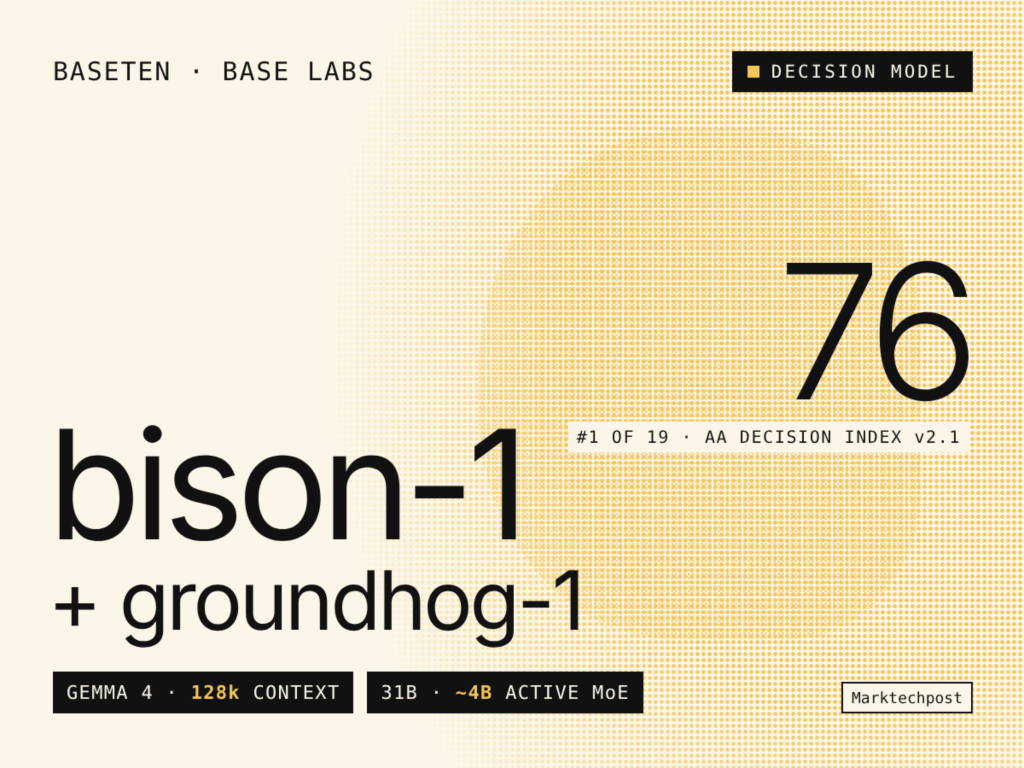
Baseten has released bison-1 and groundhog-1, 2 open-weight decision models built on Google’s Gemma 4. Decision models do not write text. They return calibrated probabilities for yes/no, choice and score questions. The Baseten bison-1 decision model scores 76 on the Artificial Analysis Decision Index v2.1. That ranks #1 of 19. Both models raise context from 16k to 128k tokens and accept images. For routing, triage and guardrail pipelines, that means full policies and histories in one call.
TL;DR
- Size: bison-1 is 31B dense. groundhog-1 is a 26B MoE with about 4B active. Both take 128k tokens (131,072).
- Runs on: Baseten Model APIs, plus open BF16 weights on Hugging Face. No inference GPU or quantized builds are listed. BF16 weights alone are about 62 GB (bison-1) and 52 GB (groundhog-1), by our arithmetic.
- Performance: bison-1 scores 76 on AA Decision Index v2.1, 1 point above Liquid AI’s d1.2-ultra (75).
- Best: When2Call, 98 (rank #1).
- Worst: AA-Omniscience-Decision v1.1, 60 (rank #11).
- Bottom line: Best: top-ranked, best-calibrated decisions (Brier 0.14) over 128k tokens at $0.10 per 1M input tokens. Worst: groundhog-1 has no official index score yet, and every number is self-reported.
What are bison-1 and groundhog-1?
bison-1 is a 31B decision model from Baseten that post-trains Gemma 4 31B to return calibrated probabilities. groundhog-1 is the cheaper sibling. It fine-tunes Gemma 4 26B-A4B, a mixture-of-experts model with about 4B active parameters per token.
Both join Baseten’s existing lineup: mammoth-1 (27B), elephant-1 (9B) and joey-1 (2B). Those 3 sit on Qwen backbones. The new pair is Baseten’s first on what it calls an American backbone.
How does a decision model work?
A request carries 1 state and any number of questions. The state is text, optionally with images. Each question has a type: noul (yes/no), choice (named options) or score (ordered levels).
The model answers every question in a single prefill pass. It returns P(yes), or the chosen option with a probabilities field. No output tokens are generated. Baseten’s earlier launch post lists ticket triage, spam detection, jailbreak guardrails and LLM routing as target tasks.
Requests longer than the trained limit are refused, not truncated. Pipelines that assume silent truncation will need a length check.
Why is bison-1 better calibrated?
Baseten credits two sources: the Gemma base and more “soft labels” in the training mix. Soft labels use probability targets instead of 1 fixed correct answer. The model learns to report uncertainty that tracks how often it is right.
The result is a Brier score of 0.14, the lowest on the index. Baseten puts d1.2-ultra at 0.15. Lower is better.
How does bison-1 score on benchmarks?
On AA Decision Index v2.1, bison-1 scores 76. Liquid AI’s d1.2-ultra scores 75 and mammoth-1 scores 71. The index blends 6 evaluations, led by AA-Paperclip at 30%.
The bison-1 model card breaks out each component:
- When2Call: 98 (#1)
- EvalSafe-O*NET-AA: 93 (#1)
- AA-Symmetry v1.1: 89 (#1)
- AA-Paperclip: 73 (#2)
- HLE-MultiChoice v1.1: 51 (#1)
- AA-Omniscience-Decision v1.1: 60 (#11)
bison-1 ranks first on 4 of 6 components. Knowledge-heavy decisions are its weak spot.
On long context, Baseten reports LongMemEval M (128k) of 84.8 for bison-1 and 77.4 for groundhog-1. LongMemEval S reads 87.1 and 79.3. groundhog-1 has no official index score yet. Baseten expects it to match mammoth-1.
‘});
q(‘#bsn-bars’).innerHTML=h;q(‘#bsn-bnote’).textContent=d.note;
setTimeout(function(){qa(‘#bsn-bars .fl’).forEach(function(f){f.style.width=f.getAttribute(‘data-w’)+’%’})},40);
qa(‘#bsn-seg button’).forEach(function(b){b.classList.toggle(‘on’,b.getAttribute(‘data-b’)===k)});setTimeout(resize,80);}
qa(‘#bsn-seg button’).forEach(function(b){b.addEventListener(‘click’,function(){drawBars(b.getAttribute(‘data-b’))})});
/* calibration */
var lab=’hard’,L={hard:[1,0,0],soft:[0.7,0.2,0.1]},LC={hard:’A hard label says billing is 100% right and the rest are 0%. The model learns to be overconfident.’,soft:’A soft label spreads probability across plausible answers. The model learns to state uncertainty honestly.’};
function setLab(l){lab=l;L[l].forEach(function(v,i){q(‘#b’+i).style.height=(v*100)+’px’;q(‘#d’+i).textContent=Math.round(v*100)+’%’});q(‘#bsn-lcap’).textContent=LC[l];
qa(‘#bsn-lab button’).forEach(function(b){b.classList.toggle(‘on’,b.getAttribute(‘data-l’)===l)})}
qa(‘#bsn-lab button’).forEach(function(b){b.addEventListener(‘click’,function(){setLab(b.getAttribute(‘data-l’))})});
function calBars(){qa(‘.pane[data-p=”cal”] .fl’).forEach(function(f){f.style.width=”0″;setTimeout(function(){f.style.width=f.getAttribute(‘data-w’)+’%’},40)})}
/* lineup */
var M=[[‘joey-1′,’2B’,’Qwen3.5-2B’,’16k’,’$0.01′,’Latency or cost dominates’,0],[‘elephant-1′,’9B’,’Qwen3.5-9B’,’16k’,’$0.035′,’Strong default at low latency’,0],[‘mammoth-1′,’27B’,’Qwen3.5-27B’,’16k’,’$0.10′,’Knowledge-heavy decisions’,0],[‘groundhog-1′,’26B MoE (~4B active)’,’Gemma 4 26B-A4B’,’128k’,’$0.035′,’Long context at low latency and cost’,1],[‘bison-1′,’31B’,’Gemma 4 31B’,’128k’,’$0.10′,’Highest accuracy, long context’,1]];
var lh=””;M.forEach(function(m,i){lh+=’
‘+m[0]+(m[6]?’NEW‘:”)+’
‘+m[1]+’ · ‘+m[4]+’
‘});
q(‘#bsn-line’).innerHTML=lh;
function det(i){var m=M[i];q(‘#bsn-det’).innerHTML=’
Best for (per Baseten)
‘+m[5]+’
‘;
qa(‘.mdl’).forEach(function(b){b.classList.toggle(‘on’,+b.getAttribute(‘data-i’)===i)});setTimeout(resize,60)}
qa(‘.mdl’).forEach(function(b){b.addEventListener(‘click’,function(){det(+b.getAttribute(‘data-i’))})});
det(4);
window.addEventListener(‘load’,resize);window.addEventListener(‘resize’,resize);setTimeout(resize,300);
})();
