


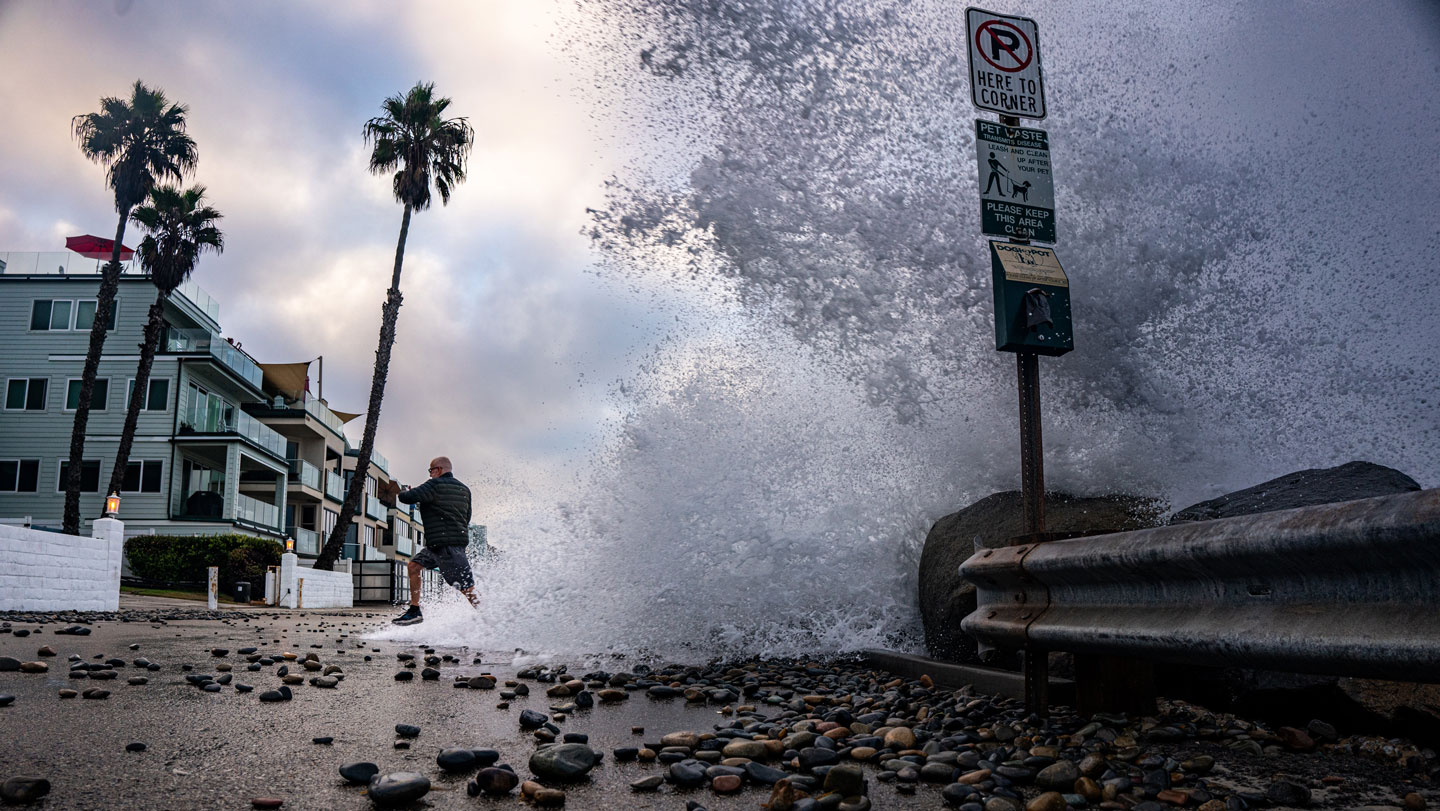
In parts of California, public officials are going door-to-door, warning residents to get ready. The state has strategically stockpiled sandbags, pumps and generators. Debris has been fished out to clear storm drains, seepage blankets shore up aging levees and dams, and wire mesh cages hold back precariously placed boulders.
What is expected to be the strongest El Niño on record is already pounding the state with giant waves. The fury of this year’s El Niño is being unleashed around the globe as well, from inundating Florida with floods to exacerbating drought in the Amazon. And much more is still to come, forecasts show, with the peak of the climate phenomenon expected to arrive between November 2026 and January 2027.
Californians know all too well the threat. El Niño has historically brought relentless rainfall to the state, flooding cities and triggering landslides.
APU GOMES/AFP/Getty Images
State officials learned a lot about preparedness and emergency water management from previous El Niños — particularly the strong event that spanned the winter of 1997–1998. But this year’s event is likely to be even more challenging, a “Super” El Niño superimposed on the backdrop of global climate change.
Climate change has made water management in California more complicated than it was just 30 years ago — as it has elsewhere around the world, says environmental scientist Letitia Grenier, the director of water policy at the Public Policy Institute of California, a nonprofit, nonpartisan think tank based in San Francisco.
In 1997, California’s overall climate was much drier; El Niño brought a big, long rainy season that spanned the state, Grenier says. But now, “it’s just so humid. The air is warmer, so it can hold more water.”
That waterlogged atmosphere means that even without El Niño, there’s been less of a distinct rainy season in California, and more rapid flip-flop between intense episodes of rain dumped on the ground followed by periods of heat and dryness. “It’s these strange, erratic patterns that we’ve never seen before,” she says. And the state is bracing for how the Super El Niño will clash with this new climate normal.
A climate event becomes a household name
1997 was the year that the term “El Niño” shot to global fame. It was the most powerful El Niño in recorded history, and the first to be scientifically monitored in real time, continuously tracked by satellites and breathlessly reported on by news outlets. El Niño’s rise to household name status was even cemented in pop culture by an appearance on Saturday Night Live, in a classic sketch by comedian Chris Farley.
But the event was no laughing matter. It caused global devastation during its brief reign. El Niño events form as westward-blowing trade winds over the eastern tropical Pacific Ocean weaken, allowing warm water to accumulate at the surface. Those waters can then release massive amounts of heat to the atmosphere, altering the position of the Pacific jet stream and helping to disrupt global weather patterns.
In 1997–1998, global temperatures spiked by 1.5 degrees Celsius on average. Along with the torrential rains in California, the event brought brutal drought to Southeast Asia and deadly summer floods to central Europe and Peru. Record-breaking floods also hit East Africa, which in turn triggered a surge in mosquito-borne Rift Valley fever. The oceans were so warm that 16 percent of the world’s reefs died.
In all, the El Niño–related weather extremes were linked to more than 22,000 fatalities around the world, including nearly 200 in the United States, and an estimated $5.7 trillion in global economic losses.
Not every El Niño is equally intense, or impacts weather in quite the same way. “There’s a lot of variability event to event,” says Washington, D.C.–based climate scientist Tom Di Liberto, of the nonprofit climate news organization Climate Central.
But there is a general overall pattern to how El Niño tends to affect weather around the planet, Di Liberto says. For example, there tend to be more tropical cyclones in the Pacific Ocean, and fewer in the Atlantic — a pattern also observed in 2026.
El Niño also tends to flatten and accelerate the Pacific jet stream, shifting its flow southward, says Mike Anderson, California’s state climatologist for the Department of Water Resources, who is based in Sacramento. And that has historically meant that a conveyor belt of back-to-back moisture-loaded storms is set on a collision course with the U.S. West Coast.
Humans bear the cost
The 1997–1998 El Niño revealed just how devastating that pattern could be in California.
As much as 30 centimeters inundated parts of the state during the month of February 1998 alone. Storm winds and high surf pounded the coast, while rivers swelled and overtopped their banks. Flooding from the “Groundhog Day Storm” destroyed some 1,700 homes in Bay Area cities Palo Alto and Menlo Park. On February 6 near Rio Nido, about 100 kilometers from San Francisco, a forested hillside suddenly crumbled, sending a wall of mud rushing down the mountain. It destroyed about 30 homes.

VINCE BUCCI/AFP/Getty Images
Landslides also threatened homes and lives in Southern California.
On February 23, then 25-year-old Jenifer Segraves and her fiancé Glenn Flook were living in an apartment on Laguna Canyon Road, in the city of Laguna Beach. The heavy rains had saturated the neighborhood’s steep hillsides, making the terrain unstable.
“We lived up against a hill in the canyon, so there were stairs up to our apartment,” Segraves says now. “They became like a waterfall. I remember my fiancé carrying me up the stairs because there was so much water.” Segraves called her father, Gary Segraves, in a panic, asking for help. Then, the slope behind the building failed, the apartment flooded and she and Flook fled into the rushing mud.
“We were strong enough to get out, but we were waist-high in mud,” Segraves said. “[My dad] almost drowned getting to us.” All three took shelter at a neighbor’s house, where they showered and hunkered down to wait out the rain.
Around midnight on February 24, the second mudslide arrived.
The neighbor’s “whole house went down,” Segraves says. She escaped through a second-floor window, but her fiancé fell through the floor and was knocked out. He didn’t make it out.
Gary Segraves, meanwhile, was swept down the hillside and landed in a pile of rubble against a rocky cliff. Battered and missing his glasses, he looked around and saw what looked like a doll.
He reached for the little form — and discovered that it was a baby, very cold but alive. Somehow, the 9-month-old had survived being swept out of her crib from a nearby home. The little girl “wouldn’t have survived if he hadn’t picked her up,” Segraves says.
Preparing for a weather whiplash
The havoc wreaked across California by the event 30 years ago cast a stark light on the desperate need to expand waterways, maintain infrastructure and coordinate emergency services, Grenier says. “An engineering system can only work as well as its capacity.”
Much of the state’s infrastructure is deteriorating. An October 13 report by the California state auditor noted that the condition of dams and levees across the state “remains a high-risk issue,” with some 57 dams in the state in poor or unsatisfactory condition. “Poorly maintained dams and levees continue to pose a risk to public safety,” the report said.
California’s water management system was also originally designed specifically to simply shunt excess water away from residential areas, rather than try to capture the water or help it infiltrate into aquifers, Grenier says. But that system worked for a different climate, one that wasn’t so prone to “weather whiplash” — wild, sudden swings between extremely wet and extremely dry conditions.
Alongside punishing, drenching back-to-back storms called atmospheric rivers, the state has also experienced frequent episodes of drought, including two recent severe events, one lasting from 2012 to 2016 and another from 2021 to 2025.
Those years of drought, dwindling snow and pumping too much water from aquifers have dramatically depleted the state’s subsurface water stores. And the heavy rains don’t necessarily help; the torrents of water mostly run off across the surface instead of infiltrating soils to reach the underground aquifer.
Such hydroclimate whiplash isn’t unique to California by any means. It’s a global problem, and it’s becoming more common. A small increase in air temperatures can give a big boost to the atmosphere’s capacity to hold water vapor, increasing that capacity by about 7 percent for every 1 degree C of temperature increase. All of that water vapor has contributed to an increase in extreme precipitation events around the globe since the mid-20th century.
Precipitation is just half of the problem. Rising air temperatures also make the air “thirstier,” causing it to draw even more moisture out of vegetation, soil and surface bodies of water during drier periods — which makes the land more vulnerable to severe drought and wildfire.
It’s now clear that these hydrodynamic shifts have been increasing the frequency of weather whiplash events around the world over the last 75 years or so, scientists reported in 2025. And that whiplash is likely to increase as the world warms more.
El Niño arrives
Months before reaching peak intensity, the 2026–2027 Super El Niño has begun making its presence known. The Amazon is suffering under intense heat and drought, priming the region for wildfires and pushing the forest closer to a worrisome possible fate: a transition from tropical forest to savanna grasslands. Fires have also begun blazing across Southeast Asia, while heavy rains began inundating the Horn of Africa in October. Arriving on the heels of severe drought, that one-two punch could devastate the region’s crops and pasturelands.
In California, the first harbingers of the arrival of the Super El Niño appeared in early September. Heavy surf pounded the coastline. Regions from San Francisco to Los Angeles saw record high tides by late October that flooded city streets and battered coastlines and seawalls, even as the skies remained clear.
The waves were amped up by an unfortunate trifecta: higher sea levels due to climate change; a lunar cycle that exerted its maximum pull on the tides; and an El Niño–linked phenomenon called Kelvin waves.
Kelvin waves are massive, slow-moving swells of warm ocean water, part of the complicated interplay between wind and water that produces the El Niño Southern Oscillation, the overall weather pattern that includes El Niño and counterpart La Niña events, says Josh Willis, an oceanographer at NASA’s Jet Propulsion Laboratory in Pasadena, Calif.
As prevailing west-blowing winds weaken over the tropical eastern Pacific, Willis says, water normally pushed west by the winds instead sloshes back eastward. Kelvin waves have historically given a boost to sea levels along the U.S. West Coast of as much as 30 centimeters. This year, that impact could be larger, researchers reported September 30 in a preprint study posted on EarthArXiv.org. Computer model simulations suggest that the risk of the risk of extreme sea levels could be 10 times higher during this El Niño year than during previous events, for coastlines from Alaska all the way to Chile.
Then, by late October, the Santa Ana winds arrived: Hot, dry gusts blowing down the mountains toward the coast, fanning wildfires in Southern California. The fires scarred the landscape, denuding it of vegetation, roots that helped stabilize and fortify the soil. Such loosened soil is more likely to become mobilized into a debris flow during heavy rains.
Those rains are now on the way. By mid-November, researchers began tracking storms headed for California. The peak of El Niño is expected to arrive by late November or early December and persist through February or March.
Segraves, after surviving nearly 30 years ago, says she is aware that another El Niño is coming. But she hasn’t been following the news closely. She’s placed herself on a news diet since her ordeal. She refused to speak to media for years, or even read the coverage about her own story.
“Everyone wanted to talk to me and I just wanted to be left alone,” she says. Staying away from the news “freed me from all that. It changed my view on life. I take each day as it comes.”
But, she adds, one lesson has stayed with her. “I swore I would never live on a cliff again.”
