


Welcome back to Foreign Policy’s Latin America Brief.
The highlights this week: Three regional presidents travel to China, the United States and Venezuela strike a military deal, and the region weighs fossil fuel phaseout plans at COP31.
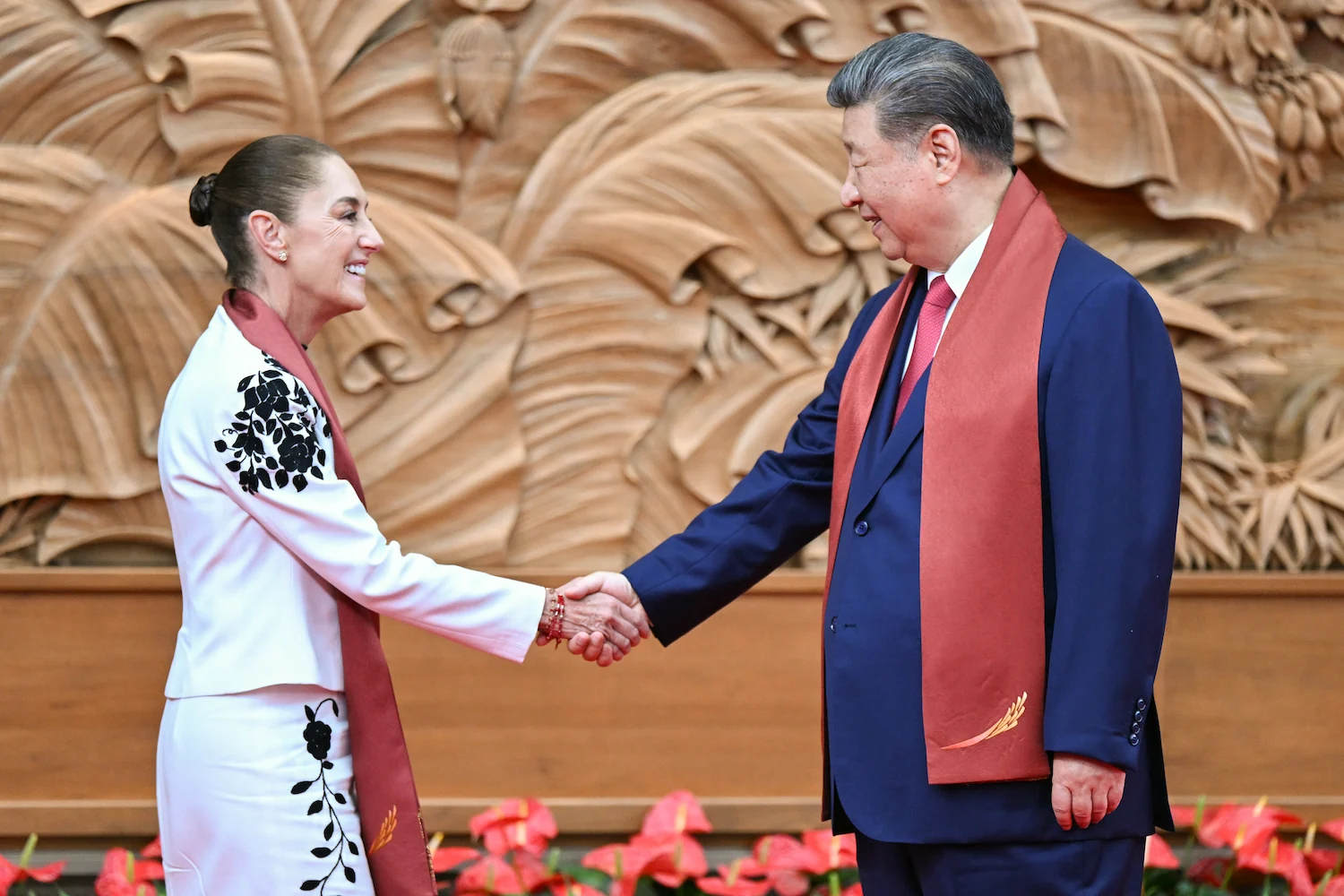
This week, many observers focused on the trilateral meeting among the presidents of China, Russia, and the United States on the sidelines of the Asia-Pacific Economic Cooperation (APEC) summit. Three Latin American presidents were also in Shenzhen, China, for the meetings: those of Chile, Mexico, and Peru.
All six countries are APEC members. Though the bloc’s Latin American leaders don’t always attend the annual summit in person, they did this year—and held separate bilateral meetings with Chinese President Xi Jinping. The 2028 APEC conference, hosted by Mexico, will see Asian leaders travel to Latin America.
In their trips to Shenzhen, the three presidents signaled that they value relations with China despite pressure from the United States to spurn the country.
The U.S. National Security Strategy issued by the Trump administration last year said that allowing “non-Hemispheric competitors” to grow their presence in the Americas was a “strategic mistake.” And the U.S. ambassadors to both Mexico and Peru disparaged China in social media posts this week.
Mexico has applied new tariffs on Chinese goods since U.S. President Donald Trump returned to office, with some as high as 50 percent. But China remains Mexico’s No. 2 trade partner, and Mexican President Claudia Sheinbaum said in Shenzhen that she hoped her trip would yield more Mexican avocado and tequila exports to China and new cooperation on smart hospitals.
For Mexico, “integration with the United States and market access to the United States is priority No. 1,” said Diego Marroquín, a fellow in the Americas program at the Center for Strategic and International Studies. But “they can achieve that and at the same time, they can engage more with China,” he said, especially on issues that aren’t central to U.S. interests.
In more sensitive areas, such as critical infrastructure and telecommunications, Mexico “will most likely accommodate U.S. demands,” Marroquín wrote this week.
Chile has not imposed tariffs on Chinese goods, though it has seen tensions with China flare in other ways. This month, Chile and Belgium jointly challenged a Chinese bid to permanently host the secretariat of the new United Nations High Seas Treaty.
The dispute over hosting rights is still unresolved, and Chilean President José Antonio Kast did not mention it in his bilateral meeting with Xi, according to multiple reports. The two countries announced a new economic cooperation road map without providing specifics. The partnership is potentially promising news for Chile as it experiences a recession.
Peruvian President Keiko Fujimori, meanwhile, walked away with a more concrete commitment from China: a $22.5 million pledge to help Peru deal with the fallout of El Niño. Both countries also celebrated an update to their free trade deal that took effect this month, which officials said could help trade and investment rise by streamlining import- and export-related bureaucracy.
“Our meeting allows us to strengthen relations between Peru and China,” Fujimori wrote on social media after meeting with Xi. The Chinese readout said that Fujimori praised the majority-Chinese-operated port in the Chancay, Peru—an investment that the Trump administration has criticized.
Fujimori, Kast, and Sheinbaum held additional bilateral meetings at APEC. Sheinbaum met with Trump, while all three Latin American presidents sat down with other Asian leaders, including those of Japan; Vietnam; the Philippines, with which Chile signed a free trade agreement; and Thailand, with which Peru did the same.
The meetings show that the three leaders hope to deepen ties not only with China but also more broadly with Asia. They are not alone in their neighborhood: Last weekend, Brazilian President Luiz Inácio Lula da Silva addressed the opening session of the Association of Southeast Asian Nations summit in Manila, Philippines.
These countries’ trade flows are beginning to reflect the presidential trips. To give one example, Mexico’s total goods traded with Japan between January and September of this year was 9 percent higher than over the same period in 2025, according to Mexican government statistics. With Thailand, trade grew by 50 percent, and with Malaysia, by 78 percent.
Friday, Nov. 20: Fujimori meets Japanese Prime Minister Sanae Takaichi in Tokyo.
Monday, Nov. 23, to Friday, Nov. 27: Polish President Karol Nawrocki visits Argentina and Chile.
Thursday, Dec. 3, to Friday, Dec. 4: Uruguay hosts the Mercosur leaders’ summit.
U.S. military deals. Less than a year after removing Venezuela’s president by force, the United States signed a military partnership with the country’s acting leaders on Wednesday. In Caracas to ink the deal, U.S. Defense Secretary Pete Hegseth called Venezuela a “compliant security partner” and said the arrangement would allow both countries to better combat drug gangs.
Former Venezuelan President Hugo Chávez ended Venezuelan military cooperation with the United States in 2005, and his successors in the chavismo movement have used their control over Venezuela’s military apparatus to cling to power and crush dissent.
Rocío San Miguel, a top Venezuelan human rights advocate, told Union Radio that the U.S. partnership could be an opportunity to rein in Venezuela’s military, relegating it to its intended constitutional role.
The Venezuela deal comes as U.S. military cooperation with neighboring Colombia appears to be falling short of Trump’s vision. The New York Times reported on Wednesday that Hegseth altered his travel plans to Colombia this week after the country’s government said it lacked the congressional votes to greenlight U.S. military operations on its soil.
Colombian President Abelardo de la Espriella wrote on social media afterward that he did not reject a specific plan but added that any U.S. military cooperation must follow Colombian law.
Shifting regional affinities. A gathering of Latin America scholars and policymakers in Rio de Janeiro last week highlighted the cross-border integration that is often excluded from headlines about the region. This newsletter writer attended the event, Conversatorio Latinoamericano.
One speaker flagged a recent University of Buenos Aires opinion survey about Argentines’ attitudes on geopolitics. Between 2025 and 2026, Brazil surpassed the United States to top respondents’ answers to two questions: “Which country do you think Argentina should have relations with?” and “Which country do you think Argentina should be like?”
The shift suggests that average Argentines don’t fully embrace President Javier Milei’s pro-Trump pivot—or his chilled relations with Brazil.
Natalia Saltalamacchia Ziccardi of the Mexico Autonomous Institute of Technology said that Brazil and Mexico are turning the page on years of distrust, experiencing a “springtime” of warming ties since around 2024. She cited increased high-level visits, coordination in response to Venezuela’s crisis, and shared support for a Chilean U.N. secretary-general candidate.
These sympathies show that dividing the region into pro- and anti-Trump camps is an oversimplification.
Chilean director Sebastián Lelio, winner of the best foreign language film award for A Fantastic Woman, poses in the press room during the 90th Academy Awards in Hollywood, California, on March 4, 2018.Alberto E. Rodriguez/Getty Images
Chilean cinema pioneer. This month, Chileans are remembering star film director Sebastián Lelio, who died on Nov. 6 at the age of 52. Lelio got his start as part of a wave of indie Chilean filmmaking in the 2000s that focused on small-scale, interpersonal plotlines and was dubbed Novísimo Cine Chileno by critics.
Lelio’s most beloved works include the 2013 film Gloria, which shows the ups and downs of dating as a 58-year-old divorcée in the capital of Santiago, and the 2017 film A Fantastic Woman, which follows a transgender singer dealing with the logistics triggered by the death of her partner—and the prejudice that she faces from his conservative family.
A Fantastic Woman won Chile its first-ever Oscar for best foreign language film and helped pave the way for the passage of a 2018 trans rights law. Though Lelio worked across genres, La Tercera’s Gonzalo Valdivia wrote that he “found his natural habitat in portraits of female characters who don’t give in or apologize.”
Which Latin American country was the first to strike a free trade deal with China?
Colombia
Ecuador
Peru
Chile
The two countries signed the agreement in 2005.

Panamanian Environment Minister Juan Carlos Navarro speaks during a press conference discussing electrification at COP31 in Antalya, Turkey, on Nov. 18. Chris McGrath/Getty Images
The leaders of Antigua and Barbuda, the Bahamas, Barbados, Bolivia, Brazil, St. Lucia, and Venezuela all traveled to this year’s U.N. climate summit in Antalya, Turkey, known as COP31. The conference is due to wrap up on Friday.
COP31 has moved the ball forward on some initiatives from last year’s U.N. climate summit, which Brazil hosted. For example, a planned investment fund that would pay countries to keep tropical forests intact has now raised more than $8 billion, thanks to a new pledge from Canada.
Last week, Brazil published a framework for countries to create national plans for transitioning away from fossil fuels, a topic that generated buzz at last year’s summit but was cut from the final agreement. Its potential inclusion in the COP31 agreement is still being haggled over.
While Brazil has left a big mark on COP31, so too has a previous Latin American government: that of Colombian President Gustavo Petro, who departed in August. Unsatisfied with last year’s event, the Petro administration hosted a new global conference in April that was devoted entirely to quitting fossil fuels, which will see a second edition next year in Tuvalu.
A group of countries that was heavily involved in planning both conferences has also committed to creating a binding treaty on moving away from fossil fuels. Though Colombia has stayed quiet about the fossil fuel treaty initiative under de la Espriella, countries including Guatemala and Panama had joined it by the time that COP31 arrived.
“We are being held hostage by the petroleum mafia,” Panamanian Environment Minister Juan Carlos Navarro said at COP31.
Many Latin American countries are currently led by right-wing leaders who have not styled themselves as climate champions. But they are nevertheless moving forward on an issue that has been proposed as a main outcome of COP31: electrification.
This year, Brazil is on track to more than double the number of electric vehicles, or EVs, sold since last year, while Mexico’s EV sales are up by more than 25 percent. Countries across the region are planning large-scale battery storage build-outs to support larger electric grids.
The attractive price of green energy—and its insulation from global price shocks—is keeping the region’s green transition gradually moving forward.
