


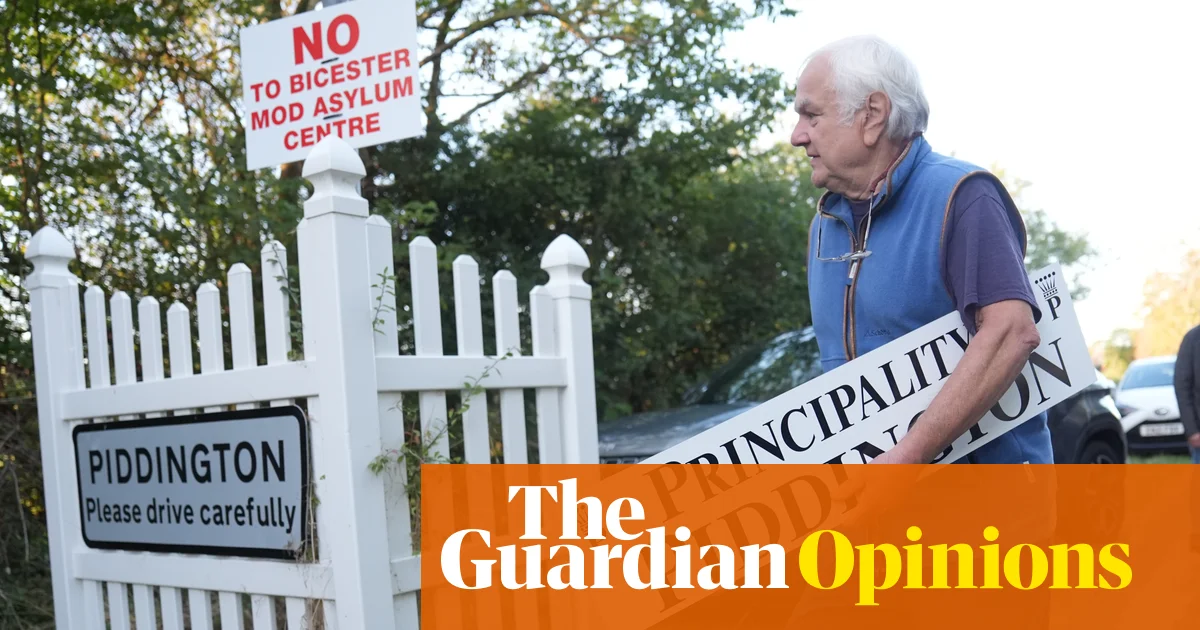
Poor Piddington. The Oxfordshire village of just 350 people was told last week by the communities secretary, Angela Rayner, that it must almost quadruple in size. That wasn’t all. The newcomers would be 1,250 young asylum seekers, mainly from Afghanistan and Eritrea, victims of Britain’s chaotic asylum appeal system. They will be housed in former military cabins on the village’s outskirts. Rayner said that this was an “urgent crown development”, which allowed her to ignore local objections.
And there had certainly been objections. In September, Piddington villagers declared they were fed up with Britain. Led by their parish council and on a 92% turnout, they voted overwhelmingly to leave the UK and become a “principality”. They are joined in their protest by Barnham in Suffolk, where locals have been told this week that they are to host nearly 1,000 asylum seekers. They have set their own date on a referendum to leave the UK.
These gestures may be ridiculed as “passports to Pimlico”, but they reflect a deadly and earnest predicament. An emergency Commons debate last month heard the immigration minister, Anna Turley, proclaim Piddington’s fate as “in the national interest”. It would help stop the need for asylum hotels in the middle of towns and cities at a cost rising to billions.
But shouldn’t these villagers have a say? In the planning policy framework introduced by David Cameron’s government in 2012, communities were invited to prepare “neighbourhood development plans”. But from day one, central government treated these as mere wishlists. Delivery targets were progressively introduced that overruled local planning control, none more radical than Labour’s “growth targets” in 2024.
Prime ministers of both parties have drawn up housebuilding targets for every English locality. Councils, it was suggested, should disregard labels such as green belts or areas of outstanding natural beauty when planning where to build. This was despite independent surveys constantly protesting that the national target of 1.5m new homes could already be met within existing built-up areas, with two thirds of sites already with planning permissions. The reality is that private developers make more money building in the country – and the government is in thrall to them. The name of the game is profit.
Hence the imposition from government now witnessed in small towns and villages across England’s south and midlands. Last year, Moreton-in-Marsh in Gloucestershire was ordered to double in size. In a poll, 96% of local people protested, but to no avail. The town is now a gallery of housing horror, encased on all sides by bland private estates. No attempt has been made to build in a village style, let alone fuse estates with the rural landscape. All that matters is the number of houses. Southern England is seeing a repeat of the suburban sprawl over London’s home counties between the wars.
What is stark is the total impotence of local people to play any part in combating this assault. Soon after taking office, Keir Starmer was insulting villagers as “blockers and Nimbys”, as if defending one’s environment was a crime. Andy Burnham then upped the ante by removing powers to block rural development from local planning committees.
This disempowerment is inconceivable in other European countries. In France, Germany, Switzerland or Scandinavia, local communities enjoy sovereignty over their future. They call it democracy. France’s 35,000 communes build plenty of houses, but they grow organically, not by an invasion of “volume builders” whipped on by central government.
The status of small communities is not a quaint archaism. The English village is a valued social construct. Its institutions are the school, the church, the pub and the youth club. Its lifeblood is the high street. Such an informal cohesion of the neighbourhood came to life during the Covid-19 pandemic. It supplied mutual help in time of trouble. It was a salve to loneliness.
after newsletter promotion
Rural parish councils need to be granted powers over their future like those enjoyed by similar communities abroad, notably in planning. But such councils are needed in cities, too. In 2007, Tony Blair’s government boldly attempted to extend parishes from rural to urban areas. Apart from one council created in London’s Queen’s Park, the attempt was snuffed out by Whitehall.
Everywhere should be a parish. The case is overwhelming for the liberation of the village and its inhabitants. Piddington has shown the way.
