



Data centers and increased energy costs brought attention to typically low-profile utility commission races in states across the country during this year’s midterms.
Nine states, all historically Republican, held elections for their utility regulators this year. Democrats won five of the 15 contested seats, flipping four Republican-held seats and retaining one, while Republicans won 10 seats, including one flipped from a Democrat in Louisiana.
Every state has a commission responsible for regulating its utilities, with authority over decisions that affect how electricity is generated, delivered and priced. Most are called Public Service Commissions (PSCs) or Public Utility Commissions (PUCs), and their structures vary. Some have three members, others five or seven. In most states commissioners are appointed officials, while in 10 states they are elected in partisan races.
In this election cycle, the biggest shifts occurred in Georgia and Arizona, where Democrats made historic gains. In Georgia, they won control of the PSC for the first time in 30 years, while in Arizona, they ended Republicans’ 5-0 hold on their commission. Both states have seen a surge in data center development, bringing new scrutiny to electricity costs and how to meet growing energy demand.
In Georgia, Democrats Shelia Edwards won her first PSC election while Peter Hubbard was reelected to his first full term, an early endorsement of the job he did his rookie year as commissioner. Joined by Commissioner Alicia Johnson, who won a seat last year, Democrats now hold a 3-2 majority on a commission that was entirely Republican just two years ago.
In Arizona, Clara Pratte and Jonathon Hill won the first Democratic seats on the commission since 2020.
Pratte also became the first Indigenous woman elected to statewide office in Arizona, bringing a unique perspective and set of goals to the utility regulator.
“We’re the sunniest state in the union; we could be generating a lot of our own solar rather than relying on fossil fuels,” Pratte said. “We need to be collaborative, and reach across the aisle to help Arizonans.”
Pratte noted that in addition to fossil fuel reliance, energy costs and transparency among utilities were key issues in the state. She also hopes to make meetings more accessible for the Navajo Nation.
Of the nine states to hold elections this year, Georgia and Arizona have experienced the most data center development. All four of the elected Democrats promised increased scrutiny for data centers, ensuring they pay their fair share of energy costs and preventing unchecked expansion.
“I think data centers definitely played a role in Democrats’ success in Arizona and Georgia,” said Jared Heern, a political scientist at Connecticut College who studies utility commission politics across the country.
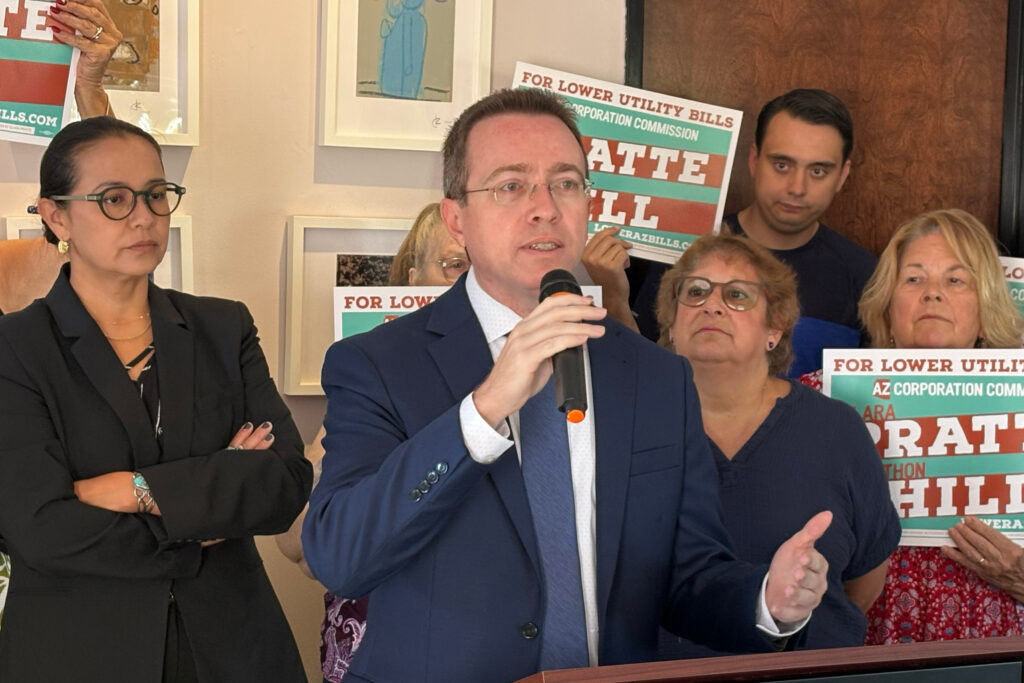
Democrats Clara Pratte and Jonathon Hill speak at a press conference calling on the Arizona Corporation Commission to launch an investigation into how data centers are increasing utility bills for Arizona Power Service customers. Credit: Wyatt Myskow/Inside Climate News
In Arizona, concerns about data centers’ water use likely played a particularly large role, according to Heern. Hill, a scientist, campaigned on protecting natural resources, including water, an increasingly prominent issue amid concerns over the Colorado River’s declining supply.
“Incumbents who got booted out in those states can be directly tied to data center development,” Heern said. Utility commissioners have the ability to shape how data centers are powered and who pays for the infrastructure needed to serve them.
Hill and Pratte defeated incumbent Kevin Thompson in the statewide, at-large election for two commission seats.Thompson owns a consulting firm and acknowledged having a data center client.
Outside spending across the two states topped $7 million. In Arizona, Democrats received the most support, largely from a PAC called Arizonans for Affordable Energy. In Georgia, Republicans received the most outside support, much of it from a group called Powering Georgia’s Future, which supports “pro-growth” policies and a stronger industrial base. Spending in Georgia reached a record high for its PSC election.
Activists and energy watchdogs also played a big role in the elections, helping raise awareness of the little-known regulatory bodies. Grassroots groups like Georgians for Affordable Energy ran social media campaigns and distributed flyers, while national groups like the Sierra Club endorsed the Democratic candidates in Georgia and Arizona and educated members on the stakes of utility commission elections.
“The increased awareness of these bodies over the past few years has translated into frustration and anger as the public sees they are not doing their job,” said David Rogers, deputy director of the Beyond Coal Campaign at the Sierra Club. ”I think that’s what really showed up at the polls.”
While Democrats’ biggest victories came in Georgia and Arizona, they also picked up a seat in Nebraska. Former state Sen. Wendy DeBoer won Nebraska’s 2nd District, which includes Omaha, by more than 30 points, breaking Republicans’ single-party hold on the state’s PSC. DeBoer campaigned on modernizing the state’s infrastructure.
But despite Democratic gains in those red states, Republicans held onto control of eight of the nine commissions that held elections. They also flipped a historically Democratic seat in Louisiana.
This story is funded by readers like you.
Our nonprofit newsroom provides award-winning climate coverage free of charge and advertising. We rely on donations from readers like you to keep going. Please donate now to support our work.
The funding gap between Republicans and Democrats in Louisiana’s two PSC races was substantial, and likely played a significant role in the outcome, according to Heern. Republican candidates raised a combined $1.26 million, compared with less than $40,000 for the two Democratic candidates, according to campaign finance filings from late September.
Louisiana is one of six states that allow regulated utilities to contribute directly to candidates for utility commission seats. Both Democratic candidates refused utility contributions, while Republican Stephanie Hilferty accepted substantial donations from companies and executives connected to utilities she will now regulate. Republican John Atkins, who won the other seat, also pledged not to accept contributions from regulated utilities.
Hilferty did not respond to requests for comment.
In the other five states that held elections—South Dakota, North Dakota, Oklahoma, Alabama and Montana—Democrats failed to pick up a single seat in the deep-red states. But that does not mean voters weren’t interested in energy affordability.
In Alabama, voters clearly sought change amid high electricity prices, even though Democrats didn’t gain any seats on the state’s Public Service Commission. The two incumbent Republican commissioners on the ballot this year lost in their party’s primary, and the commission will undergo even more dramatic changes thanks to sweeping utility legislation passed in April.
The Alabama PSC will expand from three members to seven, including the first two Black commissioners in state history appointed by outgoing Gov. Kay Ivey.
Governor-elect Tommy Tuberville will also select Alabama’s first secretary of energy, a new cabinet-level position that will oversee the commission, set its agenda and give the governor a much larger and more direct role in regulating utilities.
For states that do not elect utility commissioners, the midterms still mattered. Governors or state legislatures appoint commissioners in those states. Democrats flipped governorships and legislatures across the country, giving them more influence over appointments in states like Texas, where the governor appoints all five members of the Public Utility Commission.
“That’s obviously a much slower process decided when seats open up,” Heern said. ”But even though the public didn’t get to directly vote on commissioners, seeing how their midterm votes will translate into new commissions is important to watch.”
In Georgia, a new majority will allow Democratic commissioners to leave an immediate mark, pursuing campaign promises, improving transparency, scrutinizing data center deals and limiting rate increases as much as possible. But even in states where they made partial gains, their performance was not insignificant, according to Heern and consumer and environmental advocacy groups.
In Arizona and Nebraska, breaking up unanimous Republican majorities will give Democrats a greater voice in commission decisions and more opportunity to challenge existing policies.
“Regardless of who won and where, one thing is abundantly clear: People are struggling to meet their basic needs, including electricity,” said Rogers. ”The candidates who won promised to address these issues and we expect them to keep their word.”
Staff writer Dennis Pillion contributed to this article.
About This Story
Perhaps you noticed: This story, like all the news we publish, is free to read. That’s because Inside Climate News is a 501c3 nonprofit organization. We do not charge a subscription fee, lock our news behind a paywall, or clutter our website with ads. We make our news on climate and the environment freely available to you and anyone who wants it.
That’s not all. We also share our news for free with scores of other media organizations around the country. Many of them can’t afford to do environmental journalism of their own. We’ve built bureaus from coast to coast to report local stories, collaborate with local newsrooms and co-publish articles so that this vital work is shared as widely as possible.
Two of us launched ICN in 2007. Six years later we earned a Pulitzer Prize for National Reporting, and now we run the oldest and largest dedicated climate newsroom in the nation. We tell the story in all its complexity. We hold polluters accountable. We expose environmental injustice. We debunk misinformation. We scrutinize solutions and inspire action.
Donations from readers like you fund every aspect of what we do. If you don’t already, will you support our ongoing work, our reporting on the biggest crisis facing our planet, and help us reach even more readers in more places?
Please take a moment to make a tax-deductible donation. Every one of them makes a difference.
Thank you,

Contributor
Ryan Krugman is a recent graduate of Columbia University’s Climate School focusing on climate change reporting and communications. He also holds a Bachelor’s degree from St. Lawrence University where he studied Environmental Science and Sociology. As a former Inside Climate News fellow, he is now reporting on climate and environmental issues in New England and Georgia.
