


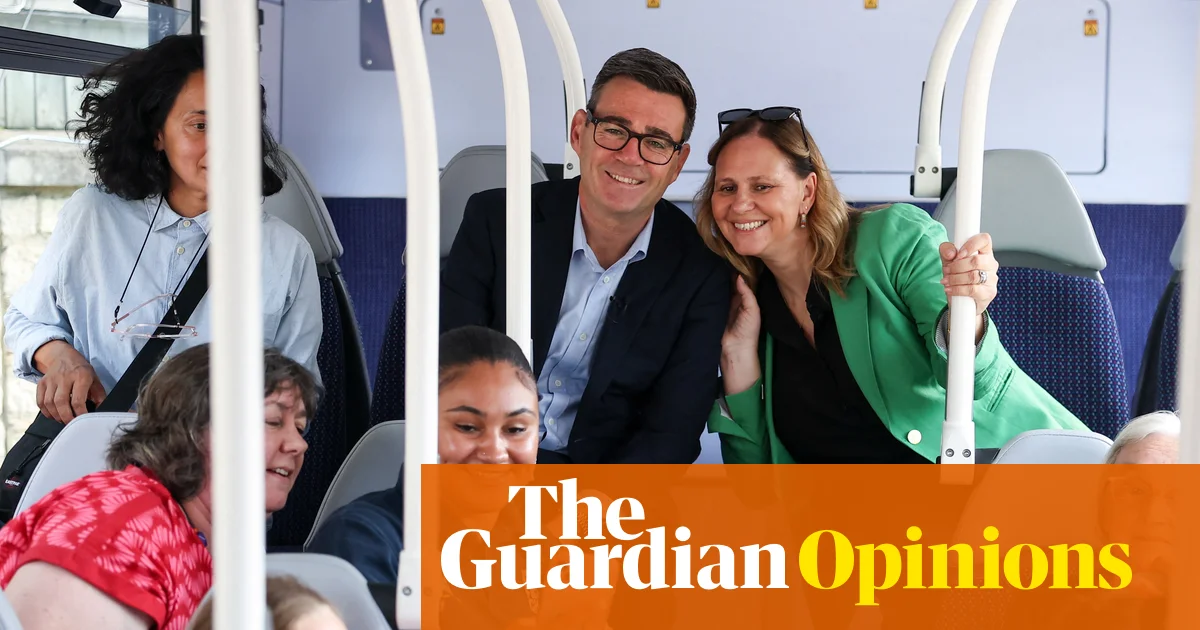
One of Andy Burnham’s first policy moves brought back a sharp memory. On Wednesday, he announced that single bus fares across England would be capped at £2, starting from January. It was part of a series of small, practical measures designed, said the new prime minister, to offer a little “breathing space” to a hard-pressed public, but this was the one that registered with me most. That’s because it echoed the first time I ever experienced a specific public policy that I realised affected me directly.
It was in the autumn of 1981 when the newly elected Greater London Council, led by Labour’s Ken Livingstone, slashed bus fares in the city. The headline-grabber was a new, short-hop fare of only 10p. I was 14 years old at the time, so for me it was even better: all child tickets were reduced to 5p. They called the scheme Fares Fair.
It became a legal and political battle – Margaret Thatcher’s government objected to the extra local tax levied on Londoners to pay for it – and eventually Fares Fair was declared illegal and shut down. But I never forgot it and nor, I suspect, did many of the residents of the capital who would make Livingstone London’s first elected mayor nearly 20 years later.
Fares Fair had what no one at the time called cut-through. It was a simple, clear offer to voters that had a direct, positive impact on their lives, one they would remember long after bigger, grander strategies had been lost to oblivion. It worked because politics is, in part, a retail business.
Burnham’s first week as PM, and his tenure as mayor of Greater Manchester, suggest he understands that very well. Yes, there can be grand talk of ending a 40-year model of political centralisation and economic privatisation, but you also need to do something for voters that is immediate, tangible and uncomplicated. Everyone understands a lower energy bill or, indeed, a cheaper bus fare.
Kemi Badenoch’s response to these first moves of Burnham’s was unintentionally revealing. They were too unambitious, the Conservative leader said, amounting to “small answers to big problems”. As she put it: “He is not the mayor of Manchester. These are mayor of Manchester ideas. Where is our prime minister?”
Obviously, it’s daft to deliver a verdict on an administration a few days old, not least when Burnham has said that bigger decisions are coming, including a 10-year plan for the country to be unveiled in the autumn. But the language of her dismissal was telling, and not only because it confirms that she does not grasp the retail dimension of politics or its value.
She associates such things with the municipal realm and therefore sees them as insufficient and unserious: they are mere “mayor of Manchester ideas”. It’s true that municipal leaders often do retail well. Several of them made their name that way – think Rudy Giuliani, before his disgrace, and his “broken windows” policing strategy that cracked down on relatively minor offences, whether a stolen bike or a snatched handbag. That’s in the nature of a local politician’s job. They’re closer to the ground than national governments, able to improve voters’ immediate circumstances directly. But Badenoch is wrong to see that as a weakness: for a politician, it’s a strength.
For national leaders, envious of that municipal impact, there are two possible responses. One option is to think retail, even when operating on the largest scale. Harold Wilson named as his greatest achievement the Open University, a simple idea that made higher education available to those who’d been denied it. Thatcher defined an era by allowing council house tenants the right to buy their homes. Or consider the ultimate retail offer – the guarantee of free medical care – in the form of what went on to become Britain’s most cherished institution, the National Health Service.
The other option is for a government not to emulate the municipal so much as to empower it. This seems to be the animating project of Burnham government, embodied by his No 10 North plan to decentralise the running of the country. Opening the new site in Manchester on Friday, the PM described it as “the best day of my life”.
Burnham’s view is that the key to Britain’s future is allowing more and more places to repeat Manchester’s experience. As he wrote in the Guardian: “We built a city-region with twice the economic growth of anywhere else in the UK. What we did in Greater Manchester, we can do across the nation.” What Badenoch meant as an insult, Burnham regards as a badge of honour: these are indeed “mayor of Manchester ideas”.
The core belief is that devolution, giving more powers to cities and regions, is Britain’s best shot at grabbing the prize that has proved so elusive for so long: economic growth. A new paper from the Harvard Kennedy School and King’s College London, authored by Ed Balls and others, argues that Britain’s national productivity problem is a function of its “persistent regional productivity problem”, with the divide between the south-east and the rest leading to “productivity gaps wider than between east and west Germany”.
after newsletter promotion
It argues that Keir Starmer’s government talked a good game on devolution but didn’t match words with deeds – and says this has been the story of British governance for decades. The Harvard-Kings team did 95 hour-long interviews, including with 10 former prime ministers or chancellors, and found not only a Whitehall machine reluctant to let go, but politicians failing to act boldly enough, early enough. John Major, Tony Blair and George Osborne all spoke of their regret that they did not push regional growth from the start, when they had the political capital to do so.
This time, it could be different. At long last there is, simultaneously, a devolution true believer in No 10 and allies in both No 11 and the key Whitehall department. As Balls puts it, the combination of Burnham, John Healey and Angela Rayner makes this “the best moment we have ever had on this agenda”.
Badenoch is not the only one grumbling that Burnham’s opening days have offered small beer. Even some Labour voices have wondered when they will see the equivalent of Gordon Brown’s 1997 granting of independence to the Bank of England or windfall tax on the privatised utilities, both of which came in week one. That fails to take account of the obstacles that stand in Burnham’s path: he has to find many billions to fund increased spending on defence, social care and much else, and yet is hemmed in by a 2024 manifesto that blocks off the most obvious routes to raising the cash.
But those grumbling may also be missing what is right in front of them. A rebalancing of British power is shaping up to be the big-ticket item of the Burnham government. If it works, it will unleash myriad policy moves as yet unimagined across the country, bringing the growth that is the prerequisite for all else. And, who knows, it might even improve the life of a teenager somehow and somewhere – one who will never forget it.
