


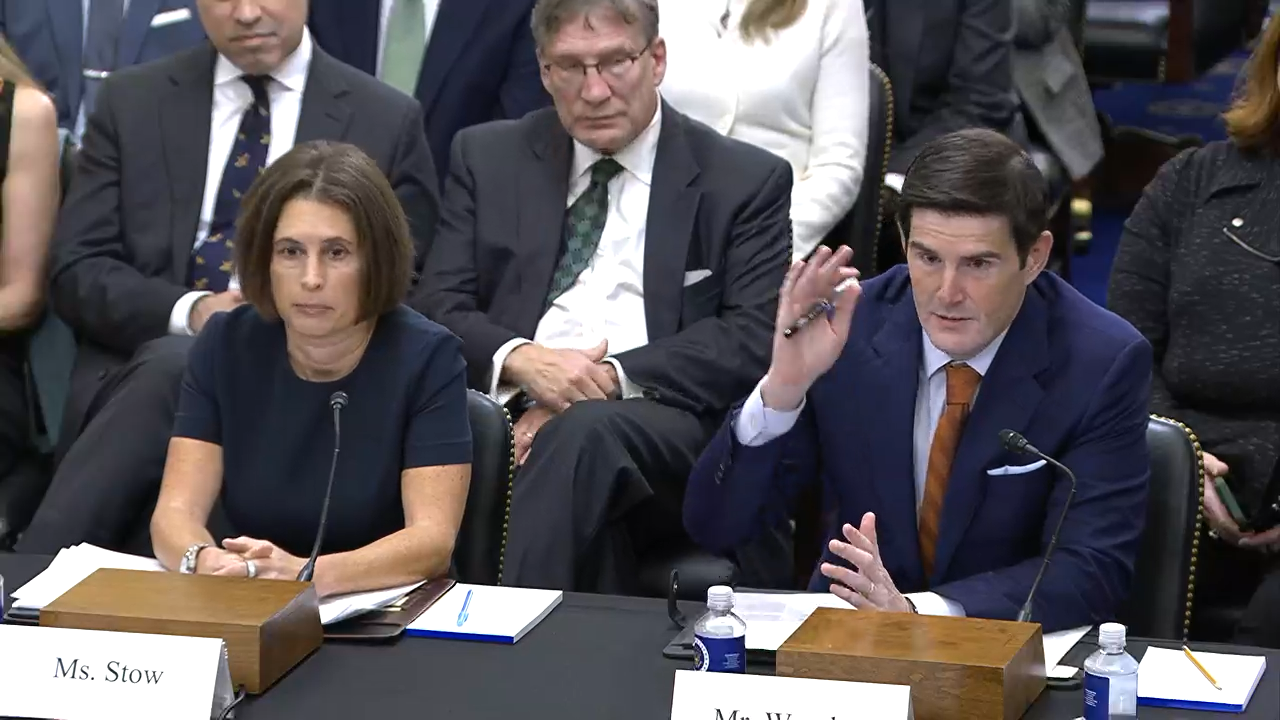
FEC nominees Ashley Stow and Andrew Woodson appeared before the Senate Rules Committee on Tuesday. (Screenshot of Senate Rules and Administration Committee video)
The Senate Rules and Administration Committee heard from President Donald Trump’s two nominees to the Federal Election Commission at a hearing on Tuesday – the next step in restoring the agency’s ability to perform its key duties.
If nominees Ashley Stow and Andrew Woodson are confirmed, the FEC would have four commissioners – enough to constitute a quorum for the first time since April 2025. Without a quorum, the FEC has been unable to make or amend rules, vote on investigations, conduct audits, issue advisory guidance, or impose punishments for election law violators.
The committee has not yet set a date for voting on the nominations.
Congress established the FEC as an independent, bipartisan federal agency in 1975. The commission is responsible for administering and enforcing campaign finance law and ensuring public disclosure of campaign finance activity. The FEC has seats for six commissioners, no more than three of whom can be members of the same political party.
The FEC last had six commissioners in January 2025, just before Republican Sean Cooksey resigned. Shortly after, Trump removed the Democratic chair, Ellen Weintraub, in a move she contended was illegal, and in April 2025, Republican Allen Dickerson resigned. Finally, in October 2025, Republican Trey Trainor resigned, leaving the commission with just two members – Democrats Shana Broussard and Dara Lindenbaum.
Although the commission has continued to operate since losing its quorum, it is unable to “fully achieve its mission,” Broussard, who currently serves as chair, wrote in an April statement.
Ten former Republican commissioners sent a letter Nov. 5 urging Senate Majority Leader John Thune (R-S.D.) to confirm Stow and Woodson before the new Democratic majority takes control, as Trump’s nominations could otherwise “be thwarted indefinitely.”
“Republicans have long defended the FEC’s bipartisan structure because it prevents either political party from exercising biased control over federal campaign-finance regulation and enforcement,” the commissioners wrote. “But that structure protects against partisan administration only when the Commission has a bipartisan quorum.”
Who are Trump’s nominees to the FEC?
Stow has worked at the FEC since 2020, serving as an executive assistant and counsel to two former commissioners.
Before joining the agency, Stow worked at 2652 Group, a law firm focused on campaign finance and nonprofit law. It has provided election-related services for the Republican National Committee and the super PAC that supported Florida Gov. Ron DeSantis’ run for the GOP presidential nomination in 2024, among others.
Earlier in her career, Stow worked as general counsel for the Koch family’s network of political nonprofits and super PACs, at the time called Freedom Partners Non-Profit Network Organizations. The network has since been renamed Stand Together. Its affiliated super PAC, Americans for Prosperity Action, was the seventh-largest outside spender of this election cycle, expending tens of millions on behalf of Republican candidates for Senate.
Woodson currently works as a partner at Wiley Rein, a Washington, D.C. law firm, where he counsels political candidates, officeholders, corporations and super PACs on compliance with campaign finance and lobbying laws.
Wiley Rein primarily counsels Republican super PACs and committees, according to FEC disbursement records. During the 2026 election cycle, the firm’s top clients were the Republican National Committee, the National Republican Congressional Committee, the National Republican Senatorial Committees and Leading the Future, a super PAC backed by the AI industry.
Woodson briefly left Wiley Rein in 2013 to serve as counsel to former Republican FEC Chairman Lee Goodman, before returning to the firm in 2015.
Nominees commit to bipartisan conduct at hearing
Sen. Bill Hagerty (R-Tenn.), who led the hearing in the absence of Chairman Mitch McConnell (R-Ky.), introduced the nominees as “well-regarded in the election law community.”
Sen. Alex Padilla (D-Calif.), the committee’s ranking member, emphasized in his opening statement the need to restore regulatory power to the FEC in the aftermath of the 2026 midterms and before the 2028 elections.
“Since the quorum was lost, both Republican and Democratic campaigns were unable to obtain guidance during the most expensive midterm elections in our history,” Padilla said. “The public, too, was left unprotected from unscrupulous campaign finance practices.”
The nominees both said they support the bipartisan structure of the FEC.
“Unique to the FEC is not just its bipartisan composition, but more specifically, the requirement that any enforcement matter be undertaken only upon the vote of a bipartisan majority of the commission,” Stow said. “This framework ensures that the agency cannot be weaponized by one party against another, which, in turn, fosters public trust in the agency’s execution of its mission.”
Stow said there is “much work to be done” if she and Woodson are confirmed, noting that the enforcement docket backlog stands at over 300 matters.
Woodson said that, if he is confirmed, he would be guided by a commitment to impartiality, responsiveness, clarity and collaboration.
“I look forward to working with my fellow commissioners and agency staff to reach common substantive ground wherever possible,” Woodson said. “But even where we disagree on policy, the American people expect a unified agency that stewards taxpayer resources responsibly.”
During the questioning period, Padilla pushed Stow and Woodson on issues related to Trump. Padilla quoted Trump saying he “controls MAGA Inc. and its spending,” asking if it is legal for a federal officeholder to control and direct a super PAC.
Stow and Woodson both said they could not comment because it’s an issue that could potentially come before them as commissioners. The Federal Election Campaign Act states that a federal office holder may not solicit, direct or spend money in connection with a federal election.
Padilla also asked Woodson if the FEC could enforce limits on PAC contributions by the owners of companies that contract with the federal government, such as Elon Musk and SpaceX. Woodson said the current ban on PAC contributions by federal contractors does not cover individuals, and Congress would need to take action to change that.
In his closing statement, Padilla expressed “disappointment” in Stow and Woodson’s answers to his questions.
“Let me just register, for the record, my disappointment in your failure to acknowledge clear federal law as it pertains to a federal elected official controlling super PAC money, in addition to claiming an inability to rein in the owners of companies who are significant federal contractors,” Padilla said.
