


This article is for students.
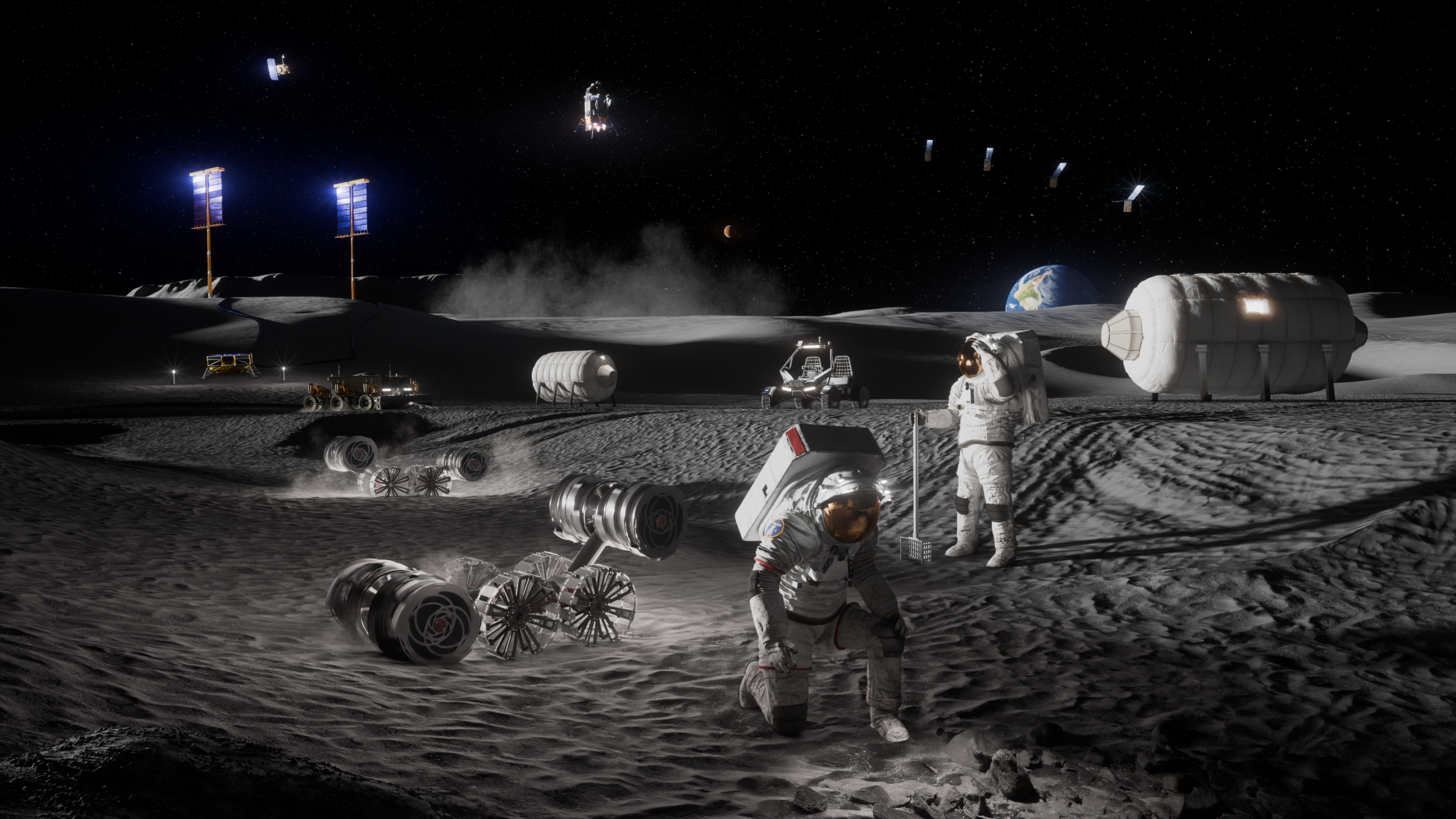
NASA is returning astronauts to the Moon – and this time they will spend more time on the lunar surface. The Moon Base is humanity’s first lunar outpost. It will be a place where astronauts live, work, and explore.
______________________________________________________________________
Words to Know
outpost: a station or base located in a remote, distant place
infrastructure: the basic framework and systems that make up a larger building or organization
terrain: the physical features, shape, and layout of the surface of a piece of land, including its slope and elevation
regolith: the layer of loose, fragmented rock and mineral dust covering most of the lunar surface
______________________________________________________________________
The Moon Base will be built in the lunar South Pole region. This area was selected for its unique lighting conditions and potential for scientific discovery.
Near the lunar South Pole, the Sun stays low on the horizon. Some areas can receive extended periods of sunlight. Other areas stay in shadows for long periods of time. In some craters, sunlight may never reach the surface at all.
Areas that receive extended sunlight could be good for generating solar power. Longer sunlight hours are also good for navigating and exploring. Areas that remain in shadows are some of the coldest areas on the Moon. In these locations, scientists hope to find deposits of frozen water ice.
The Moon Base will be constructed in three phases. Each phase will build on what is learned along the way.
Phase One is taking place right now. Over the next few years, NASA and its partners will send robotic missions to explore the lunar South Pole region. They will test new technologies and practice landing on the Moon. This phase will include multiple different landers and lunar terrain vehicles. These missions will conduct science experiments and look for the best locations for building the Moon Base.
Phase Two is planned for 2029-2032. During this period, NASA will begin setting up long-term infrastructure. This includes things like power systems, cargo transportation, and communications hardware. These components will be set up across multiple locations. This will allow for future expansion of the Moon Base.
During Phase Three, NASA will begin assembling a permanent lunar outpost. This is where astronauts will be able to live and work for extended periods. Habitats, power and communication systems, and transportation will all come together to grow Moon Base.
Crewed and robotic lunar rovers will play an important role in the development of the Moon Base. These rovers will test out technologies, transport astronauts, map terrain, and more. Let’s learn about a few of the rovers being built as part of the Moon Base.
NASA’s VIPER (Volatiles Investigating Polar Exploration Rover) is fully built. It is being tested at NASA’s Johnson Space Center in Houston. In 2027, it will launch to the Moon from NASA’s Kennedy Space Center in Florida. Its mission will be to explore permanently shadowed craters to look for water and other resources. It will travel more than 15 miles, collecting data and analyzing the lunar soil.
NASA’s PROMISE (Polar Rover for Observation, Mapping, and In-Situ Exploration) is a nuclear-powered rover. It is being built from existing hardware that was created for NASA’s Mars rover missions. PROMISE will look for resources – like potential water ice – on and below the lunar surface. It will carry multiple science instruments, including several that are also on VIPER. The mission is targeted to launch by late 2028.
Lunar terrain vehicles (LTVs) will launch to the lunar South Pole region by 2028. These crewed vehicles will be driven by astronauts during missions to the Moon. This will allow the crew to explore larger areas and gather geology samples. When astronauts are not on the Moon, the LTVs will be remotely operated from Earth. They will map the lunar surface and collect data about the extreme environment in the region.
In addition to rovers, NASA’s MoonFall mission will send a group of propulsive drones to the Moon. They will land near the lunar South Pole by 2028. The drones will descend to the lunar surface independently. They will operate separately over the course of a single lunar day (about 14 Earth days). They will use high-definition cameras to map hard-to-reach terrain. This data will help NASA select potential Artemis landing sites.
The lunar South Pole region is an extreme environment. The Moon doesn’t have any noticeable atmosphere. This means temperatures can reach more than 130°F (54°C) in sunlit areas. And it can be as cold as -334°F (-203°C) inside permanently shadowed craters. This can be very dangerous for astronauts. But it is also a challenge for designing infrastructure and hardware.
Navigating the uneven lunar surface can be difficult. The South Pole region of the Moon has steep slopes, ridges, rocks, and deep craters. Shackleton Crater is more than twice as deep as the Grand Canyon. Detailed mapping and robotic exploration will help NASA identify safe landing areas and plan routes for astronauts and rovers.
The lunar surface is covered with regolith. This layer of rocky material is the result of meteoroid impacts. Since there is no wind or rain to cause erosion on the lunar surface, regolith particles have sharp edges. This means regolith can quickly wear down spacesuits and equipment. It can be particularly irritating to skin and dangerous if inhaled. Precautions must be taken to keep regolith and lunar dust out of areas where astronauts live.
The Moon Base is an important step in learning how to live and work on another world. What we learn on the lunar surface by testing new landing techniques, construction methods, and exploration technologies will help prepare for human missions to Mars.
Here are a few examples of the careers that are making NASA’s Moon Base plans possible:
Space tire engineer: The rovers being designed as part of the Moon Base need to have special tires. Engineers must consider the lack of atmosphere, extreme temperature, and rocky terrain when designing tires to drive long distances on the Moon. A career in engineering demands a strong understanding of math and complex problem-solving. An advanced college degree is usually required. Click here to see a space tire engineer in action.
Exploration geologist: These scientists study rocks and minerals on Earth and throughout the solar system. They look at geological processes to see how erosion and harsh environments can change terrain. For Moon Base, they’re helping to select locations to explore on the lunar surface. And they’re helping train the astronauts who will land and gather samples. This career requires strong observational skills and usually requires an advanced college degree. Click here to see what it’s like being an exploration geologist at NASA.
Manufacturing technician: Turning designs into reality takes skilled technicians. Fabrication and assembly of robotic equipment and spacecraft parts requires precise calculations. Being able to follow intricate instructions is key. Trade school training and skills such as operating forklifts and heavy machinery may be required.
Instrument technician: These experts install, calibrate, and maintain sensors and control systems. They troubleshoot issues that might come up with delicate systems and equipment. This career path often starts with an apprenticeship or hands-on training alongside experienced technicians. An associate’s degree is often required. Click here to see some of the testing completed on one of the Moon Base landers.
Moon Base Website
Houston We Have a Podcast Episode: The Moon Base
Moon Base Learning Resources
NASA Moon Base Video Playlist
What is Lunar Regolith?
