


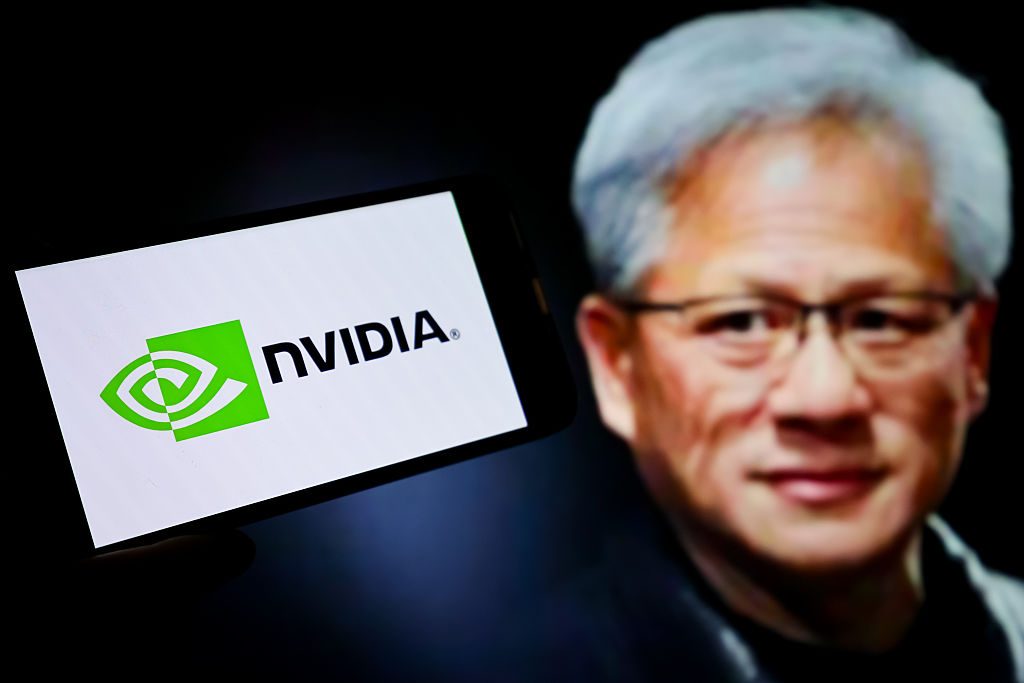
Nvidia co-founder Jensen Huang resigned as CEO on Nov. 12. (Photo by VCG/VCG via Getty Images)
As Nvidia grapples with the fallout from the resignation of its CEO and co-founder amid an espionage scandal, federal records show the chipmaker had been steadily expanding its influence in Washington – spending millions on lobbying, launching a corporate PAC and contributing tens of millions of dollars to projects backed by President Donald Trump.
Jensen Huang, the company’s 63-year-old CEO and co-founder, resigned Nov. 12 amid national security concerns raised by the disclosure of his affair with a Chinese businesswoman who also allegedly worked as a spy for Beijing, as well as another affair with a woman who reported to him. Those revelations have triggered calls for congressional scrutiny and sparked investigations both internally and by the Department of Justice. In a Nov. 17 social media post, Huang acknowledged “serious mistakes in my personal life” that “created problems for the Board that I deeply regret,” and expressed a desire to reclaim his job. He is scheduled to appear before three House committees on Dec. 1.
The scandal has placed scrutiny on the political relationships Nvidia built as it rose to become one of the world’s most valuable firms, producing the advanced chips that have powered the artificial intelligence boom. An OpenSecrets review of federal disclosures revealed how the tech giant became increasingly enmeshed in Washington – from its current record-setting lobbying push and $26 million in contributions to Trump’s pet projects to active trading in Nvidia stock by the president and members of Congress. OpenSecrets reached out to the company for comment but did not receive a response.
“You have U.S.-China competition. You have Silicon Valley. You have money. You have espionage. You have sex,” Sam Bresnick, a fellow at the Center for Security and Emerging Technology at Georgetown University, told OpenSecrets. “There’s all sorts of intrigue with this story, right? And so there’s pretty much something for everybody here.”
Nvidia rapidly ramps up federal lobbying
One of the world’s most valuable companies, Nvidia has a market capitalization approaching $4 trillion. In recent years, it has become an increasingly active spender on K Street.
The company spent a quarterly record $2.2 million to lobby the federal government between July 1 and Sept. 30 – a 72% jump from the second quarter.
Through three quarters of 2026, Nvidia reported $4.7 million in federal lobbying spending, putting it less than $300,000 shy of shattering its annual high of $5 million set in 2025. That represents a more than fiftyfold increase from 2022, when in its first year of federal lobbying the company reported just $90,000 in lobbying expenses. It ramped up its spending to $510,000 in 2023 and $640,000 in 2024.
(function(){function e(){window.addEventListener(`message`,function(e){if(e.data[`datawrapper-height`]!==void 0){var t=document.querySelectorAll(`iframe`);for(var n in e.data[`datawrapper-height`])for(var r=0,i;i=t[r];r++)if(i.contentWindow===e.source){var a=e.data[`datawrapper-height`][n]+`px`;i.style.height=a}}})}e()})();
By comparison, rival chipmakers Advanced Micro Devices ($2.8 million), Intel ($2.45 million) and Broadcom ($1.83 million) each spent significantly less across the same nine-month period of 2026.
The obvious question: What is Nvidia trying to accomplish in Washington?
For years, Bresnick said, Huang expressed a belief that it is in the best interests of the U.S. to sell high-end technology to China because cutting that nation off from Nvidia’s chips would incentivize Chinese manufacturers to produce chips of their own.
“He has been the loudest voice in Washington, D.C., making his case that, actually, these export controls on high-end semiconductors are not good, [that] they should be rolled back,” Bresnick said. “Where the lobbying comes in is in trying to water down bills going through Congress – or stall them – that would make it harder for Nvidia to sell products to China.”
So far this year, Nvidia’s lobbying efforts have focused on trade, computers and information technology and defense. The company has lobbied 11 federal agencies and offices, including the departments of Commerce, Defense, Energy and State along with the House, Senate and White House.
Among the measures that appeared most frequently in its lobbying disclosures:
- The bipartisan Chip Security Act is designed to strengthen export controls on advanced semiconductors and prevent the smuggling or diversion of chips to China and other foreign adversaries. It would require chipmakers to incorporate technical security measures – such as location verification – to detect and prevent unauthorized transfers.
- Similarly, the AI OVERWATCH Act would regulate and oversee the export of advanced AI chips and dual-use technology to foreign adversaries.
While the House Foreign Affairs Committee voted to advance rewritten versions of both bills to the floor, their Senate companion measures remain in committee.
Nvidia hired 34 lobbyists through nine months of 2026, with 15 from BGR Group, one of K Street’s top-earning firms during the third quarter. That firm is led by former Trump campaign adviser David Urban and has previously employed Transportation Secretary Sean Duffy. Nvidia has hired 23 lobbyists in 2026 who previously worked in government, including:
- Stewart Barber, a former special assistant to the president during Trump’s first term and a past deputy assistant U.S. trade representative.
- Zachary Isakowitz, who served in the Treasury Department during Trump’s first term and as the legislative director for Rep. Michael McCaul (R-Texas), a past chair of the House Foreign Affairs Committee.
- Nadeam Elshami, chief of staff to former House Speaker Nancy Pelosi (D-Calif.).
- Erskine Wells, the president of BGR Group and a former staffer for several congressional Republicans from Mississippi: former Rep. Steven Palazzo (for whom he served as chief of staff), Sen. Roger Wicker and former Sen. Thad Cochran.
And in an indication that the revolving door can complete its cycle, Nvidia in June hired Bruce Andrews – a veteran lobbyist and former general counsel for the Senate Commerce, Science and Transportation Committee – to lead its Washington-based government affairs department.
Trump invested millions in Nvidia in 2026
Trump, who during his second term has executed thousands of stock trades, reported 37 separate transactions – 23 purchases and 14 sales – involving Nvidia stock worth millions of dollars between Jan. 6 and Aug. 26, according to the periodic transaction reports he filed between May and September.
(function(){function e(){window.addEventListener(`message`,function(e){if(e.data[`datawrapper-height`]!==void 0){var t=document.querySelectorAll(`iframe`);for(var n in e.data[`datawrapper-height`])for(var r=0,i;i=t[r];r++)if(i.contentWindow===e.source){var a=e.data[`datawrapper-height`][n]+`px`;i.style.height=a}}})}e()})();
Those disclosures indicate he bought between $5 million and $16.3 million worth of the company’s stock and sold between $4.4 million and $12 million. Three transactions – purchases on Feb. 10 and April 9, and an April 17 sale – were valued between $1 million and $5 million apiece. Nine trades took place in March, his busiest month. Because those trades are reported in broad ranges, exact totals cannot be determined. The Washington Post reported that Trump’s stake in the company grew to $62 million.
Unlike his predecessors, Trump did not place his investments in a blind trust or liquidate stocks.
In a statement to OpenSecrets, White House spokesperson Davis Ingle said Trump’s portfolio is independently managed by third-party financial institutions that replicate recognized indexes, and that neither the president nor his family has “any ability to direct, influence or provide input regarding how the portfolio is invested or when investments are bought or sold.”
But Sarah Kreps, a Cornell University professor and non-resident senior fellow at the Brookings Institution, pointed to the ethics concerns raised by those transactions.
“The biggest issue here is at least the appearance of conflict of interest, where [the] government can directly affect Nvidia’s financial prospects through decisions it makes on export controls to China and that those making the decisions can materially benefit from those policies one way or another,” Kreps said.
Those concerns go beyond Trump. More than a dozen members of Congress have executed scores of stock transactions involving Nvidia, according to Quiver Quantitative, which tracks trades by senators and representatives.
“Public service should not be creating opportunities for financial gain, which argues for strict limits on elected officials trading individual stocks in industries they oversee,” Kreps said.
Inauguration, White House ballroom donations headline political spending
Nvidia has donated to two of Trump’s key initiatives, starting with $1 million for his 2025 inaugural fund. It later contributed $25 million to the White House ballroom, tying Apple for the largest disclosed corporate contribution, The Washington Post reported, adding that Nvidia attempted to keep its donation undisclosed.
“The optics are not great, given that the Trump administration is charged with making decisions worth billions of dollars to the company,” Kreps said. “We don’t have smoking-gun evidence of a quid pro quo, but the appearance of privileged access does not look good. The question of export controls has been one of national security rather than commercial preferences, and should be determined by the calculation about whether holding China back from advanced AI chips actually can hold China back in the AI boom, and whether any associated lag even matters. But the appearance of material influence undermines confidence that decisions reflect public interest rather than financial incentive.”
The company launched a political action committee, the Nvidia Corporation Employees Federal PAC, on Aug. 27, and several key figures – including now-interim CEO Colette Kress and Huang’s wife, Lori – contributed $5,000 apiece in September. The PAC raised more than $260,000 during the midterm election cycle but made no political contributions. Its spending was almost entirely to PayPal for credit-card processing fees.
While the FEC database contains no record of Huang donating to any federal candidates, OpenSecrets data shows co-founder Chris Malachowsky has donated more than $265,000 since 2004, mostly to left-leaning organizations or candidates. That includes contributions totaling more than $89,000 to the Democratic National Committee between 2020 and 2024, more than $54,000 in donations to Kamala Harris’ campaigns or her joint fundraising committee during that span and a $25,000 contribution in 2020 to Joe Biden’s JFC.
