


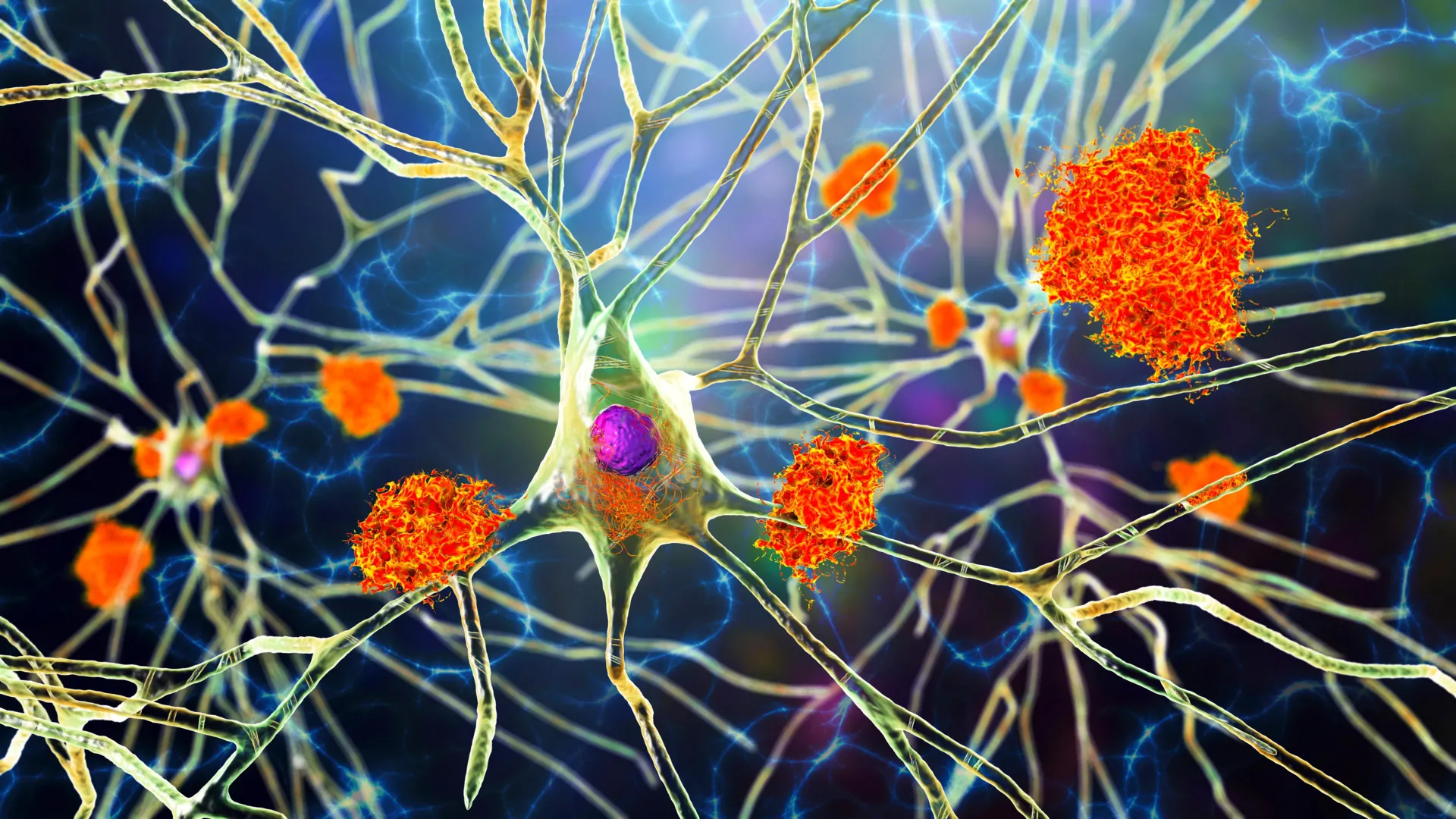
A protein that helps protect the brain may offer scientists a promising new way to fight Alzheimer’s disease and other forms of dementia. Researchers have discovered that increasing levels of this protein can reduce the buildup of toxic tangles associated with brain damage, while also helping preserve the connections that allow nerve cells to communicate.
The findings, published in Science Advances by scientists at Sanford Burnham Prebys, suggest that strengthening the brain’s own protective mechanisms could eventually lead to new treatments for neurodegenerative diseases. In experiments with mice, the researchers found that boosting the protein reduced several damaging changes associated with Alzheimer’s, including brain shrinkage and the accumulation of abnormal tau proteins.
The discovery is particularly significant because tau plays an essential role in keeping healthy brain cells functioning. Under normal conditions, tau proteins help stabilize microtubules, tiny structures that provide internal support to neurons and help maintain the intricate networks of the nervous system.
In Alzheimer’s and several related disorders, however, tau proteins can become abnormal and stick together, forming harmful clumps known as tau tangles. These tangles disrupt the normal functioning of nerve cells and are associated with cognitive decline and neuronal death. Diseases characterized by abnormal tau accumulation are collectively called tauopathies.
A Protective Protein With a Surprising Role in Alzheimer’s
The researchers investigated a protein called sorting-related receptor with A-type repeats (SORLA), which has already attracted scientific attention for its potential role in protecting the brain against Alzheimer’s disease.
Previous studies have shown that SORLA can help limit the production and accumulation of amyloid-beta, another protein closely associated with Alzheimer’s. Amyloid-beta can build up into plaques in the brain, making it one of the disease’s major pathological hallmarks alongside tau tangles.
“In the last 15 or 20 years, considerable data has come out from our lab and other groups showing that SORLA can suppress one of the hallmarks of Alzheimer’s disease — amyloid-beta generation and accumulation,” said Timothy Huang, PhD, assistant professor in the Center for Neurologic Diseases at Sanford Burnham Prebys.
“Very little was known, however, about whether SORLA affected the tau tangles reflected on the other side of the coin in Alzheimer’s disease.”
To investigate this question, the scientists developed a mouse model by breeding animals engineered to produce additional human SORLA with mice that develop tau tangles, brain atrophy, and cognitive impairments. This allowed them to examine whether higher SORLA levels could reduce tau accumulation and protect against the damage it causes.
Boosting SORLA Reduces Toxic Tau and Brain Shrinkage
The results revealed that additional SORLA provided protection against several processes that contribute to tau tangles and the progression of neurodegenerative disease.
One important effect involved a process called hyperphosphorylation. This occurs when too many phosphate groups attach to tau proteins, altering their behavior and contributing to the development of harmful tangles. Higher SORLA levels reduced this abnormal modification.
The protein also limited the ability of misfolded tau to act as “seeds” that encourage other tau proteins to clump together. This seeding process can help toxic tau aggregates multiply and spread their damaging effects.
Beyond reducing tau abnormalities, SORLA helped preserve synapses, the specialized connections through which neurons communicate. It also protected synaptic plasticity, the brain’s ability to strengthen or modify those connections, which is essential for learning, memory, and normal cognitive function.
“When you upregulate SORLA, you can suppress the negative effects found in tauopathies,” said Huijie Huang, PhD, a staff scientist in the Huang lab at Sanford Burnham Prebys and lead author of the study.
“We found there was less brain atrophy and less tau accumulation, which was very exciting to see.”
Removing the Protein Makes Brain Damage Worse
After observing the benefits of increasing SORLA, the researchers examined what would happen if the protein were missing entirely.
SORLA is produced using instructions encoded by a gene called Sorl1. Some people carry mutations that interfere with this gene’s function, potentially disrupting the production or activity of the protective protein.
To investigate the consequences, the team studied genetically modified mice that lacked Sorl1 and therefore could not produce SORLA.
The results contrasted sharply with those seen in mice carrying additional copies of the protein. Instead of protecting against tau-related damage, the absence of SORLA made the harmful effects more severe.
“The opposite turned out to be true when we deleted the ability to produce SORLA proteins,” said Tim Huang, senior and corresponding author of the manuscript. “A lack of SORLA exacerbated the harmful effects observed in tauopathies.”
These contrasting results provided further evidence that SORLA plays an important protective role in the brain and may influence how severely tau-related diseases progress.
A New Clue Could Lead to Alzheimer’s Treatments
To understand why changing SORLA levels had such different effects, the researchers examined the molecular activity of individual brain cells and the surrounding tissue.
They combined advanced sequencing methods to measure protein levels and gene activity in individual cells with techniques that map where RNA and proteins are located within brain tissue. This detailed approach helped reveal how SORLA influences the biological processes involved in neurodegeneration.
The analysis showed that increasing SORLA helped prevent harmful changes in protein production at synapses while also suppressing other mechanisms associated with tauopathy progression.
The researchers also discovered that higher SORLA levels reduced abnormal gene activity in glial cells. These cells perform several essential functions in the nervous system, including supporting, maintaining, and protecting neurons. Changes in glial cell activity can contribute to the progression of neurodegenerative diseases.
One finding was especially intriguing because it pointed toward a potential target for existing medications.
“One particularly notable finding that we can build on is the upregulation of a member of the plexin-B family of receptors in the absence of SORLA,” said Huijie Huang.
Plexin-B receptors are proteins involved in cellular signaling, helping cells respond to information from their surroundings. The increased activity of a receptor in this family when SORLA was absent suggests that this signaling pathway could be involved in some of the damaging changes associated with tau disorders.
Importantly, drugs capable of targeting this family of receptors already exist, raising the possibility that scientists could investigate whether they might be useful against tau-related dementia.
“There are unique drugs that can target this class of receptors that we may be able to apply to tau-related dementia disorders,” said Tim Huang. “One potential future direction is to repurpose these drugs to target overactivation of glial cells and perhaps reverse some of the phenotypes in tauopathies.”
The Next Step Toward Human Alzheimer’s Research
Although the findings are encouraging, the protective effects were demonstrated in mice, and more research is needed to determine how these mechanisms operate in humans.
The team now hopes to investigate how individual types of brain cells respond when SORLA levels increase or decrease. One planned approach involves transplanting human neurons or glial cells into mouse brains, allowing researchers to examine the effects of different SORLA mutations in a living brain affected by disease.
“Mouse cells and human cells are different,” said Tim Huang. “Because we’re looking at human disease, it’s more informative if we can observe the modulation and dysfunction of SORLA in the context of a human cell inside of a diseased brain environment.”
These experiments could help clarify how SORLA protects neurons from toxic tau accumulation and why disruptions in its function make neurodegeneration worse.
Ultimately, the researchers hope that a deeper understanding of this protective protein will reveal new treatment strategies, either by enhancing SORLA’s activity or by repurposing existing drugs to interfere with damaging cellular pathways. Such approaches could eventually offer new ways to combat Alzheimer’s disease and other forms of dementia driven by toxic tau tangles.
The study was supported by the National Institutes of Health, National Cancer Institute and National Institute on Aging.
