


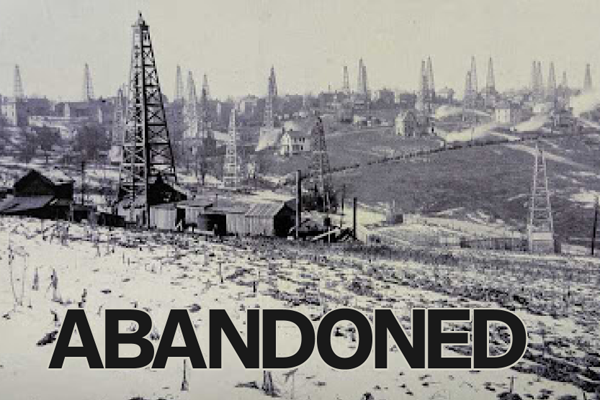
Abandoned: The aging oil and gas wells haunting Pennsylvania. This project is a collaboration between Inside Climate News and the Pittsburgh Post-Gazette.
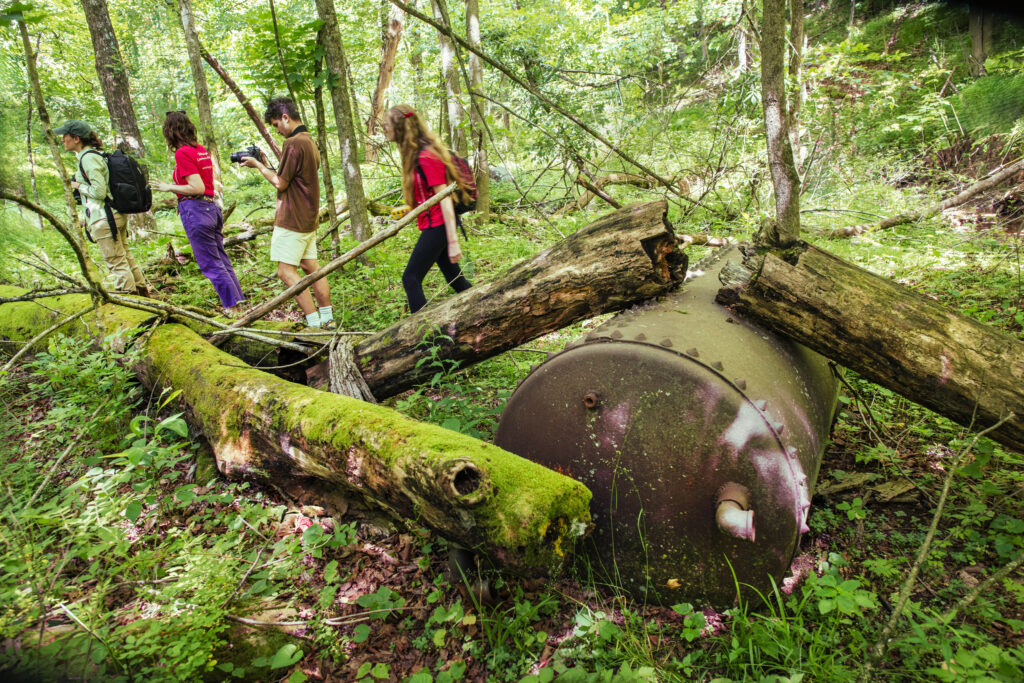
The property that became the Pittsburgh Botanic Garden has led many lives: coal mine, farmland, resurrected forest. Inside the southern boundary, in acres of dense woods off-limits to visitors, the relics of a less-remembered chapter litter the landscape.
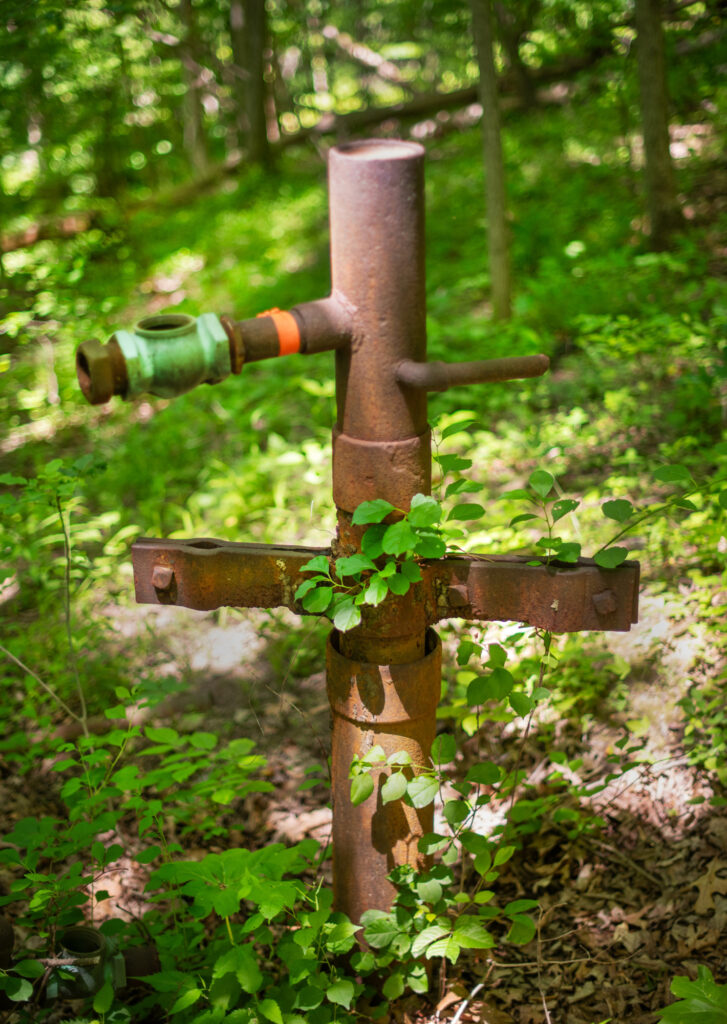
Past the back gate is a jumble of overturned tanks, stained sheds and tangled, broken pipes. The creek gurgles strangely, a sulfurous smell hanging in the air. High on the ridge, rusted pumpjacks stand like quiet sentries. One wears a metal tag stamped with the name of a woman who lived here more than a century ago.
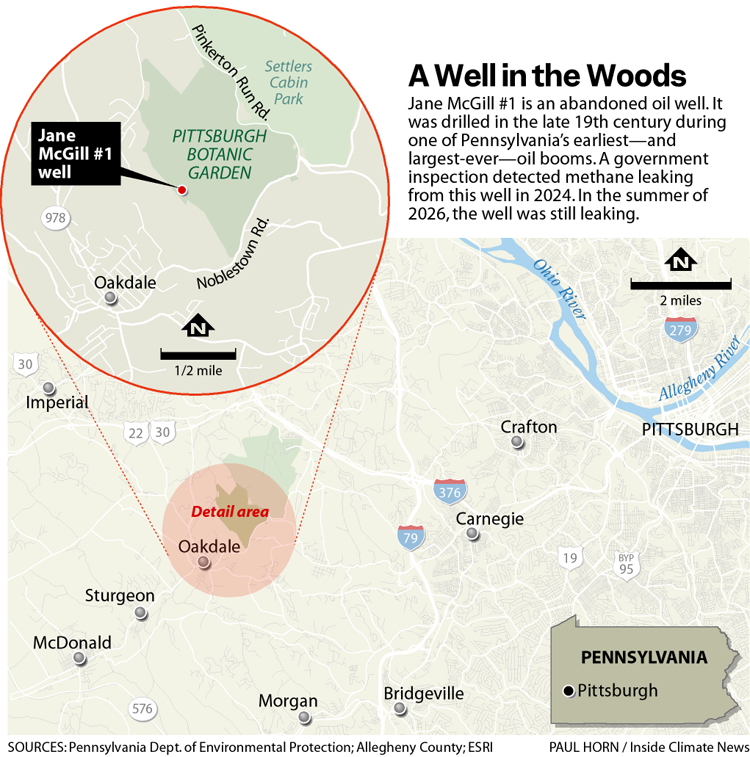
Jane McGill #1 is an abandoned oil well, drilled at the height of what was then the biggest oil rush in the world, and this is an oil field graveyard. The well is one of hundreds of thousands of oil and gas wells left unplugged by operators and scattered across the state, from Washington County in the southwest to Susquehanna in the northeast.
Some of them are fouling the air with methane, the highly flammable gas and potent climate pollutant, and other chemicals like cancer-causing benzene. In some cases, abandoned wells have been linked to home explosions. Others are implicated in water contamination, acting as accidental conduits between present-day drilling and private water wells.
For decades these lost wells went largely unnoticed. But dealing with them has become more urgent as suburbia sprawls into what used to be open space. Forgotten oil and gas wells now lurk near and even beneath shopping centers, schools, homes, backyards and public parks. They may no longer be marked, their metal casing stripped for scrap, the only sign a patch of dead grass, bubbles surfacing in a pond or an unassuming hole in the ground.
Inside Climate News and the Pittsburgh Post-Gazette set out to help make residents more aware of the wells in their midst. Using data from the Pennsylvania Department of Environmental Protection, we built an interactive tool that allows users to input an address anywhere in the state and immediately see if active, abandoned or orphaned wells are nearby.
In Pennsylvania, a well is considered abandoned if it has not produced oil or gas in the past 12 months or if it’s no longer equipped for production. An “orphaned” well was abandoned before 1985 and has not created economic benefit for its current operator or owner. Our map includes data from digitized historical sources that is missing from other tools—a critical source of information because many of the state’s orphaned wells are more than 100 years old.
Because recordkeeping was not required until the 1950s, no one knows for sure where the majority of Pennsylvania’s oldest wells are. This is why we’ve included historical data in our tool. These wells’ locations have largely not yet been verified by the state. But they are a valuable resource for finding wells that may no longer be visible at the surface.
“It’s not a situation that we want to leave unchecked,” said Seth Pelepko, deputy secretary for the Department of Environmental Protection’s Office of Oil and Gas Management. Plugging these wells “is a critical first line of defense for ensuring that the environment’s protected and public health and safety is protected.”
Is There an Oil or Gas Well Near Your Home?
Use the map below to search for the oil or gas well nearest to addresses in Pennsylvania. The map will display information about the well, including inspection photos where available. You can click on other wells in the map view to see information for those sites.
Exercise caution if you think a well is nearby; some may be hazardous, and many are on private property.
The well information is maintained by the Pennsylvania Department of Environmental Protection (DEP), which is responsible for data accuracy. If you have concerns about a well, contact the agency directly through this form or by calling the agency’s oil and gas office in your area.
We simplified the DEP’s descriptions of well status into four categories:
Active/Other. These are mostly wells that are still producing oil or gas. However, the DEP’s active category includes wells with no other status description, which means some disused wells may be mistakenly included. We have also included a small number of wells with “regulatory inactive status,” which allows an operator to shut down production for up to five years without having to seal a well.
Plugged wells are recorded as sealed. Most were plugged by contractors hired by their former operators, but some were plugged by the state. Plugging may fail, so some of these wells may still leak gases.
Abandoned/Orphaned includes abandoned wells, which have been out of production for more than 12 months, and orphaned wells, for which no responsible operator or owner exists.
Historical. In addition to its oil and gas wells inventory, the DEP is in the process of digitizing historical maps showing older wells. These historical maps are not comprehensive and have largely not been verified by modern inspections. Treat this information with extra caution.
The state has plugged about 3,800 wells since starting that work in 1989, a tiny fraction of an estimated 300,000 to 750,000 that could be out there. In the fall of 2022, the well-plugging program received a huge influx of federal funding that has allowed Pennsylvania to seal 500 wells since then and ramp up work to find and inspect more. Even at this faster pace, it would take many lifetimes to address them all. In 2022, the state estimated it would cost more than a billion dollars just to plug its documented orphaned wells.
“The problem is overwhelmingly large,” said Adam Peltz, a senior director at the Environmental Defense Fund who has worked on oil and gas issues for 15 years.
Companies are legally responsible for plugging inactive wells, and operators have sealed more than 50,000. But some operators walk away or go bankrupt first, and the abandoned list grows every year. Meanwhile, fracking companies continue to drill new wells, and the money the state requires they set aside for plugging is nowhere near the actual cost.
Critics of the expanded well-plugging program argue that it’s a distraction from the pollution caused by the modern oil and gas industry. They believe it cements an expensive precedent for taxpayers to assume responsibility for harm caused by industry. But its champions see it as a necessary, if Sisyphean, effort—especially as development brings more people into close proximity to hidden wells.
“The world is not perfect. We’ll never make it perfect,” said Dan Brockett, an energy educator at Penn State Extension who worked with the Environmental Defense Fund to add wells on private property in northwestern Pennsylvania to the list for plugging. “But from my point of view, what we can do is find problems and fix the biggest problem.”
That means the state must locate the most dangerous wells for plugging—a daunting task given the dearth of documentation for older wells. Scientists, government officials and environmental advocates are trying to speed up the process using artificial intelligence, drone flights, community outreach and historical maps. Their work has led them to residential neighborhoods, farms, forests and public places, including Settlers Cabin Park and the Pittsburgh Botanic Garden. They’ve knocked on doors, held town halls and peered into the past, studying hand-drawn paper maps from the state’s archives.
The wells are an enduring legacy of Pennsylvania’s long history of drilling, which began with the country’s first commercial oil well in 1859.
In Western Pennsylvania, the American oil industry’s boom-and-bust business model was born, a cycle of rapid growth and desertion that would be exported to Texas, Oklahoma and eventually around the world.
Read More
How and Why We Mapped Pennsylvania’s Forgotten Oil and Gas Wells
By Peter Aldhous, Anya Litvak, Kiley Bense
“Pennsylvania’s energy story is absolutely essential,” said Brian Black, a history professor at Penn State Altoona who wrote a book about the 1860s oil rush. “It’s really where we learned for the first time as a society that if we wanted one thing, we were willing to make a mess of everything else to get that one thing.”
This pattern explains why so many wells were abandoned here—one analysis found that Pennsylvania has more documented orphaned wells than any other state but Ohio, which doesn’t account for the possibly hundreds of thousands that Pennsylvania hasn’t officially documented. It may also explain why the abandonment continues today.
“The actual area that produced the oil was an afterthought, and Pennsylvania is one of the first examples of that. It defined how those places were treated afterwards as well,” Black said. “This was the first place left behind.”
Somewhere Hides a Well
Jane McGill #1 was named for the owner of the farm where it was drilled during one of Pennsylvania’s biggest oil booms. “There has been nothing like the present activity in the history of the business,” The Pittsburgh Dispatch declared in October 1891. “Such gushers as are now being struck were never known before. They are the wonder of the age.”
At its height, the McDonald oil field produced between 84,000 and 96,000 barrels a day. Wells were everywhere: in front yards, backyards, graveyards and onion beds, “some of them scarcely a yard apart,” not just in the country districts but many within town limits.
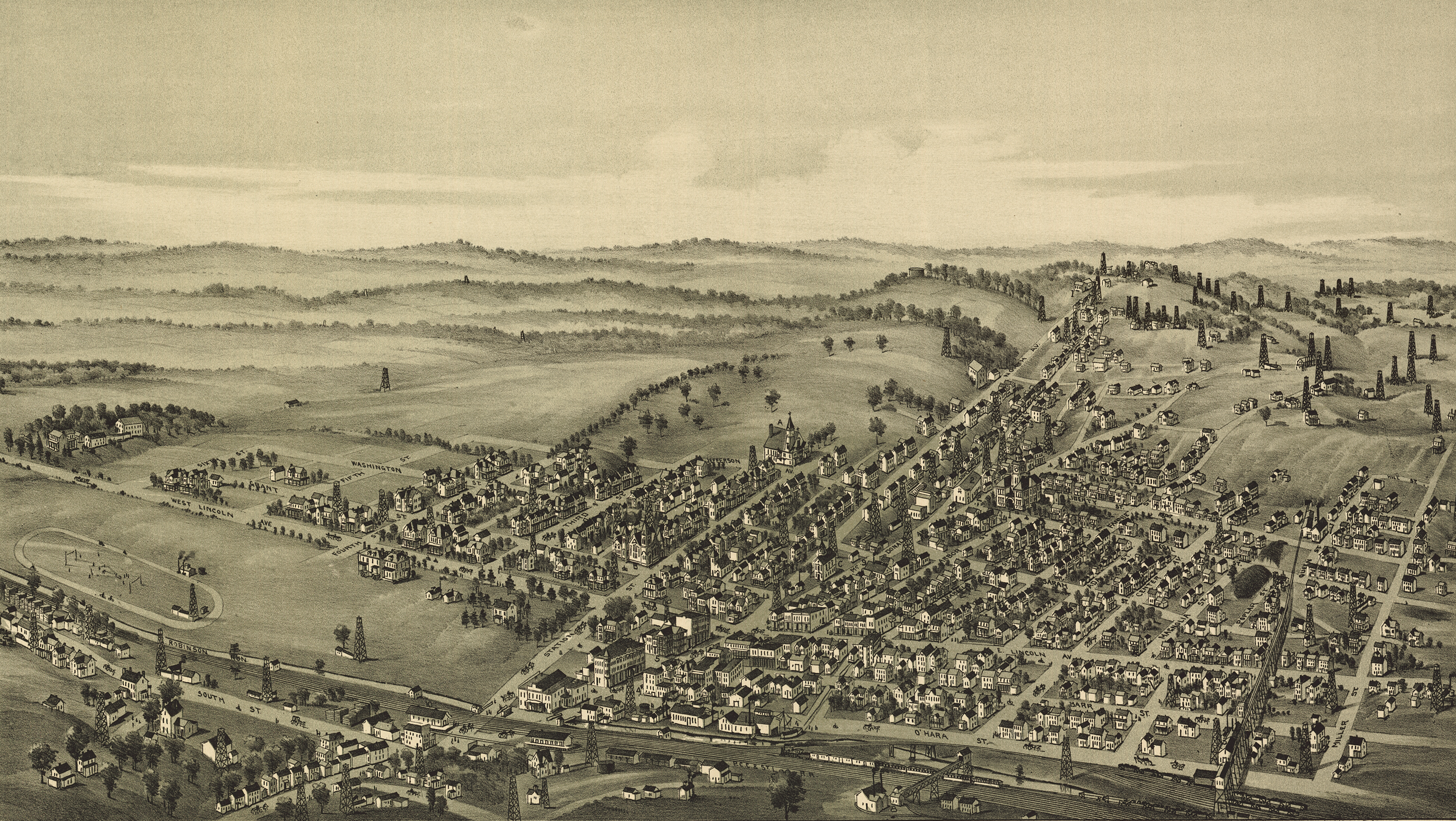
In 1891, this was the largest oil field in the world, said Vinny Curtis, co-director of a local historical association in Washington County. “Everyone wanted to try to get into it, so they were just plopping down wells everywhere they could,” he said. “Because there was so much oil in such a short amount of time, it actually caused the price of oil to crash.”
In the village of Oakdale, just up the road from the town of McDonald and next door to where the Botanic Garden is today, the population tripled, dozens of new buildings and shops went up and a local returning from California refused to get off the train because he no longer recognized his hometown.
“To the natives it is Sleepy Hollow in a twentieth century robe,” a reporter explained. “To the new comers it is simply business.”
Read More
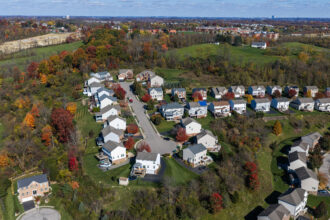
In Western Pennsylvania, You Might Live Next to—or on Top of—an Unplugged Well
Story by Anya Litvak, data analysis and visualization by Peter Aldhous
Some people got rich overnight; cash was “free and easy.” The Presbyterian congregation in McDonald made enough of a fortune from two wells on the property to build a new church. One of the congregants became a millionaire. People drilled more than 1,200 wells.
This summer, a team of environmental advocates went in search of what remains of those wells on the Botanic Garden and adjacent Settlers Cabin Park property. They were there to observe conditions and monitor for leaks. Historical maps suggest there could be dozens of wells in the garden and park. The Environmental Defense Fund flew drones with magnetometers that can detect metal casing even if it’s buried deep underground, and the findings backed up the archival record.
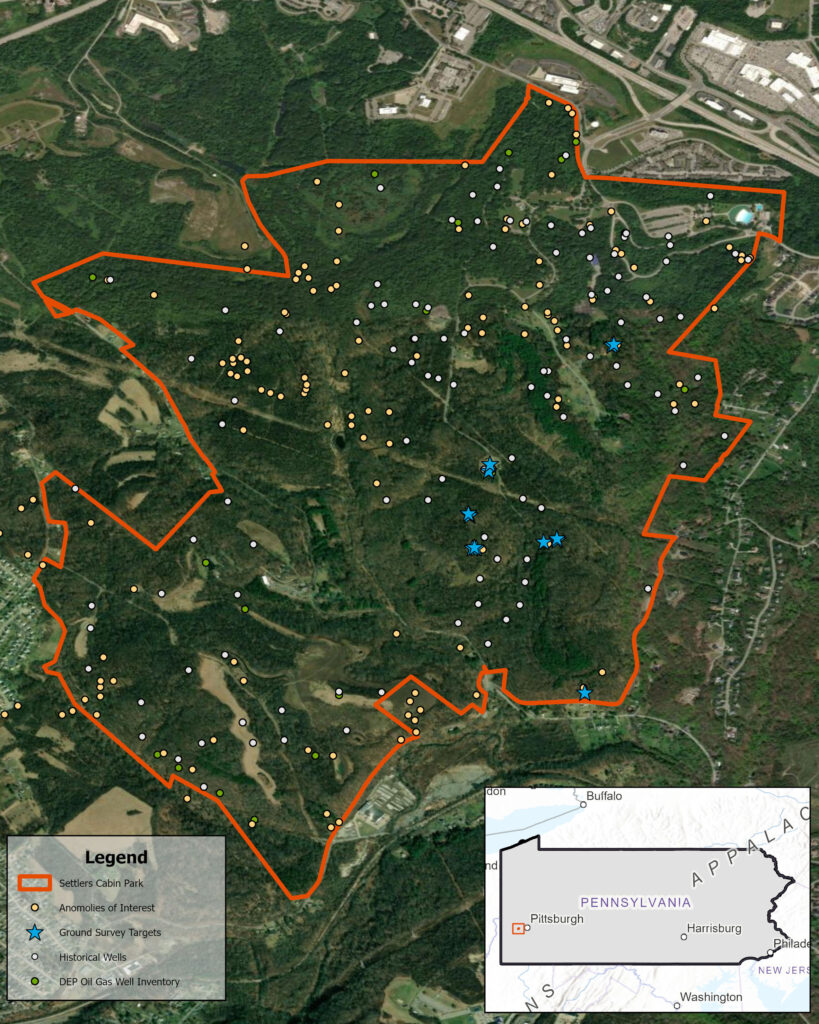
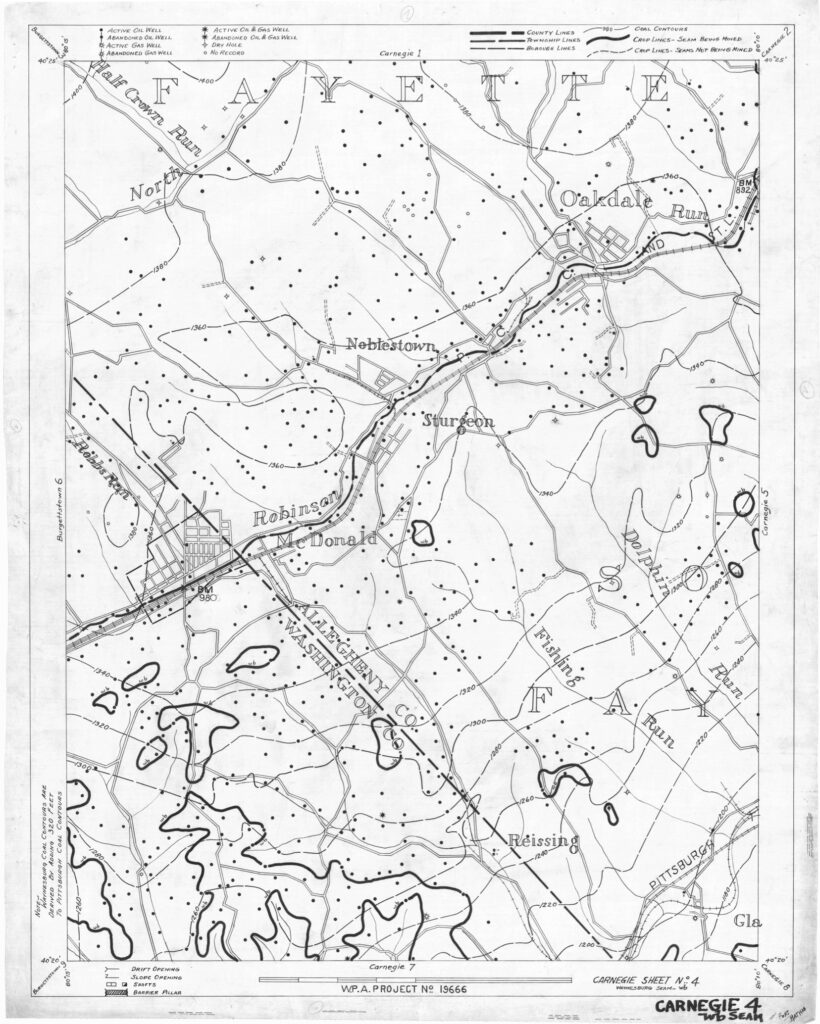
What was once farmland and then part of a strip-mining operation in the Botanic Garden is now a young forest. To reach the wells, the group carried heavy equipment for more than an hour, wading through tall grasses and across the creek on a rotting makeshift bridge, pushing through thorny brush and climbing a steep, muddy embankment.
“It’s not an easy area to get to,” said Melissa Ostroff, Pennsylvania policy and field advocate at the environmental group Earthworks. There is no clear trail, and the rusted pumps disappear into the trees.
“The first time I saw it was like, ‘Oh, this looks like a little seesaw or something.’ It’s almost cute. It’s very different than fracking operations, where it’s a huge rig,” Ostroff said. “It’s easy to just kind of lose them in the middle of a forest.” Ostroff used an iPad with mapped coordinates to navigate to the wells.
An orange ribbon was tied around Jane McGill #1 where it sat in a nest of pipes, tree branches, weeds and tanks. Ostroff set up a tripod with a type of infrared camera that allows her to see plumes emerging from oil and gas wells. “All right, I see a leak,” she said, peering through the viewfinder. “It’s less bad than I thought, but you don’t want to be over there because it’s coming out that way.”
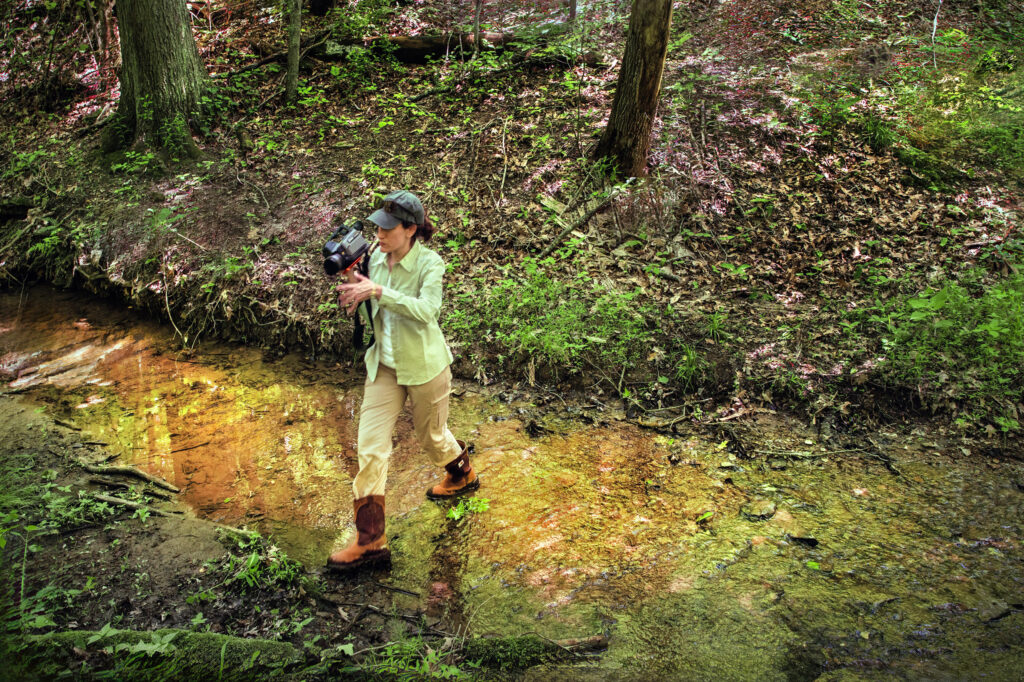
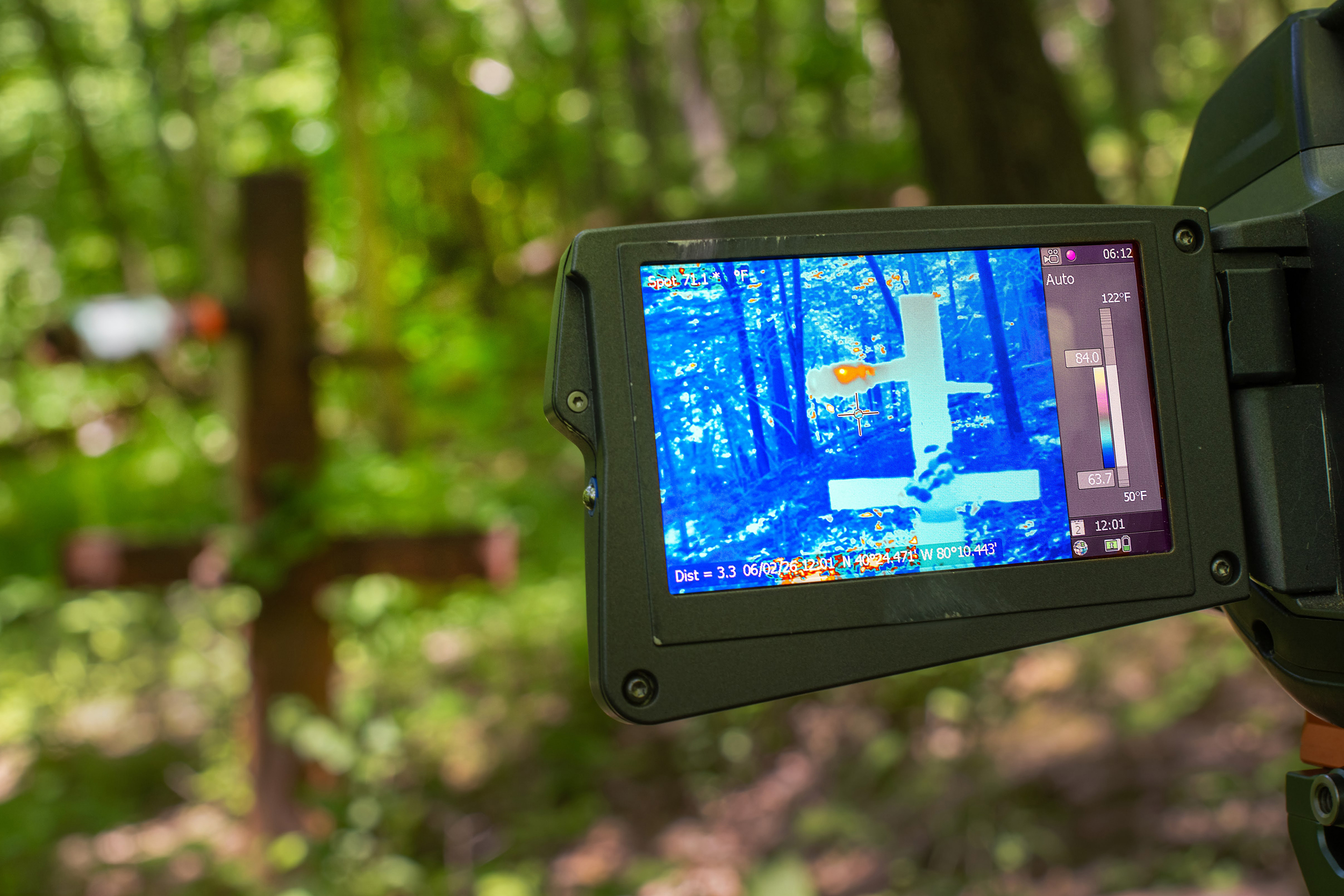
She motioned for the rest of the group to move away from the well and opened a pop-out display screen on the camera. It recast the pump in otherworldly colors, with bright orange spots where sunlight was heating the metal pipes and dead leaves on the ground through a break in the tree canopy. The screen captured what was otherwise invisible: a small but steady cloud wafting upward from the structure.
In recent years, scientists have tested more wells like Jane McGill #1, trying to better understand how many are leaking and how much those leaks are impacting the climate, environment and public health.
“It’s estimated that about 10 to 20 percent of them have some emissions at the surface,” said Nick Gianoutsos, a physical scientist at the U.S. Geological Survey who helped create a federal database of documented orphaned wells. It’s an estimate only, because most of these wells have not been found, let alone tested. “In terms of prioritizing wells based on leaking, it’s hard to know, because the vast majority of them, 99 percent of them, have never been measured in terms of emissions,” he said.
Send Us Your Tips
Have a tip for us about abandoned and orphaned oil and gas wells in Pennsylvania? Tell us at tips@
Those emissions include methane and, in some cases, other chemicals called volatile organic compounds, or VOCs. A 2023 study analyzed 48 abandoned wells in Western Pennsylvania and found that many of them were leaking VOCs like harmful benzene. A smaller number of unplugged wells were emitting carbon monoxide and hydrogen sulfide, both of which are deadly at high enough concentrations.
In 2024, a government inspector detected methane leaking from Jane McGill #1 at 6,235 parts-per-million-meter, a measure of gas across a column of space. “That indicates that quite a bit of gas is leaving the well,” said Seth Shonkoff, one of the authors of the abandoned wells study and the executive director at PSE Healthy Energy, a research institute. That reading “is a strong indicator that there is a significant problem.”
The risks are much higher from wells beneath or close to buildings, Shonkoff said. The study found that nearly 25 percent of abandoned wells in Pennsylvania are located within a few hundred feet of a building.
His research turned up wells near houses, schools, daycare centers and nursing homes, Shonkoff said. When a building is constructed on top of a forgotten well, gases can get trapped indoors. If odorless, colorless methane builds up inside, it can trigger an explosion before anyone notices the leak. Inside Climate News’ interactive map shows wells clustered thickly around Pittsburgh and surrounding counties and spattered across the state’s Northern Tier. The state has found wells in church basements, beneath artificial landscaping rocks and even under wishing wells.
“There’s been much less work done on what this means for exposure to things like benzene,” Shonkoff said. “Since Americans spend 90-plus percent of their time inside, the exposure potential to those types of chemical constituents is actually quite high.”
Scientists are also studying how these wells could be affecting water quality; just down the ridge from Jane McGill #1 and three other known wells runs a stream. “Abandoned wells are frequently drilled through groundwater resources,” Shonkoff said. The older the well is, the more likely that the casing meant to keep the borehole sealed underground has corroded, rusted or failed completely.
“Nothing lasts forever,” Shonkoff said.
Pennsylvania has an unusually high number of households that depend on unregulated private water, which increases the risk that people will unknowingly consume water polluted by legacy drilling. Two years ago, the state plugged an orphaned well that had contaminated a family’s water well in Clarion County, about 80 miles northeast of Pittsburgh. Pennsylvania’s patchwork of abandoned coal mines, hidden oil and gas wells and ongoing fracking, often in the same place, can increase the chances of groundwater contamination.
“The subsurface almost looks like Swiss cheese,” said Joshua Woda, a hydrologist with the U.S. Geological Survey who worked on a 2025 study about the risks orphaned wells pose to aquifers. Nationally, he said, “Pennsylvania stood out.”
This story is funded by readers like you.
Our nonprofit newsroom provides award-winning climate coverage free of charge and advertising. We rely on donations from readers like you to keep going. Please donate now to support our work.
Old wells can be especially dangerous to water supplies if companies drilling for gas today don’t know where they are. In New Freeport, Pennsylvania, a new gas well that accidentally connected underground to an abandoned well was blamed for water contamination in dozens of homes; methane was found in more than 50 water wells.
Because so few abandoned wells have been officially documented compared to the total and far fewer have been tested, “considerable uncertainty” remains about how much they are contributing to U.S. greenhouse gas emissions, according to U.S. Geological Survey scientists. But preliminary numbers are alarming.
In 2022, the Environmental Protection Agency estimated that leaks from abandoned wells make up about 4 percent of total emissions from the American oil and gas industry. That’s the equivalent of the carbon pollution created by 1.8 million gas-powered cars in a year.
“Monuments to Dead Hopes”
The heyday of the McDonald oil field, where Jane McGill #1 was drilled, didn’t last long. Production declined in 1892, and by 1906, a visitor to the field found that “bleak and weather-beaten derricks … stand like specters,” the frenzied moneymaking of the rush replaced with a scene as silent as the grave. Some of the wells had been dismantled or destroyed by the elements and others held on “like monuments to dead hopes.”
McDonald and the surrounding area never recovered economically, said Curtis, of the historical society. “It’s a common story,” he said, one that is echoed in the fates of other places in Western Pennsylvania, like the Mon Valley after the decline of the steel industry, “where you’re left with these towns and cities along the river that are shadows of what they once were.”
The death of the oil rush ushered in decades of coal mining that left this region even more deeply scarred. When strip mining ended, some of the land was unusable, as farmland or anything else. Curtis, who grew up here, believes this legacy of neglect has a way of getting into people’s minds—shaping what they think is and isn’t possible for themselves and their children.
“That land has sat like that, abandoned and useless, for 50 years,” he said. “You’re living there and driving past it every day, and it’s just like barren, slate-covered land. Nothing can grow on it. It plays into that depressed-region mindset.”
He hopes that teaching history can break this generational pattern of assuming “this is what happens here.”
Black, the environmental historian, said the early oil booms created an “ethic of extraction” statewide. When fracking was on the rise in the 2000s, Pennsylvania could have chosen, like neighboring New York, to ban or seriously curtail it. Instead, the gas industry was welcomed.
He is hopeful the state that led the nation on fossil fuels could become a different kind of leader.
“Yes, energy is going to be crucial moving forward, but the way we get it, it doesn’t need to be the same way we did in the past,” he said. “We can learn that there are sustainable and smarter ways of doing things that allow us to still get the energy that we need.”
For now, state officials must contend with the messes they inherited. More than two years ago, the government issued a notice of violations to the operator of Jane McGill #1, alleging that he failed “to ensure that the integrity of the well is maintained and health, safety, environment and property are protected” and “to plug the well upon abandoning it.”
In the summer of 2026, the well was still leaking. Ostroff believes it’s stranded in legal limbo, a common obstacle to well-plugging. Landowners are not necessarily the owners of wells drilled on their property; Jane McGill #1 sits on land owned by Allegheny County and leased by the Botanic Garden, but its last recorded operator appears to have died in 2025. The Department of Environmental Protection did not respond to questions about the ownership or status of the well.
These distinctions matter because well-plugging is expensive.
A 2026 report found that the average cost to plug an orphaned well and restore the site afterward was more than $100,000 in Pennsylvania, about $30,000 higher than the number across six states that have received federal funds for well-plugging. The age of the wells is one reason: The average well plugged here is more than a century old, and older wells are typically more difficult and costly to seal.
If the state can find a responsible owner to pay for plugging, it has an obligation to try every avenue to do so. “We want to make sure that we pursue all assets that an operator may have,” said Pelepko, the state regulator. “That’s a time-consuming process.”
Compared to other states, Pennsylvania could be doing a lot more to ensure that companies drilling right now stay on the hook for the costs associated with inactive wells rather than passing that burden to taxpayers, experts say. For non-fracked wells, operators must set aside $2,500 per well. Costs for fracked wells depend on the specifications of the well and how many the operator is responsible for; those bonds start at $4,000 per well. This year the state has issued more than 400 violation notices to operators for abandoning wells.
Pennsylvania’s orphaned wells are a reminder that the choices made today can have consequences far into the future.
It’s unlikely that the state is going to find a responsible party to deal with most of the oldest wells, said Daniel Raimi, a fellow at Resources for the Future, who recently co-authored a report on the progress made by the federal well-plugging program. “But what we really need is reforms to state policies to reduce the likelihood of additional wells becoming orphaned,” Raimi said. “This should not be the responsibility of taxpayers. This is an industry problem.”
Telling the Story of the Land
It took 17 years to clean up the slice of the Botanic Garden property that is now open to visitors. Rather than erasing that work, staff incorporated the cleanup into the design of the garden, adding signs that explain the site’s mining history and drawing attention to the system that filters out mine drainage from the watershed.
Unlike the public-facing area, with its neat plant species labels and accessible trails, the part of the property where Jane McGill #1 awaits its fate has not yet been remediated. It is marked with the scars and artifacts from centuries of use and abandonment, from the rusted oil equipment and leaking wells to lumps of bituminous coal and a pit created by a mine collapse.
“Everything that could happen in Western Pennsylvania happened,” said Sue Myers, the horticulture and conservation director at the Botanic Garden. “The whole past land use history is there, and all of the ecological stories are there. It’s almost like a manuscript that you just have to learn to read.”
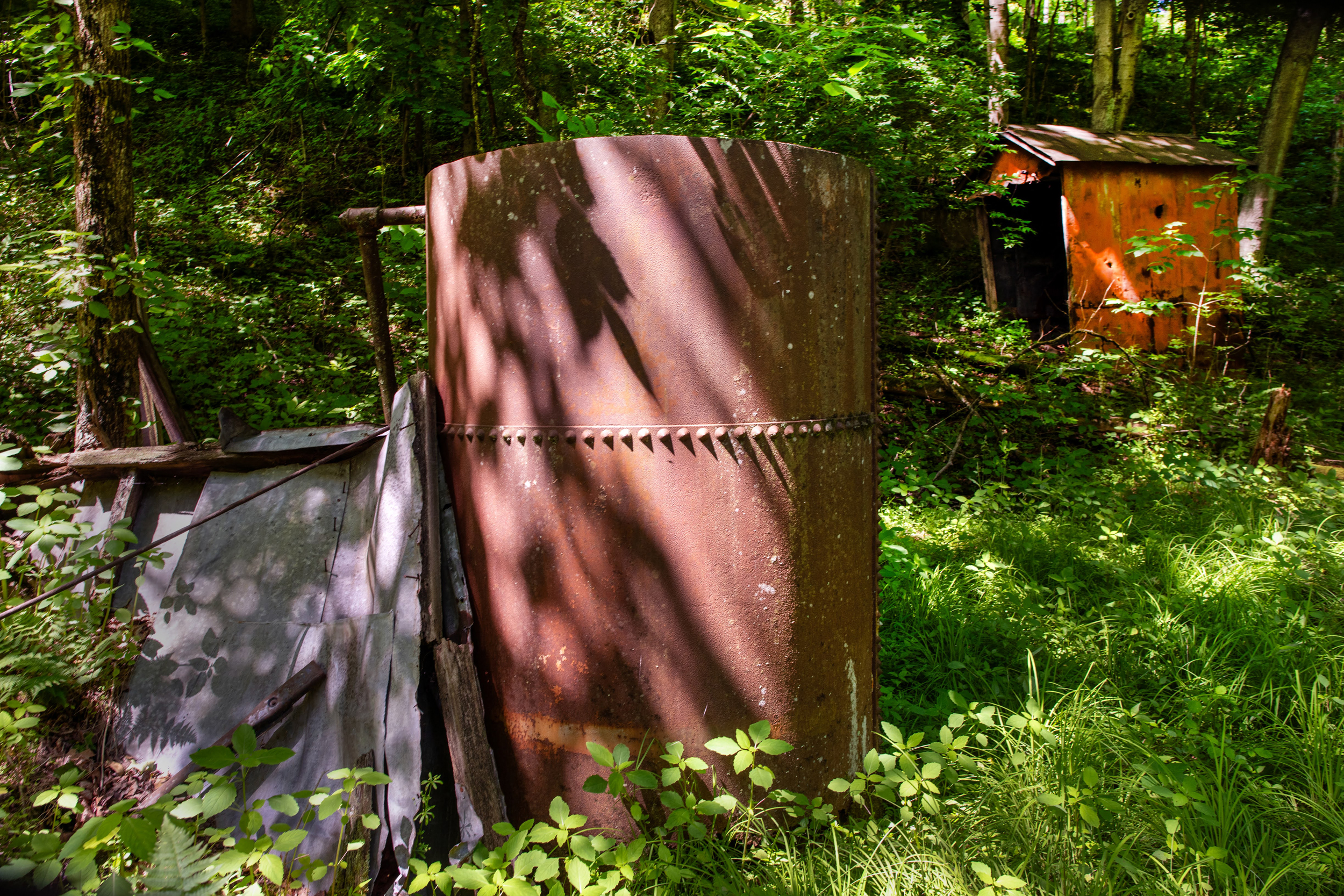
This land was swept up in an oil rush and dotted with derricks; flattened for a strip mine; timbered, excavated and cleared. Generations of farmers tilled these hills. The steep slope down to the creek is part of the region’s natural topography. The fossil fuels beneath the surface are clues to the distant past, remnants of an ancient sea.
This story is written on the land, but its ending is not pre-ordained. “Sometimes it feels like it’s too late to correct a lot of it,” said Nate Reese, the site’s associate communications director, of the layers of pollution and damage left behind. Learning more about the history here—and working alongside so many people who want to care for the land over the long-term—has made him more optimistic about what is possible.
“In reality we’re actually just at the beginning, and all of this land is still extremely usable,” he said. “I think it’s going to be an incredible landscape that hopefully I get to see.”
Myers, a botanist, sees something else in this landscape of ruins: resilience. “That’s one of our most biologically diverse areas,” she said.
In the shade of tall trees protected by the garden’s borders for decades, the temperature drops, and the creek runs slow and cold. Wild raspberries grow in the bramble near spicebushes and sassafras. Frogs croak, insects hum and a turtle sleeps in a pocket of sunlight. The trees rustle with birds. The muddy creek banks are inscribed with the footprints of deer and racoons.
After staff cleared invasive plants from a parcel of land for a new garden, they noticed something surprising: a tiny native seedling, poking through the soil. The recent restoration work opened an opportunity for the yellow fumewort to emerge. “Who knows how long those seeds were waiting?” Myers said.
Someday, after the wells are plugged, Myers imagines the back section of the property and its wreckage starting a new chapter as a living map that shows not only how to heal the wounds of the past—but also how to write a different future.
About This Story
Perhaps you noticed: This story, like all the news we publish, is free to read. That’s because Inside Climate News is a 501c3 nonprofit organization. We do not charge a subscription fee, lock our news behind a paywall, or clutter our website with ads. We make our news on climate and the environment freely available to you and anyone who wants it.
That’s not all. We also share our news for free with scores of other media organizations around the country. Many of them can’t afford to do environmental journalism of their own. We’ve built bureaus from coast to coast to report local stories, collaborate with local newsrooms and co-publish articles so that this vital work is shared as widely as possible.
Two of us launched ICN in 2007. Six years later we earned a Pulitzer Prize for National Reporting, and now we run the oldest and largest dedicated climate newsroom in the nation. We tell the story in all its complexity. We hold polluters accountable. We expose environmental injustice. We debunk misinformation. We scrutinize solutions and inspire action.
Donations from readers like you fund every aspect of what we do. If you don’t already, will you support our ongoing work, our reporting on the biggest crisis facing our planet, and help us reach even more readers in more places?
Please take a moment to make a tax-deductible donation. Every one of them makes a difference.
Thank you,

Senior Editor
Kiley Bense is a senior editor at Inside Climate News. She was previously the Pennsylvania reporter, covering climate change and the environment with a focus on politics, energy, pollution and public health, and reporting on everything from fracking and steel to plastics, wildlife and extreme weather. Her past work has appeared in the New York Times, the Atlantic, Smithsonian Magazine, the Believer, and Sierra Magazine, and she holds master’s degrees in journalism and creative writing from Columbia University. She is based in Pennsylvania.
