


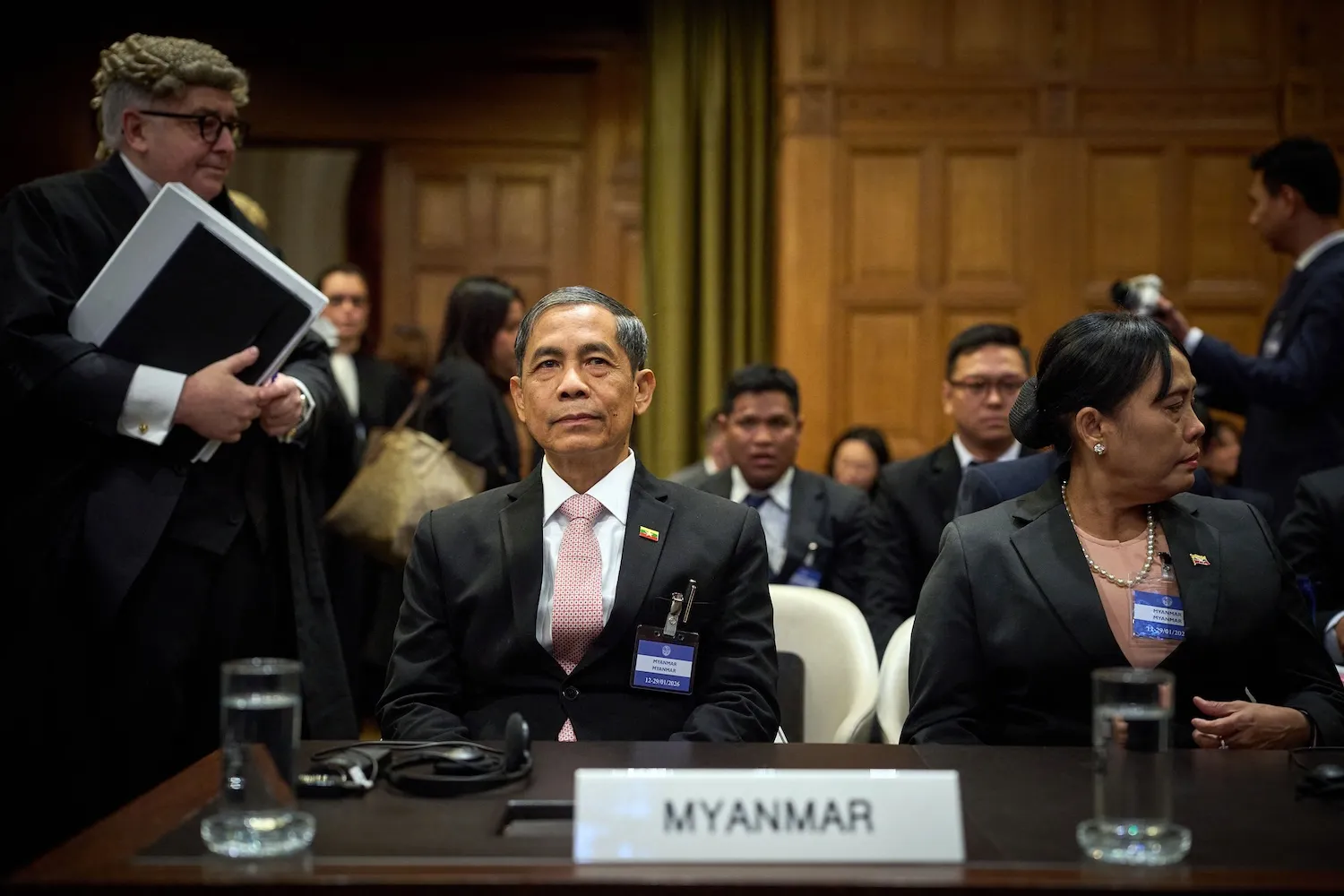
The International Court of Justice (ICJ) is set to deliver a Nov. 19 verdict on whether Myanmar violated the Genocide Convention during the mass persecution and massacres of the Rohingya people that began in August 2017. The ICJ has never found a state responsible for genocide; such a verdict in this case would have immediate and wide-ranging impacts.
In a span of roughly two and a half months that year, the Myanmar military killed thousands of people, committed widespread and organized sexual assault, and razed nearly 400 villages in northern Rakhine state. More than 700,000 Rohingya fled across the Naf River into Bangladesh, where many of them now remain in refugee camps.
For Rohingya victims, the ICJ case presents an opportunity to have their suffering recognized on one of international law’s biggest stages. For opponents of Myanmar’s military regime—which recently rebranded itself as a nominally civilian government—a verdict that finds the state culpable of genocide could serve as a lever to halt the regime’s recent emergence from diplomatic isolation.
And in the eyes of the global pro-Palestinian movement, it would likely signal a looming genocide verdict for Israel at the same court, although that decision is not expected for a few more years. The Myanmar case is expected to set a number of international legal precedents, including those concerning standards of evidence and reparations.
“From an international law perspective, this case is once in a generation,” said Michelle Onello, a senior legal advisor at the Global Justice Center, a humanitarian law organization.
Gambia brought the Myanmar case to the ICJ in 2019, marking the first time that the court—which hears disputes between nations—took up a genocide case lodged by a country not directly affected. Gambia argued that Myanmar violated a treaty that both countries are party to, the Genocide Convention. In December 2023, South Africa used the same argument to pursue a genocide case against Israel for its conduct during the Gaza war.
“In Gaza, the Palestinians were subject to killing and other violence on a scale that considerably exceeds that of Myanmar,” said William Schabas, a professor of international law at Middlesex University. Schabas served on Myanmar’s defense team but resigned after the military seized power in 2021. “A finding that Myanmar committed genocide will therefore make a finding that Israel has committed it much more likely.”
Lucky Karim was just 14 years old when the Myanmar military came to burn her village in Maungdaw township in 2017. “You just keep running until you are told to rest,” she said of the experience fleeing the village during an interview this month.
Before the escalation in 2017, the Rohingya faced severe restrictions on their freedom of movement in Myanmar, access to healthcare and education, and citizenship status. The situation worsened in 2012, when thousands of people were driven from their homes during sectarian riots and forced into squalid displacement camps.
There were warning signs in the weeks leading up to the 2017 crackdown, Karim said, including the military arresting people who could read and write in order to leave the rest of the community in darkness. Around a week before the Muslim holiday of Eid al-Adha, the military began raiding Rohingya villages.
“We have experienced this in most of our lives in Myanmar. Right before a big event for Muslims to celebrate, they will do something terrible,” Karim said. “But we never thought it was going to be something permanent.” But by the time that her family reached Bangladesh, after a week of walking, her village was a smoldering ruin.
Myanmar’s de facto leader at the time, Nobel Peace Prize laureate Aung San Suu Kyi, was widely seen as downplaying the atrocities—though she had no authority over the armed forces. In 2019, Aung San Suu Kyi appeared at the ICJ to defend Myanmar against the allegations of genocide. Her speech in The Hague characterized the crisis as a legitimate internal conflict with a Rohingya militant group, despite an abundance of evidence that the military had targeted the whole population.
Aung San Suu Kyi was overthrown in the February 2021 military coup and jailed; she was moved into house arrest this year.
The coup sparked a civil war in which the military has been accused of further crimes against humanity throughout the country. The junta was left isolated, but more than five years later, many of Myanmar’s neighbors now seem to accept that the dictatorship—with crucial backing from China and Russia—is here to stay. President Min Aung Hlaing, who led the coup, has met with most of his counterparts in the Association of Southeast Asian Nations, and the United States has lifted some sanctions and begun directly engaging with the regime.
A genocide verdict could complicate things, theoretically activating legal obligations for other countries to act to prevent genocide. These could include arms embargoes or sanctions that could be imposed by the United Nations Security Council, though China and Russia are likely to block any such efforts.
“An ICJ ruling does not, by itself, deliver justice,” Tom Andrews, the former U.N. special rapporteur for Myanmar, wrote in an email. “Justice requires UN member states to act, starting with the UN Security Council. If the political will existed, the Security Council would refer those responsible for the genocidal attacks against the Rohingya to the International Criminal Court. But, it doesn’t.”
“The bottom line is that the international community must demonstrate that a finding of genocide carries consequences. That will require that states take strong, principled action. The Rohingya deserve no less,” Andrews said.
Legal experts say the Myanmar case could also be a landmark one when it comes to the issues of sexual violence and reparations. Sexual violence was such a trademark of the Myanmar military’s 2017 campaign that it became central to Gambia’s genocide allegation.
“The ICJ previously stated in Croatia v. Serbia that rape and other acts of sexual violence are capable of constituting genocidal acts,” Marianne Vitug, a legal advisor at the Global Justice Center who attended the Myanmar proceedings at the ICJ, wrote in an email. But in the Serbia case, the ICJ found that genocidal intent was not the “only reasonable inference” from crimes of sexual violence. (Serbia was not found directly responsible for genocide.)
“The ICJ 1795022435 has a first-time opportunity to squarely address whether and how genocide can be committed through reproductive violence,” Vitug said.
Gambia also made a “robust” request for reparations, Onello said, including domestic criminal accountability, safe return for refugees, property restoration, medical rehabilitation, recovery and reburial of bodies, protection against discrimination, and full and equal citizenship. It is the first time that a state has made a request for reparations at the ICJ on behalf of a third party; enforcement of any potential reparations would be difficult.
Finally, the case is being watched closely because of the implications that it could have for the case brought by South Africa against Israel, particularly regarding how the ICJ interprets genocidal intent.
Previously, intent to destroy a group needed to be the “only reasonable explanation” for the pattern of conduct to constitute genocide, Schabas said. If a “more relaxed approach to proving genocidal intent” could be applied, then it would make a genocide verdict in the Israel case more likely, he added.
Vitug said that some members of the legal community have criticized the previous standard as unreasonably high. Gambia was “very thorough” in meeting that standard, she said, but observers are also watching to see “whether the court decides this continues to be the evidentiary standard.” The ultimate verdict will “almost certainly affect the succeeding cases,” Vitug said.
Whether U.N. commissions of inquiry are deemed permissible as evidence is another key point to watch, as they rely on a standard of “reasonable grounds to believe” that a genocide was committed rather than “beyond a reasonable doubt.” U.N. investigators determined that the Myanmar military carried out “genocidal acts” against the Rohingya. A U.N. commission of inquiry concluded that Israel has committed genocide against Palestinians in Gaza.
Those who argue against a genocide verdict in the Myanmar case point to a relatively low death toll—most estimates range between 10,000 and 25,000 out of a pre-2017 Rohingya population of 1.2 million—and say the military’s primary motivation appeared to be ejecting the Rohingya from the country rather than exterminating them.
However, Onello said the extreme violence during the displacement suggests otherwise: “They surround a village. They set it on fire. They mass murder men. They mass rape women. They throw babies into the fire,” she said. “Yes, some people ran away, and they shot them in the back as they were fleeing.
Karim, who now lives in the United States, said she hopes that even if the ICJ doesn’t rule that Myanmar committed genocide, it acknowledges other state crimes—an unlikely outcome, since the case centers around the Genocide Convention.
Karim has been working with community members to manage expectations in the refugee camps in Bangladesh. “If the verdict is positive and the court decides to rule against the military, it will be a historic victory for us; however, a positive outcome doesn’t immediately repatriate the refugees or hold the military accountable,” she said. “The piece of paper doesn’t immediately change the ground reality.”
A verdict in the other direction—failing to hold the state responsible for genocide—wouldn’t “define the decades-long suffering we have gone through,” Karim said.
