


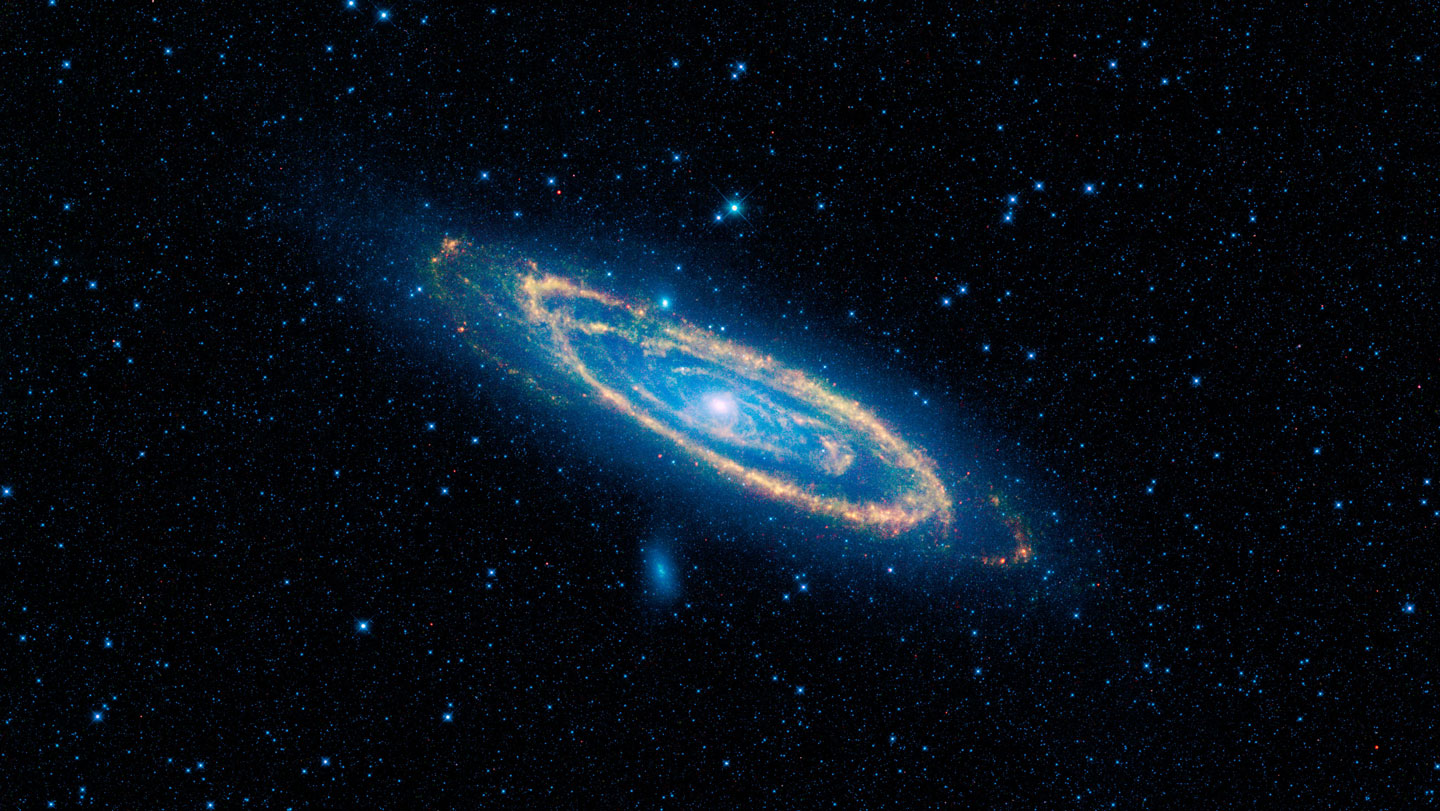
For seven years, a giant star in the Andromeda galaxy grew brighter. It swelled to more than twice its original size, even as its surface temperature barely changed. Then, in October 2025, it erupted. The slow brightening and sudden eruption tell a story of a smaller star orbiting inside of a massive star and what became of the pair, researchers report November 18 in Nature.
In work published last year, after poring through nearly 30 years of telescope data, astronomers had found that the giant began brightening in 2018 and proposed that a smaller star was circling ever closer around a giant companion and had even slipped inside its outermost layers. Astronomers call this elusive phase of a binary star’s life common-envelope evolution.
Now, the astronomers have analyzed the system’s dramatic next developments, culminating in the October 2025 eruption. (The stars are nicknamed Little Bao and Big Bao as a nod to that event’s official designation, AT 2025abao.)
First, astrophysicist Viraj Karambelkar of Columbia University and colleagues revisited those years of brightening given the imminent eruption. One cause of the brightening could have been gas flowing away from the stars, giving off light as it slowed down. But even if all the energy of that moving gas turned into light, it still wouldn’t be enough to explain the glow.
Instead, the researchers determined that the binary hypothesis they had originally proposed fit better: As Little Bao orbited inside Big Bao’s gas outer layers, the gas pushed back against the little star. That drag made Little Bao spiral inward and transfer energy to the surrounding gas. Some of that energy escaped as light, making Big Bao shine brighter.
Then, it was time to dig into what caused the eruption. If the outburst threw enough of the shared gas into space, the individual stars could have survived in an even tighter orbit. But the team estimates that only about a tenth of the giant’s outer gas escaped. The energy carried by that fast-moving gas also suggests that Little Bao reached Big Bao’s core. Together, those clues point to a merger.
Still, too much dust clouds the system to directly see what remains. And it won’t settle for years or even decades, although Karambelkar and his colleagues will be watching.
They’ll be looking for more examples of this type of merger, too. “Now we can go and try to look for similar systems,” Karambelkar says, “and hopefully aim to catch more of these systems even before they erupt.”
