


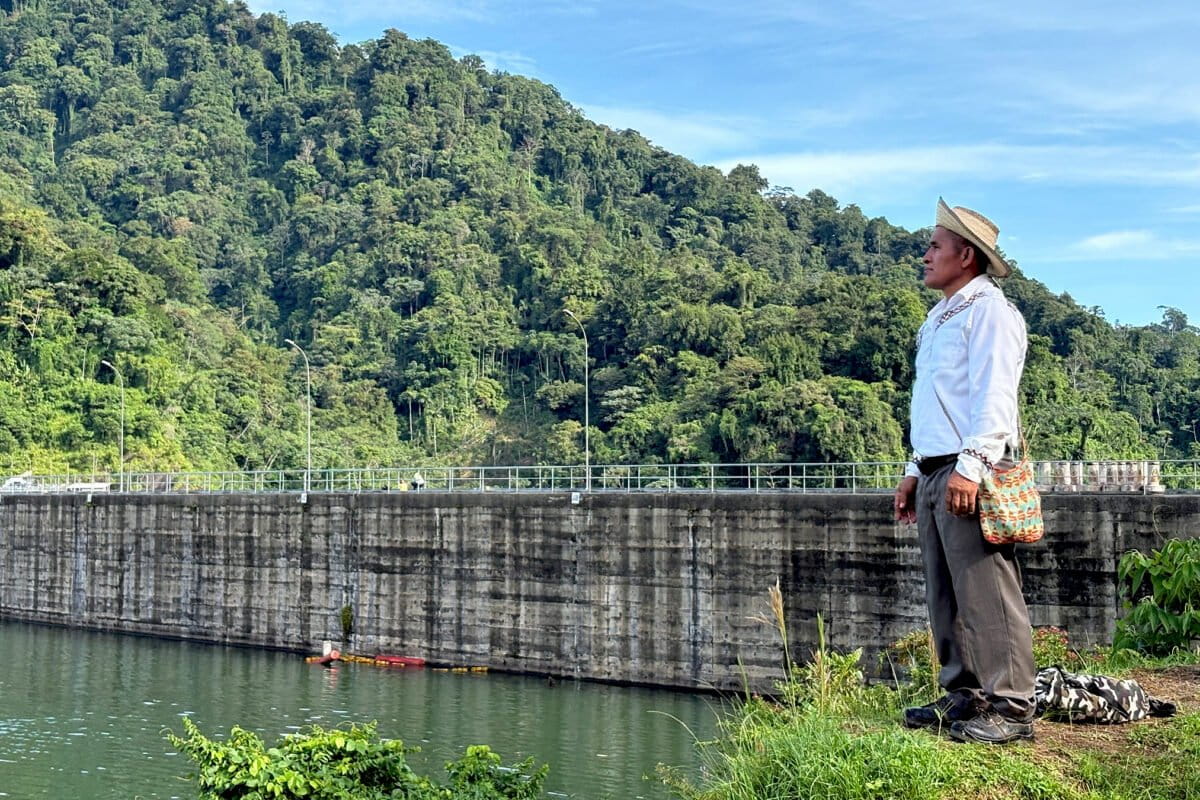
- The construction of the CHAN-75 hydroelectric dam on Panama’s Changuinola River in 2007 led to the displacement of Indigenous Ngäbe families, disrupted fishing, access to water, traditional livelihoods and culturally significant sites, according to a new report by Cultural Survival.
- Plans for a second dam have raised concerns among communities still awaiting reparations for the environmental, cultural and social damage caused by CHAN-75, who say the new project could lead to more threats.
- In 2021, the Inter-American Commission on Human Rights found that Panama had violated the rights of affected communities, but Cultural Survival says the government has yet to fully implement its recommendations.
- The state-owned electric power generation company (EGESA) has said that the project would support Panama’s transition toward renewable energy and increase the country’s installed generating capacity by approximately 9%.
Nearly two decades after construction began on the CHAN-75 hydroelectric dam project, Indigenous Ngäbe communities in western Panama continue to face severe environmental, cultural and spiritual impacts, according to a new report by the Indigenous rights organization Cultural Survival. It found that communities still suffer from displacement, pollution, the loss of local fish species, medicinal plants, spiritual practices and other threats to their livelihoods.
As communities continue to fight for reparations, Panamanian authorities have granted a concession for a second dam on the same river.
Ismael Quintero, a Ngäbe leader of the Guayabal community, said their lives changed completely when the state-owned electric power generation company Empresa de Generación Eléctrica (EGESA) began to build the first dam in 2007. “Crops were abundant, and there was free navigation along the Changuinola River,” he told Mongabay via WhatsApp voice messages. “Our whole family enjoyed the clean and healthy river at that time.”
For the Ngäbe people, the river traditionally holds deep spiritual and cultural significance. Quintero said it provides them with food, such as fish and shrimp, and serves as a source of inspiration and strength. It is sacred to them, he added. They traditionally believe that a spirit — the owner of the fish and river ecosystems — resides within it, and therefore, any catch is a gift from this spirit. For this reason, they offer prayers to the spirit before undertaking any activities there.
Now, the river’s natural flow has changed, and a lake has formed, meaning that access is no longer what it used to be, Quintero said. Many native fish species have disappeared entirely, and the water, which he says has been contaminated, is no longer safe for human consumption. While researchers have documented water-quality problems in the river, the extent to which these can be attributed directly to the dam remains unclear.
“When the [dam’s] floodgates are opened, fish — among other things — are crushed, and the resulting contaminated water flows downstream,” Quintero said. “Many people who rely on the river for navigation, consumption and other needs are now unable to use its water.”
When approached for comment, Panama’s National Energy Secretariat told Mongabay to reach out to EGESA, which did not respond to requests by the time of publication. EGESA has previously said that the project would support Panama’s transition toward renewable energy and increase the country’s installed generating capacity by approximately 9%.

Unresolved impacts
The Cultural Survival report describes the Changuinola River and the surrounding forest as areas of cultural and spiritual importance to the Ngäbe that strengthened their connection with their territory. It says homes, lands and culturally important places were damaged during the construction of the first dam, which was approved without adequate consultation with communities.
Panama defense program coordinators at Cultural Survival, Llenia May Pérez (Guna) and Ñushpi Quilla Mayhuay Alancay (Quechua Kolla), who authored the report, told Mongabay over email that during the construction, there were forced displacements, internal conflicts and situations of violence that left profound scars, especially on women and children.
“Some were arrested and imprisoned, even along with their children,” the authors said in a joint response. “These experiences left emotional wounds that, to this day, have not received adequate attention or reparations.”
Displacement also altered community spirituality alongside livelihoods, family relationships and cultural practices.
As many affected families were forced to relocate to Panama City, Quintero told Mongabay that traditional practices such as the guará dance is being lost, as well as the local language.

The report authors also described the loss of the pita plant (Aechmea magdalenae), previously found on the riverbanks of the Changuinola, due to the flooding of the territories. Its natural fibers are used by the Ngäbe to make chácaras, which are traditional baskets used to transport food, harvest products and belongings.
“The women harvested the agave, prepared its fibers, and crafted the chácaras using knowledge passed down from their mothers and grandmothers,” the authors said. “The loss of a plant also has economic and cultural consequences. It’s not just about losing a natural resource, but about affecting a traditional practice and the conditions for transmitting that knowledge.”
Other subsistence food sources, such as bananas, plantain, peach palm fruit and cacao, as well as livestock farming and medicinal plants, have diminished or are being lost altogether, Quintero said. The report said it is no longer possible for communities to access or practice traditional medicine as they did before.
In 2021, the Inter-American Commission on Human Rights concluded that Panama had violated the rights of the affected Ngäbe communities and issued a series of recommendations. Five years later, Quintero and Cultural Survival say the Panamanian government has not yet complied.

A second dam
Panama first granted a concession for Changuinola II, or the Bocas del Toro Hydroelectric Project, in September 2013, authorizing EGESA to develop another hydroelectric dam on the Changuinola River. The concession subsequently changed hands to Bocas del Toro Energía in 2016, before returning to EGESA in 2017.
Government records list January 2025 as the construction start date. But in March 2026, the country’s utilities regulator (ASEP) said the project is still in its final design stage.
The report authors say they are concerned that the state will move forward with the new project without having resolved the human rights violations associated with the first project.

“The state has granted a massive concession for this dam, effectively stripping the Indigenous people of their property and land,” Quintero said. “They are left without the means to work, live or build their communities. This is deeply concerning, and the pollution is only set to worsen.”
He said that given the “grave harm” CHAN-75 caused, the construction of a second project will likely have an even greater impact on the communities.
“We believe this project should not be built,” he said. “We are already enduring the initial consequences — facing countless hardships and negative impacts resulting from the existing construction.”
Banner image: Ismael Quintero, Ngäbe Indigenous leader from the Guayabal community. Image courtesy of Cultural Survival.
Panama delays promised relocation of sinking island community
Cite this article
Aimee Gabay (2026). Indigenous communities in Panama fear a second dam as damage from first goes unrepaired. Mongabay Conservation news. DOI: https://doi.org/10.66709/news-336272

