


In the chronicles of 21st-century diplomacy few statements have caused as much offence with as few words as Barack Obama’s 2014 description of Russia as a “regional power”.
Vladimir Putin’s politics were defined then, as now, by vengeful resentment of his country’s relegation from superpower status after the cold war. His worldview is warped by a paranoid conviction that Nato never stopped striving to deepen that humiliation, even after the USSR had unravelled. From his Kremlin throne, the Russian president expects to be treated as a colossus of world history. It is hard to overstate how bitterly he hated being dismissed by Obama as a geopolitical B-lister.
In Donald Trump, Putin has a ready supplier of balm to soothe his injured vanity. The US president has a shallow, venal concept of power. He is impressed by gilded palaces and heavily armed thugs. He feels thwarted by American democracy and envies tyrants who operate without equivalent restraint. Since Trump measures greatness in a country by its leader’s contempt for smaller nations and appetite for self-enriching plunder, he willingly promotes Russia back to the top tier.
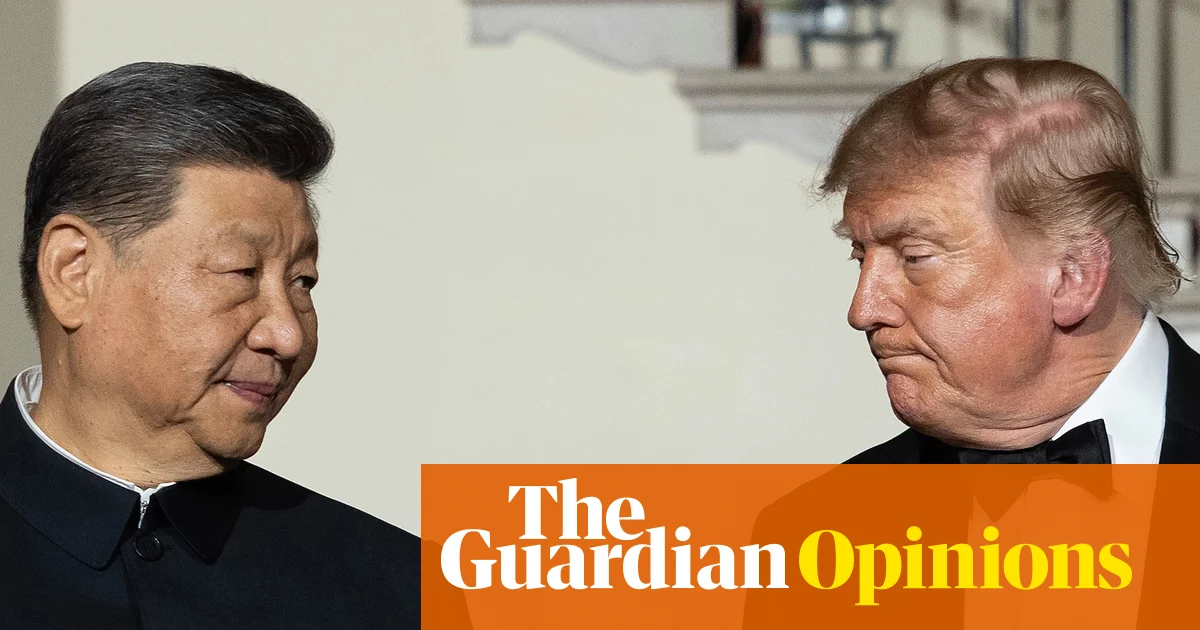
That is the significance to Putin of a three-way summit with Trump and China’s Xi Jinping in Shenzhen on Thursday. It confers trappings of parity with the world’s two genuine superpowers. That is a win for Russia, regardless of whether anything of substance is agreed.
The agenda is vague. The Chinese foreign ministry has said the discussion will focus on “safeguarding world peace” and “promoting strategic stability in major-power relations”. Xi will be satisfied with the projection of China as convener of a new world order. Trump has said he expects the conversation to cover denuclearisation, Iran, trade and “my favourite subject, Ukraine”.
The image of three leaders calibrating the balance of global power has been compared to Yalta, February 1945: Roosevelt, Stalin and Churchill drawing up plans for postwar Europe. That was a week-long conference where military allies were settling the fate of a defeated enemy. The analogy is revealing mostly as an expression of anxiety in those who will not be present.
For many Europeans, Yalta conjures memories of cynical partition, with eastern nations condemned to decades of Soviet captivity. The fear in Kyiv is that Putin will use his privileged access to Trump’s ear to pour in poisonous theories about the origins of the Ukraine war and how to end it – a twisted narrative of Nato provocation, irresistible Russian superiority and the need for Europe to stop wasting money and US military hardware on a losing cause.
The exclusion of European democracies from the room in Shenzhen is partly just a function of the conversation happening on the sidelines of a summit for countries with Pacific coasts. But it probes a deep strategic insecurity. Ukraine’s continental allies have asserted their rights to be part of any peace process but not found a way to turn that entitlement into a collective position, coordinated by a figure with diplomatic gravitas.
After a round of peace talks in Abu Dhabi last week, Jared Kushner, one of Trump’s envoys, made the reassuring statement that a deal could not be done “without Europeans being at the table”. By contrast, Russia’s chief negotiator, Vladimir Medinsky, accused the Europeans of lacking serious intent to find solutions. He dismissed their delegation to the Gulf as “tourists” who might as well “chat in the hotel bar”.
That is standard Kremlin trolling, but it cuts with a shard of truth. It points to an old problem, often described with the apocryphal tale of Henry Kissinger complaining that there was no number to call when he wanted to speak to Europe. The challenge is more acute today. The institutional and economic foundations of European influence are under assault. Trump is ambivalent at best about Nato. His administration is protectionist and nationalist. Maga ideology casts liberal democratic Europe as a moribund civilisation erasing itself with mass immigration.
China treats Europe as a bundle of consumers for manufactured exports whose politicians usually, by default, defer to Washington. The EU has ambitions of “strategic autonomy” but the process is slow and expensive. It means evolution from soft power – rivalling the US and China in economic heft as a single market whose regulations set global standards – to something a lot harder. European electorates may despise Trump and fear Putin, but they are not all comfortable with the choices that follow if the remedy is a shift in budget priorities to higher defence spending.
A lot of European politics in recent years has been driven with a longing eye on the rear view mirror, wondering if there is a way back to the old world of open trade, respect for international law, a White House that wouldn’t abet the Kremlin in an imperial land grab. But there is growing recognition that Europe’s future cannot resemble its recent past.
The UK is part of that story, and Andy Burnham has understood the implications. In a speech on Monday, the prime minister expanded his criticism of Brexit from the economic to the geopolitical arena. It was, he said, “the first domino to fall” in a pattern of global fragmentation. It introduced a schism in European alliances that was “exactly what our enemies wanted”. Burnham’s audit of the costs in forfeited trade was familiar enough, but he moved the argument up a gear by noting that withdrawal from the top table of European decision-making has cost Britain power and influence in the world. That is something continuity Brexiters cannot compute.
after newsletter promotion
As Burnham finds his pro-European voice, the old Eurosceptic myth-making industrial complex is grinding back into motion. Newspapers have published tenuous stories about the cost of restored alignment with Brussels and hypothetical migrant influxes. Veterans of the leave campaign are limbering up for a dismal dance around the 2016 totem pole. It is rotten from exposure to a decade of international storms.
Britain is a regional power that undervalued the amplifying effect of EU membership. The benefits of being in the club felt enough like great-power status to fool Eurosceptics into thinking they could go it alone. They cling to that delusion. Kemi Badenoch has written about Britain having “latent great power attributes”. She doesn’t have a theory of how those dormant traits will be awoken in a world carved into continental blocs.
Burnham’s plan is hardly precise, but at least he starts with facts: Britain is a European country; Europe will be safer and richer if it pools its resources; the UK should not want to be on the margin.
A summit where Xi, Putin and Trump claim to be deciding the fate of the world may not yield much in the way of concrete deals, but it still contains a warning to European democracies. And a choice. One option is to boost leverage through closer continental cooperation. The alternative is flight into fantasies of immaculate national sovereignty and resurrected historical grandeur. One of those routes is a way for Europe to grow autonomy, security and prosperity in the 21st century. The other is the path of bitter self-defeat modelled by Brexit.
