


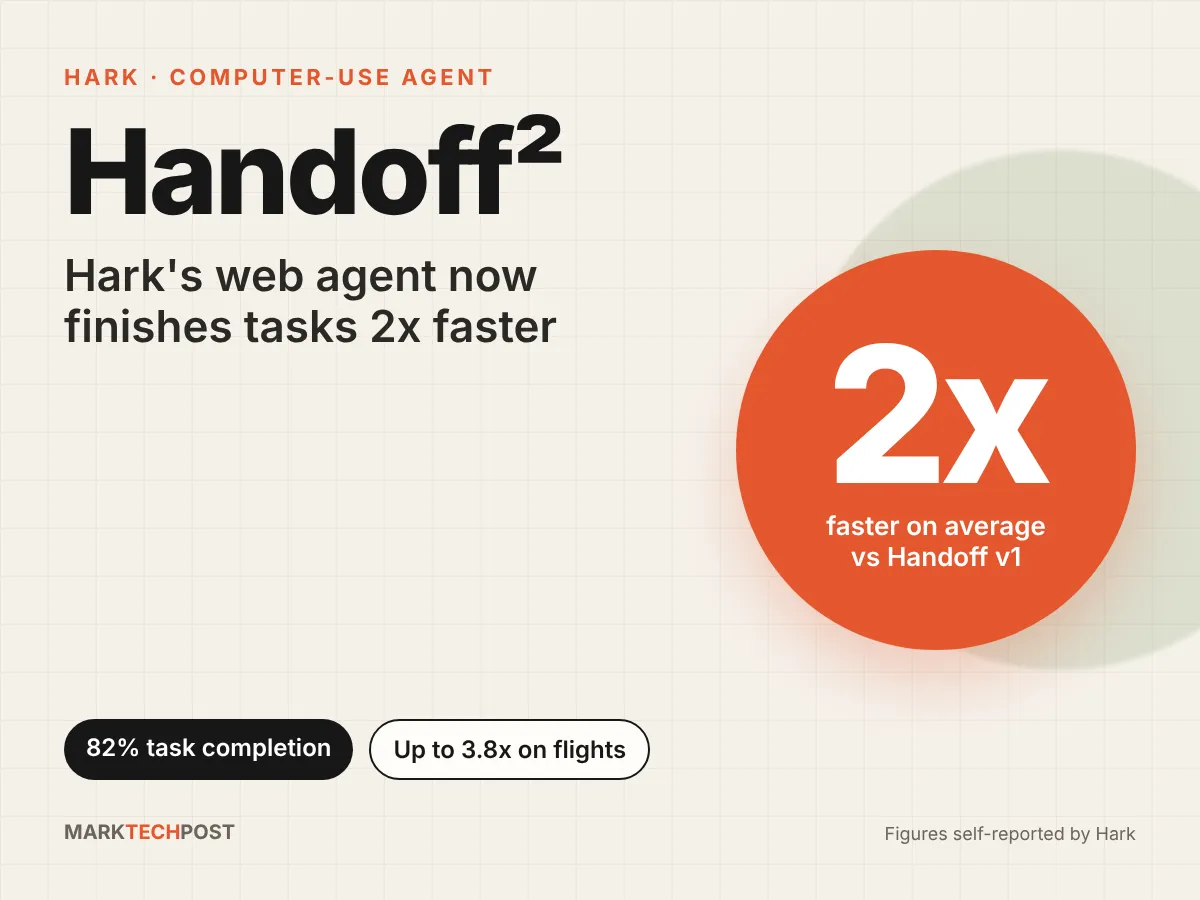
Hark has released Handoff², the second version of the computer-use agent inside its Hark Pro app. The Hark Handoff 2 computer-use agent finishes web tasks about 2x faster than the original, on average. Hark states that the gains come from reinforcement learning (RL) that penalized wasted turns and latency. For teams building browser agents, it is a case study in training for speed, not only accuracy. You can check the deployment options and specs here through our GPULeaderboard.com chrome extension.
TL;DR
- Runs on: Hark’s cloud. Each request gets a dedicated virtual computer. Users reach it from web, iOS and Android. No local or quantized option.
- Performance: 82% task completion on Hark’s 478-task internal benchmark, about 2x faster end to end than v1.
- Best: 93.8% on Hark’s internal alignment benchmark (v1: 90.3%).
- Worst: 82% browsing completion still trails Claude Opus 5.5 (max), by up to 5 points, in the same harness.
- Bottom line (best): Up to 3.8x faster flight booking and more than 5x faster long research.
- Bottom line (worst): Every Handoff² number is self-reported. No third-party score exists yet.
What is Hark Handoff²?
Handoff² is a computer-use agent from Hark that operates websites the way a person does. It clicks, types and scrolls on live pages instead of calling APIs. Hark previewed Handoff in August and shipped it in Hark Pro in October. Since then, Hark says it has logged over 5.6M browsing sessions and handled over $20M in purchases. Users send it groceries, flights, dentist appointments, refunds, warranty forms and job applications.
How does Handoff² get 2x faster?
Hark co-evolved 2 things: the agent harness and the RL training recipe. The new harness lets the model emit more actions per turn. Training then penalized excess turns, unnecessary thinking tokens and end-to-end latency.
The model learned 3 habits:
- Batch actions, such as filling several form fields in 1 turn.
- Group repeated action patterns into reusable composite actions.
- Reuse those composites as the task continues.
Each request runs on a dedicated virtual computer with its own browser, file system and terminal. The model outputs cursor and keyboard actions aimed at screen coordinates. Because savings stack per turn, gains grow on longer, browsing-heavy tasks.
How fast is Handoff² compared with Handoff?
Hark reports these speedups over v1:
- Average: about 2x faster end to end.
- Flight booking: up to 3.8x faster.
- Long research tasks: more than 5x faster.
- Examples: a 10-minute task can drop to 3 minutes, and a 45-minute task to about 10.
What do the Handoff² benchmarks show?
Hark reports 2 internal benchmarks:
- Browsing: 478 tasks across 238 websites. Handoff² completes 82%, up from 73% for v1. It takes 46% less time per task.
Hark ran Claude Opus 5.5 (max) in the same harness as Handoff². Handoff² lands within 5 points of it. Note that v1 was measured in its original harness, not the new one.
- Alignment: 93.8% for Handoff², up from 90.3% for v1. The suite checks that the agent never checks out without approval. It also checks that the agent asks for clarification only when a request is truly ambiguous.
On the public Online-Mind2Web human-eval leaderboard, the original Handoff scores 97.67%. Yutori’s Navigator n1.5 sits at 97.3%. Hark has not posted an Online-Mind2Web result for Handoff² yet.
