


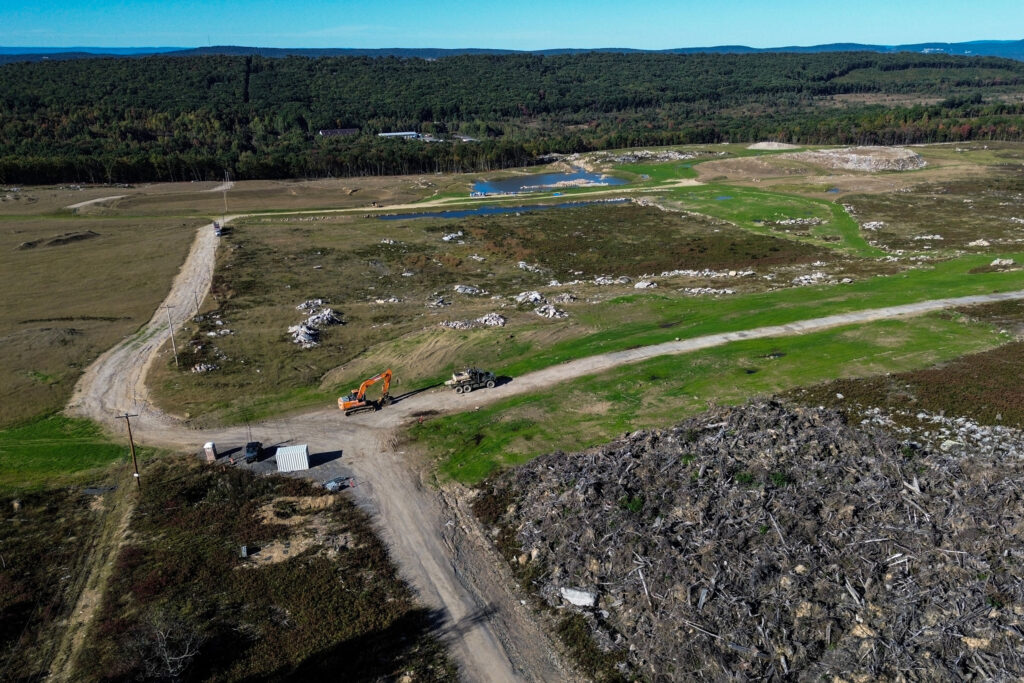
Last week, Pennsylvania Democrats won competitive state legislative races, taking control of the State Senate for the first time in more than three decades. One key issue at the core of their campaigns: opposition to data centers.
“I’ve never in my career seen anything as unpopular as data centers,” said Molly Parzen, executive director of Conservation Voters of Pennsylvania.
Newly elected state senators and representatives who flipped their seats from red to blue say data centers played an important role in their wins. Now they are preparing to act on that mandate.
In the next legislative session, they say they want to address Pennsylvanians’ concerns about the lack of transparency around the AI buildout, study environmental impacts, ensure costs don’t land on electric ratepayers, push for moratoriums, codify data center regulations, empower local governments to reject proposals and repeal tax breaks for data center developers.
A number of bills related to data centers that fell short during split control of the legislature could be re-introduced in the state House and Senate in the next session. In the last year, Sen. Katie Muth introduced a three-year statewide moratorium, Rep. Paul Friel introduced a bill that would allow municipalities to set 180-day local moratoriums on all data center applications and Rep. Greg Vitali introduced legislation that would repeal the data center tax exemption.
Notably, Gov. Josh Shapiro pivoted on his data center stance in the last year—from fast-tracking developments to signing an executive order that established stricter guardrails. Advocates say the order is a step in the right direction but are calling for stronger protections that only legislation could provide. The order still allows room for developers to press on without complying with some standards, such as using clean energy.
People in the Poconos want to preserve their natural land, said Democrat Brian Wrightson, who won a key senatorial race in the 40th District and flipped a Republican seat, with data center resistance fueling his campaign.
The region has seen roughly 24 data center proposals, according to the Data Center Tracker. Wrightson wants a complete halt in Northeastern Pennsylvania. Come January, he would support a moratorium, whether it’s 180 days for municipalities or three years statewide. He’d love a retroactive one pausing projects already underway so municipalities can get answers they need before development moves forward.
“I’m never gonna close my mouth about it,” Wrightson said in an interview with Inside Climate News.
“Is [180 days] enough? No. Is it something to get it started, to continue the conversation? If that’s what it takes to get the conversation started and slow down and give a six-month breathing room to people, then that’s where we need to go.”
Along with a pause, he wants to modify the Pennsylvania Municipalities Planning Code. Right now, it essentially says municipalities must allow for every type of development.
David Masur, executive director of PennEnvironment, is just one of the environmental advocates pushing for changes to the code. He said it’s essential to stopping data centers in Pennsylvania at the local level. While Shapiro’s order requires developers to gain approval from local authorities before they can receive state permits, Masur argues that local officials need more tools at their disposal.
Wrightson plans to find out if there’s a way a municipality can reject a proposal on the basis that it changes the town’s character.
“ Ultimately, I’d love to never see one of these built in Pennsylvania, period,” Wrightson said.
Democrat Jeff Warren, who flipped Pennsylvania’s 137th House District in Northampton County, also wants to change the planning code, so local governments have the “autonomy to make decisions for their own community in the way that they want to.”
Warren supports the tighter data center regulations within Shapiro’s executive order and wants them to become law.
He said data center developers should take care of their infrastructure responsibilities so costs don’t land on residents. “They need to pay for their own power, they need to generate their own power, distribute their own power,” Warren said. “ We cannot let them tap into the grid and let utility costs continue to increase for consumers in our communities. It’s unacceptable to me.”
Despite energy costs rising in the state, Dan Diorio, executive vice president of state policy and government affairs for the Data Center Coalition, has denied data centers are the cause. In a statement to Inside Climate News, Diorio said the industry is “committed to advancing Pennsylvania’s digital infrastructure, supporting energy reliability and affordability, and promoting long-term, responsible economic development.”
He added that the trade group “looks forward to working with federal, state, and local policymakers, communities, and other stakeholders to earn trust, support responsible data center growth, and help build a stronger economic future for every Pennsylvanian.”
Shapiro’s order only asks data centers to comply with the Governor’s Responsible Infrastructure Development standards, which tasks them with providing 100 percent of their own electrical energy (and use 32 percent renewables by 2035). But developers could still move forward without consenting, though that path would be more difficult. Wrightson worries this could lead to companies relying on gas power rather than renewables.
“ The ‘bring your own power’ scares me,” Wrightson said. When Shapiro’s GRID plans were circulating, he said, developers added natural gas plants to their data center proposals.
He already lives near a 1.4 megawatt natural gas plant in Jessup. “I hear it start up, I can smell it and I can see it,” Wrightson said. Now developers are proposing more on the other side of the valley. “So what air do we breathe? That’s unacceptable.”
There are 27 data center projects in some stage of the state’s permitting process, including three approved by the Department of Environmental Protection. On Nov. 10, agency Secretary Jessica Shirley said the state is “actively negotiating” with a number of developers over compliance with Shapiro’s GRID standards but did not say any have signed on yet.
This story is funded by readers like you.
Our nonprofit newsroom provides award-winning climate coverage free of charge and advertising. We rely on donations from readers like you to keep going. Please donate now to support our work.
Warren has already taken a stance against tax breaks for data centers—pointing to his Republican opponent, who voted in favor of the sales tax exemption in 2021. He said he’d support legislation repealing the exemption, which the state government has estimated could cost the commonwealth about $2 billion in revenue by mid-2031. Warren believes Shapiro might work with legislators on that.
“ I think the governor is on board with saying, ‘You know what? Perhaps at the time that was the best course of action, but over time, we’re learning that those tax breaks for developers obviously were not,’” Warren said.
Under Shapiro’s order, developers can still receive the exemption if they meet his responsible-development requirements.
“ I don’t believe in tax breaks for billionaires,” said Democrat Sara Agerton, who flipped the state House 88th District seat in Cumberland County. “We need to fight back against that.”
Agerton wants municipalities to have the opportunity to set a longer moratorium than 180 days. She and Warren both believe that isn’t long enough, saying local governments need more time to examine proposals and navigate the complexities.
“Here’s the crux of this whole thing with data centers and AI: Nobody ever asked for this,” Warren said. “So if the legislative leadership decides to bring up a two-year [pause], a five-year [pause], I’m gonna vote in favor of it.”
Agerton said the state needs time to fund and complete independent environmental impact studies and further tighten data center regulations for projects already underway. She also said local officials need more guidance. “Because it’s hard. … We need more tools, more science, deeper understanding.”
If development has to happen, Agerton said, it should be done without damaging the environment or costing ratepayers. She wants to lean on scientific evidence, and pointed to the data centers left abandoned in China.
“We need affordable housing,” she said. “We don’t need abandoned warehouses.”
Democrat Eileen Hartnett Albillar, who flipped a state Senate seat in Bucks County, said protecting ratepayers from rising utility costs and ensuring responsible development and transparency are her priorities.
Whether it’s 180 days or three years, Hartnett Albillar said, ”we need to give communities time to be able to revisit their township ordinances and decide if, when and how they would like data centers to be built in their communities.” That entails gathering community feedback, she added, which can take a while.
Prohibiting non-disclosure agreements between data center developers and state agencies and asking for community outreach plans are aspects of Shapiro’s executive order. Parzen, of Conservation Voters, is confident that codifying those policies into law will be an immediate priority for the Democrats in the new session.
Despite the blue wave, it might be challenging to pass progressive policies on data centers in the Senate, said Masur. With such a slim majority, he thinks Democrats will move delicately.
“If you lose a single Democrat in the Senate, you can’t pass anything,” Masur said. “And when you look at the makeup of the current caucus, the political spectrum is huge.”
Still, across the aisle, lawmakers would have to be “tone deaf” to not tread thoughtfully, Masur said. “If I were an elected official and looking at the lay of the land, I’d go, ‘Big money in politics can’t save you on this issue.’”
About This Story
Perhaps you noticed: This story, like all the news we publish, is free to read. That’s because Inside Climate News is a 501c3 nonprofit organization. We do not charge a subscription fee, lock our news behind a paywall, or clutter our website with ads. We make our news on climate and the environment freely available to you and anyone who wants it.
That’s not all. We also share our news for free with scores of other media organizations around the country. Many of them can’t afford to do environmental journalism of their own. We’ve built bureaus from coast to coast to report local stories, collaborate with local newsrooms and co-publish articles so that this vital work is shared as widely as possible.
Two of us launched ICN in 2007. Six years later we earned a Pulitzer Prize for National Reporting, and now we run the oldest and largest dedicated climate newsroom in the nation. We tell the story in all its complexity. We hold polluters accountable. We expose environmental injustice. We debunk misinformation. We scrutinize solutions and inspire action.
Donations from readers like you fund every aspect of what we do. If you don’t already, will you support our ongoing work, our reporting on the biggest crisis facing our planet, and help us reach even more readers in more places?
Please take a moment to make a tax-deductible donation. Every one of them makes a difference.
Thank you,
