


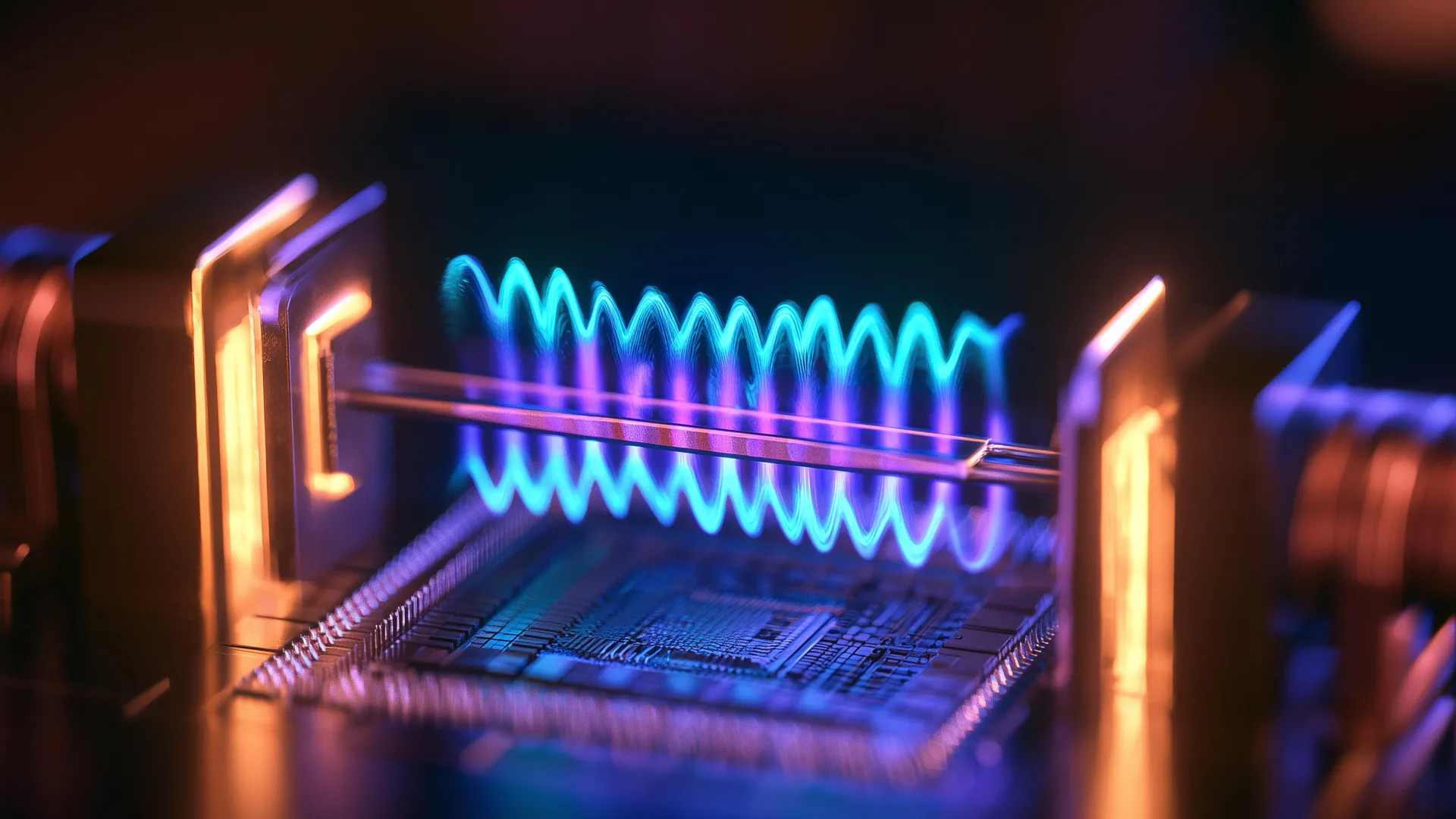
A quantum computer might seem to have little in common with a guitar, but researchers at ETH Zurich have found a surprising connection. Physicist Yiwen Chu and her team have developed a system that uses microscopic mechanical vibrations to store and manipulate quantum information, much like the vibrating strings of a guitar produce musical notes.
Unlike the sounds produced by a musical instrument, these vibrations occur at frequencies far beyond human hearing. They take place within a tiny quantum chip, where they serve as a new form of computer memory.
By harnessing these vibrations, the researchers have created a way for quantum computers to process information efficiently while accessing a flexible working memory. “The interaction between the quantum processor and the quantum memory provides a crucial foundation with a view to establishing quantum computers as a powerful and reliable way to perform computations that are not feasible with conventional computers,” says Yiwen Chu.
The breakthrough, described in the journal Science, introduces a different approach to quantum computer design. Instead of closely integrating information processing and storage, as many existing systems do, Chu’s team has developed an architecture that gives these functions more distinct roles.
Quantum Memory Inspired by Conventional Computers
The researchers drew inspiration from the basic design of everyday digital computers. In a conventional machine, the central processing unit (CPU) carries out calculations while information is held separately in working memory, commonly called random access memory (RAM). The arrangement of these components plays an important role in determining how efficiently a computer operates.
Chu’s quantum system follows a similar principle. A superconducting qubit acts as the processing and control unit, performing a role comparable to that of the central processing unit (CPU). Meanwhile, a separate quantum memory temporarily holds the information needed during calculations, allowing the processor to retrieve and modify it as necessary.
The major difference lies in how that information is stored.
“In our quantum working memory, however, information is not stored electromagnetically — as is usually the case today — but rather in the form of mechanical vibrations,” explains Chu.
Quantum computers take advantage of unusual properties of quantum physics, including superposition, which allows quantum systems to exist in combinations of different states, and entanglement, which creates powerful connections between quantum states. These effects could eventually enable quantum machines to tackle certain extremely complicated calculations much faster than conventional computers, including some problems that are currently beyond their practical capabilities.
Why Vibrating Quantum Memory Could Be Better
One of the greatest challenges in quantum computing is maintaining precise control over quantum information. The states used for calculations are delicate, and even small disturbances can cause information to be lost. To perform calculations reliably, the processor and memory must interact closely enough to transfer and manipulate quantum states with high precision.
In the new system, microscopic structures called mechanical resonators hold information in particular patterns of vibration. When the superconducting qubit needs that information, it accesses the stored vibrational state, performs the required operation, and returns the modified information to memory.
Many existing quantum computers instead use electromagnetic memory alongside superconducting qubits. Researchers understand these technologies well, and they can be combined to provide extremely accurate control over quantum states, including reading, changing, and manipulating stored information.
However, electromagnetic memory systems have a significant disadvantage. They can occupy considerable space, making it difficult to expand experimental quantum devices into the larger, more capable computers that researchers and industries ultimately need.
Mechanical resonators offer several potential advantages. They are substantially smaller, allowing more compact designs. They can also support numerous different patterns of vibration, providing opportunities to store more information simultaneously than conventional electromagnetic memory.
Another important benefit is that mechanical vibrations can preserve quantum states for longer periods before the stored information begins to fade. Longer storage times could make it easier to carry out complicated calculations that require information to remain available throughout multiple processing steps.
New Quantum Computer Passes Major Tests
The research published in Science provides the first experimental demonstration that mechanical resonators can work together with superconducting qubits to carry out quantum computations. The results establish that vibration-based memory is a feasible alternative to electromagnetic storage.
The achievement goes beyond simply storing information. Chu’s team demonstrated that its architecture can handle both relatively straightforward calculations and more demanding quantum operations.
To evaluate the system, the researchers tested two important computational techniques: the quantum Fourier transform and period finding. Both are fundamental tools in quantum computing and require a computer to coordinate multiple quantum states with considerable precision.
“The Quantum Fourier Transform is a fundamental computational procedure required for many quantum algorithms. The period-finding algorithm we implemented served as a demonstration of how this procedure can be used,” explains Igor Kladaric, doctoral student in Chu’s team and co-author of the publication.
Successfully completing these tasks requires the system to store, control, and maintain coherent relationships among multiple quantum states at the same time. The experiments showed that the new architecture can meet these requirements, providing strong evidence that it can support genuine quantum computation rather than simply function as a memory device.
A Promising Step Toward Powerful Quantum Computers
One of the most significant findings is that the new system can, in principle, carry out all the fundamental operations needed for arbitrary quantum computations. This means the architecture has the essential capabilities required for a programmable, general-purpose quantum computer.
However, demonstrating those capabilities in an experimental chip is only the beginning. The next major challenge is scaling the technology to larger systems with greater processing power while preserving the precision and reliability demonstrated in the laboratory.
Chu and her colleagues are continuing to investigate how their approach can be developed further. Its long-term success will depend on whether mechanical quantum memory can remain effective as more components and increasingly complex computations are added.
Practical quantum computers powerful enough for widespread scientific and industrial applications are still some distance away. Nevertheless, by showing that tiny mechanical vibrations can serve as compact, capable quantum memory, the ETH Zurich team has demonstrated a promising new route toward making those machines a reality.
