


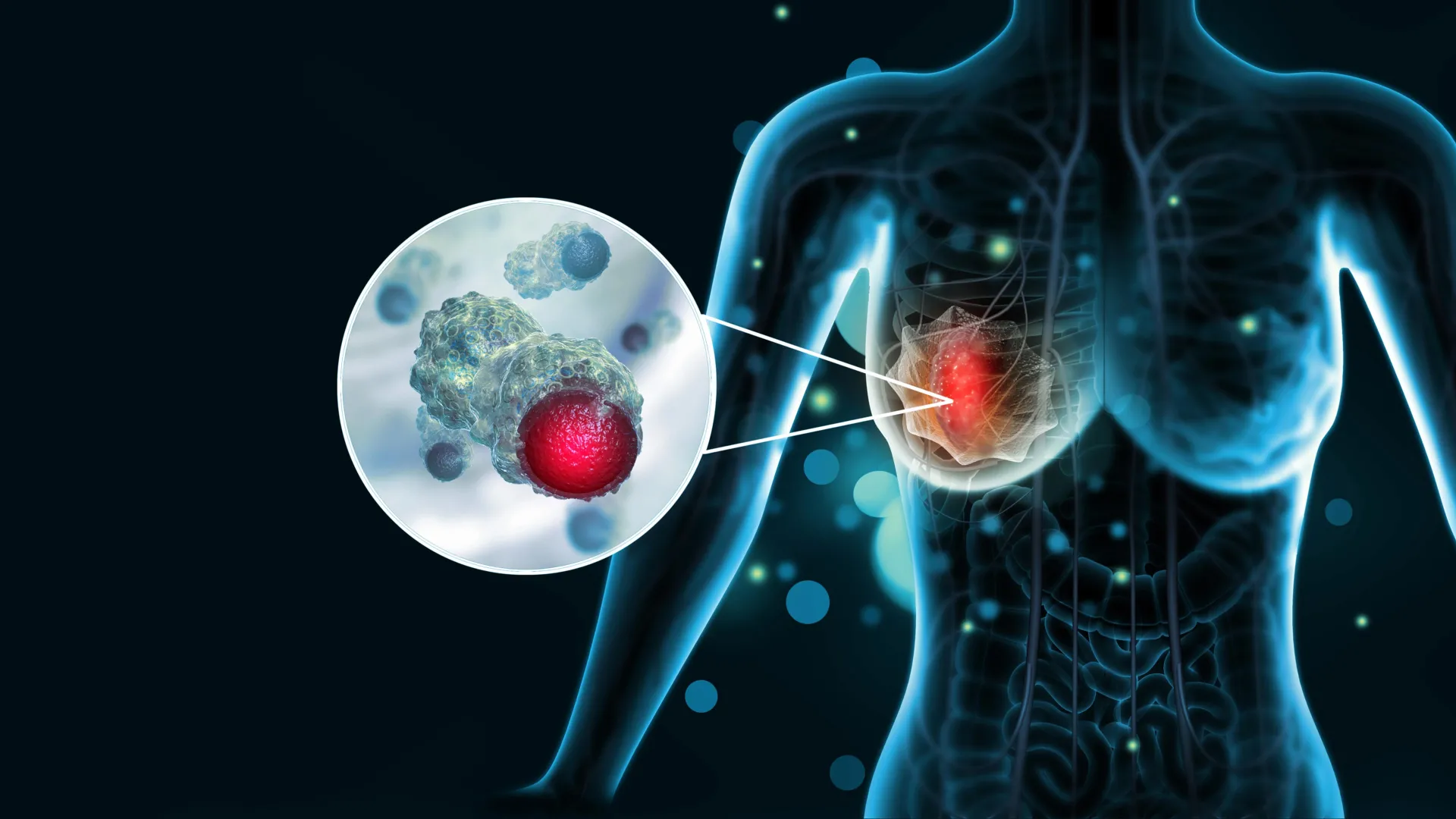
Women with higher blood levels of two common “forever chemicals” may face an increased risk of developing a particularly aggressive form of breast cancer, according to new research from the National Institutes of Health (NIH), part of the U.S. Department of Health and Human Services (HHS).
The study identified a connection between estrogen receptor-negative, or ER-negative, breast cancer and two widely encountered chemicals: perfluorooctanoic acid (PFOA) and perfluorooctanesulfonic acid (PFOS). Women with greater concentrations of these substances in their blood were more likely to develop this type of cancer. However, researchers found no clear link between either chemical and breast cancer risk overall.
Both substances belong to a large family of per- and polyfluoroalkyl substances, commonly called PFAS. These chemicals have been used in numerous everyday consumer products and are often described as “forever chemicals” because they resist breaking down in the environment. They can also accumulate in the human body and remain there for years.
“Women deserve clear answers about how chemicals in their environment may affect their health,” said HHS Secretary Robert F. Kennedy, Jr. “This NIH study links two forever chemicals to a higher risk of ER-negative breast cancer and demands further investigation. Under President Trump’s leadership, we will pursue the evidence, confront environmental health risks, and give women the information they need to protect their health.”
Why This Aggressive Breast Cancer Is Concerning
ER-negative breast cancer differs from more common forms of the disease because its tumor cells lack the receptors that allow estrogen to stimulate cancer growth. These cancers are often more aggressive and generally have poorer outcomes than tumors that respond to estrogen.
Despite their severity, researchers still have relatively little information about what makes someone more likely to develop ER-negative breast cancer. The new findings suggest that exposure to certain persistent environmental chemicals could be one contributing factor.
“Our findings, which we confirmed using a meta-analysis of prior research, indicate that certain legacy PFAS, including PFOA and PFOS, are associated with a higher risk of ER-negative breast cancer, a more aggressive tumor type with few known risk factors,” explained NIH Stadtman Investigator Alexandra White, Ph.D., who led the study.
The findings were published in the Journal of Clinical Oncology.
Higher Forever Chemical Levels Linked to Greater Cancer Risk
To investigate the possible connection, NIH scientists and their collaborators examined blood samples that had been collected years before participants received a cancer diagnosis. The researchers measured concentrations of 17 different PFAS chemicals, allowing them to compare earlier exposure levels with subsequent breast cancer outcomes.
The results revealed substantial differences for two chemicals. Women in the highest PFOA exposure group had a 67% higher rate of ER-negative breast cancer than women in the lowest group. The association was even stronger for PFOS, with the highest exposure group showing a 93% higher rate, nearly twice that of the lowest group.
These percentages represent relative differences between groups rather than the absolute probability that an individual woman will develop breast cancer. The findings also establish an association, not proof that the chemicals directly cause the disease.
The analysis used data from the Sister Study, a major research project conducted by NIH’s National Institute of Environmental Health Sciences (NIEHS). Between 2003 and 2009, the study enrolled 50,884 women ages 35-74 from across the United States and Puerto Rico.
All participants were free of breast cancer when they enrolled, although each had a full or half-sister who had already been diagnosed with the disease. For the PFAS investigation, researchers analyzed information from 1,609 women who subsequently developed breast cancer and a comparison group of 2,269 women.
Could Reducing PFAS Exposure Lower Cancer Risk?
Although PFAS can remain in the environment and the body for long periods, researchers emphasize that exposure is not necessarily unavoidable. The findings could eventually help identify new ways to reduce the risk of aggressive breast cancer.
“These findings matter for women’s health broadly,” said first author, Che-Jung Chang, Ph.D., who previously worked as an NIH research fellow and is now a researcher at DLH, a scientific research organization. “Although PFAS are persistent in the environment and in our bodies, exposure to them is still potentially modifiable, meaning people can take steps to reduce their exposure, and these findings could open new avenues for prevention.”
The researchers are also interested in understanding how these chemicals might influence cancer development. Because the strongest associations appeared in tumors that lack estrogen receptors, the findings suggest that PFAS could act through biological processes unrelated to hormonal signaling.
Potential explanations include changes in gene activity or alterations in the immune system. However, the study did not directly investigate these mechanisms, so their involvement remains uncertain.
Newer Forever Chemicals Raise Unanswered Questions
Although PFOA and PFOS have largely been phased out and replaced with other PFAS compounds, measurable amounts of both substances are still present in most people’s bodies. Their persistence means that exposure to these older chemicals remains a potential public health concern.
The researchers say additional investigations should focus on populations with greater PFAS exposure, as well as groups that experience higher rates of ER-negative breast cancer. Such research could help clarify the strength of the observed associations and identify whether certain populations face greater risks.
Scientists also need to determine whether the newer chemicals introduced as replacements for PFOA and PFOS carry similar health concerns.
“More research is needed, particularly evaluating the risk of breast cancer associated with newer replacement PFAS chemicals,” White said.
The findings add to growing questions about the long-term health effects of forever chemicals and highlight the importance of understanding how environmental exposures may contribute to aggressive forms of breast cancer.
The research received support from NIEHS grants Z01ES044005; Z1AES103332; and R01ES032831.
