


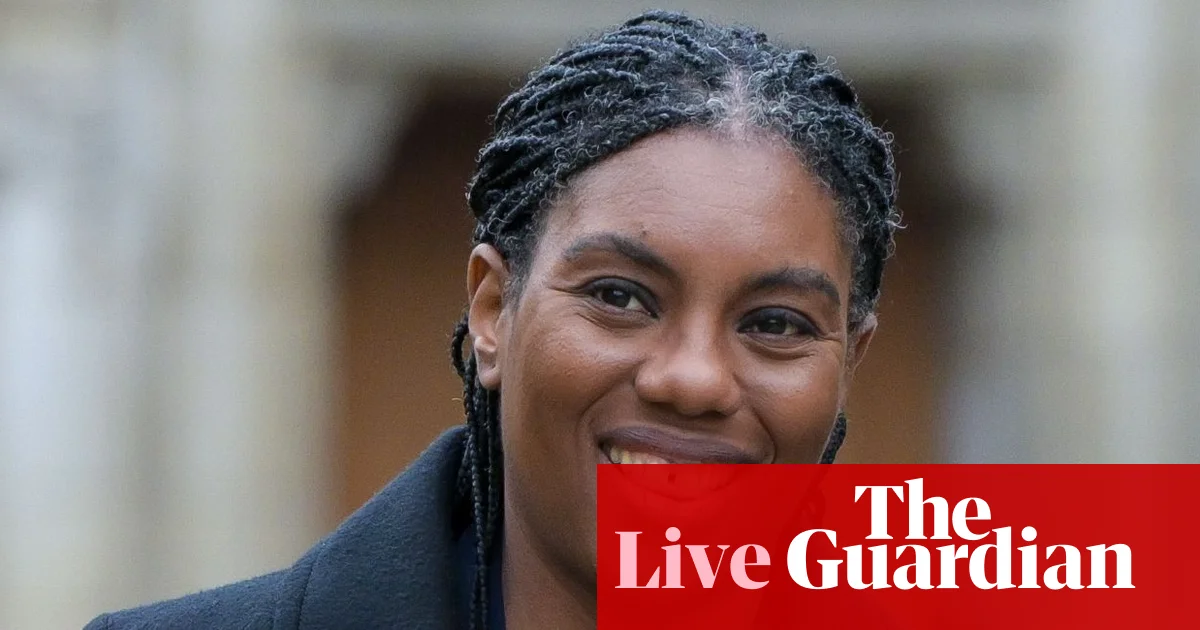
Badenoch says ‘double amputees run marathons’ as she defends plan to slash disability benefits as part of £36bn welfare cuts
Good morning. It is quite easy for politicians to declare that they will cut the welfare bill by X amount – but much harder when they have to explain exactly who will lose out. This is summed up by a good anecdote about a former chancellor (Ken Clarke, according to some versions, but it could have been any of them), who gave this reply when asked for cuts that would save £1bn:
So, do you want one million people to lose £1,000 each, or 10 million people to lose £100 each?
Today Kemi Badenoch is giving a speech to launch a policy document, Welfare That Works, explaining how the Tories would cut welfare by £36bn. That’s 36 million people losing £1,000 each, according to the logic of our notional chancellor, although of course it is not quite as simple as that. All of these cuts are ones that the Conservative party has proposed already, but what we are getting today is a bit more detail about how some of them would be implemented in practice, and a big overall argument defending them.
Here is a page from the document summarising where the cuts would fall.
I will post more on the detail in the document later.
According to extracts from her speech released in advance, Badenoch will say that she is publishing these proposals now so that voters do not get any “nasty surprises” if they elect a Tory government.
It is too late to work out what you think once you’re in government. If you want to change this country, you need to know exactly what you want to do and how you’re going to do it …
We’re telling people what we are going to do now so that there will be no nasty surprises from us such as cutting your winter fuel payment, the jobs tax or the family farm tax once we get into government.
Badenoch will also claim that spending on working-age benefits is “crushing our economy”. More than a third of her proposed savings would come from cuts to sickness and disability benefits, and Badenoch will claim there is a “fundamental difference” between Conservative and Labour thinking on this issue. She will say:
Labour MPs think cutting welfare is always cruel. They believe the kindest thing you can do for someone who is struggling is to tell them it’s okay not to look after themselves. That there’s nothing wrong with a life of dependency. And if you don’t think very hard about it, I can see why you might believe that is kind. Of course, there are people who genuinely cannot work. People with serious illnesses and disabilities. People who need time to recover. We must have a safety net for those people.
But the reality is that millions of people can and do contribute to our economy to their families to their communities even when they face serious challenges. Double amputees run marathons. People who are housebound do wonderful creative work from home. People with autism run some of the biggest tech companies in the world.
If you tell a young person that their ADHD means they are defective and will never amount to anything, that mindset is likely to be more destructive to their future than the condition itself. That is what our welfare system is currently doing. Conservatives believe in a system that looks at people through the lens of what they can do, not what they cannot.
In fact, this is a misleading caricature of Labour thinking on welfare; the government is about to publish a report from Alan Milburn that will be 100% dedicated to making the system more focused on what young people “can do, not what they cannot”. But, as is often the case with Badenoch’s rhetoric, it crystalises an argument and makes for a good headline.
Here is the agenda for the day.
9.30am: Andy Burnham chairs a political cabinet.
10.30am: Kemi Badenoch gives a speech on her plan to cut benefits by £36bn.
11am: Michael Marra gives what is being billed as his first major speech since becoming Scottish Labour leader.
11.30am: Alex Norris, the justice secretary, takes questions in the Commons.
Noon: Downing Street holds a lobby briefing.
I’m afraid we are no longer able to have comments open below the line every day on this blog. If you want to contact me, please email politics.live@theguardian.com. You can use this email to flag up corrections, comments for publication, questions or complaints.
Key events
Q: [From Nomia Iqbal from the BBC] If you spend money to get people into work, aren’t you just spending money to get them off the unemployment register.
Whately does not accept that. She says it can make sense to support people into work.
Q: Do you still think the government is not doing enough to help the US in its war against Iran?
Badenoch says Iran is an enemy.
And she says it is “very concerning” that the Americans are withdrawing aircraft from bases in the UK.
And our government has got absolutely nothing to say about it. So we need to focus on what is actually happening right now. The world is becoming more dangerous and I want our government to get serious about it rather than spend time, you know, doing goodness knows what’s on TikTok.
Badenoch and Whately are now taking questions.
Q: [From Rob Powell from Sky News] We are running a report on the Netherlands, where youth unemployment is much lower than in the UK, but the amount they spend on getting people into work is much higher. Do you want to spend more on job training and support?
Badenoch says Labour killed jobs with its jobs tax (the rise in employer national insurance).
Whately says the Tory plan would involve intensive support for young people to get them into work. But it would be stricter than Labour’s version, because young people will lose their benefits if they don’t show up.
Whately says the government will publish Alan Milburn’s plan to tackle youth unemployment next week.
But this will involve higher spending upfront, she says (because the government wants to invest in support to get people off benefits into work).
She says the Tory approach would be different; they would help more young people into work by cutting employer national insurance for under-25s, and getting rid of some of the measures in the Employment Rights Act that make hiring people more expensive.
Helen Whately, the shadow work and pensions secretary, is speaking at the launch now, giving details of the proposed cuts.
She starts by describing a mum, Nicky, who came to see her because her son, who has autism and ADHD, had now incentive to get a job because he was getting benefits.
She’s frustrated the state is paying him money to stay at home, and she desperately wants the job centre to get on his case. But there’s no sign of that. So Jack is literally left to his own devices, gaming in his bedroom most of the time. Who would want that life for their child?
Whately claims stories like this were increasingly common.
She says that, since becoming shadow work and pensions secretary, she had spoken to many people – jobcentre coaches, tribunal judges, Pip assessors. psychiatrists, GPs, charity workers and government insiders – all frustrated by the way the system works.
People are making a mockery of the system, bragging about their free Motability cars, flaunting their new keys on TikTok. They think it’s a victimless crime. It isn’t. Eighteen million households will each pay £50,000 in taxes for working age welfare.
She claims that Labour had made made benefits “more generous and easier to claim”.
The Tories will change this, she says.
Today we’re publishing publishing the detail behind our savings policies. We will tighten eligibility for sickness benefits so you can no longer claim for mild mental health and routine back and joint pain and reform.
Badenoch claims Burnham ‘lacks the will to even try to cut welfare’
Kemi Badenoch is now delivering her speech at the launch of the Conservative paper giving details of its proposed £36bn welfare cuts.
She says:
Britain is now handing out more than £180bn a year in benefits to working age adults. It’s hard to comprehend just how big that number is. It’s more than we spend on our army, our schools and our police combined. It is more than £4,000 for every taxpayer in the UK. It is more than the entire GDP of Ukraine.
The weight of this welfare burden is crushing our economy and plunging us deeper and deeper into debt. There is no world in which the current system is sustainable and not just because of the cost.
And she criticises Andy Burnham for suggesting in a recent interview that welfare cuts could lead to people committing more crime. She says:
Labour think that, if someone is struggling, the answer is always to give them more money. The prime minister even said that unless we give people benefits, they will commit to crime. This is a terrible view of human nature.
In that interview, Andy Burnham criticised all £36bn of savings. That is because he lacks the imagination, he lacks the will and he lacks the support of his party to even try to cut welfare.
Badenoch was referring to an interview Burnham gave to ITV where he said:
If [the Tories] were to do that, there’d be another big number over here for the utter chaos that they cause in people’s lives. If you just go to brutal cuts, you will leave people in absolute crisis and then they will be going into other services in a chaotic way.
If you come at it from a numbers game, you’ll just make those cuts and you’ll throw people into crisis, so the £36bn won’t be a number that will hold because you’ll be spending money on people in A&E and the police, [the] criminal justice system.
‘It was different era’ – Lucy Powell defends her role in letting Russell Brand interview Ed Miliband during 2015 election
In an interview this morning, Lucy Powell defended her role in arranging for Ed Miliband to do an interview with Russell Brand during the election campaign in 2015, when Miliband was Labour leader. Powell was vice chair of the election campaign and was said to be one of those encouraging Miliband doing the interview with Brand, who was already controversial at the time but was also seen as being influential with younger voters.
Powell told Sky News that Brand at the time had a “powerful platform” with his online show, The Trews.
She said:
It was a long time ago, obviously and had I or Ed Miliband or anybody at the time had any sense at all that this was someone who was a sexual predator, who was involved in these sorts of crimes.
I think like anybody who would have paid to go to his show, would have watched him on TV, who was his employer at the time, who had interactions with him – anybody, including those of us who were involved in that at the time – would look back and really regret that, knowing today what we now know.
As the Press Association reports, by the time the interview took place, Brand had already lost his BBC Radio 2 show for leaving a series of lewd messages on actor Andrew Sachs’ answerphone about a romantic liaison with his granddaughter, been fired from XFM for reading pornography on air and detailed his womanising in his autobiography.
Asked about her role in setting up the interview, Powell said:
Look, we were in very different times. We weren’t in the social media age at the time, so where you could maybe search things up and see allegations or things about somebody at the time.
And, as I say, if there was any suggestion at all, we were dealing with someone who was a known sexual predator at the time then, of course, no one would have done that.
But as I say, he was a well-known public figure. Lots of people, from Hollywood to the BBC to many others, gave this person a very, very powerful platform.
We didn’t know at the time and unfortunately, maybe had people come forward or felt able to … it was a different era.
Here are pictures of some of the ministers arriving for cabinet this morning.
DfE toughens up guidance to keep smartphones out of schools, saying ‘not seen, not heard’ rules aren’t enough
Lucy Powell was giving interviews this morning in part to publicise an announcement from the Department for Education beefing up guidance on mobile phones in schools in England. As the BBC reports, schools are already supposed to be phone-free, but in many places this just means they operate a “not seen, not heard” policy, allowing pupils to retain their phones in their bags.
The new guidance, which will come into force in September next year, will require schools to adopt a tougher approach. The DfE said:
Schools should be a place that provides a clear break from those pressures, protecting the school day as a time to learn, connect and engage with others.
While most schools set out that phones should be not seen and not heard, only 16% of secondary pupils say phone rules are followed all of the time, and with the rapid increase in technology take-up and emerging evidence, pupils, schools and parents need more clarity.
Some schools are already putting stronger whole-school approaches into practice through lockable pouches, collection at the start of the day, secure storage or prohibiting phones onsite altogether.
The strengthened guidance will build on this leadership, giving every school clearer backing to keep phones inaccessible and helping parents and pupils understand what a truly phone-free school day means.
Laura Trott, the shadow education secretary, welcomed the announcement, saying that “this sudden outbreak of common sense is welcome” and that a proper ban on smartphones in schools was what the Conservatives had been calling for.
Caroline Voaden, the Lib Dem schools spokesperson, said the new guidance was “a positive step”, but that the government should ensure schools had the funding to implement it properly.
US reportedly evacuate aircraft from RAF Mildenhall over Iran threat
The US military has reportedly evacuated aircraft from a second airbase in Britain after a threat from Iran, Jamie Grierson and Dan Sabbagh report.
Lucy Powell, the deputy Labour leader and education secretary, was giving interviews on behalf of the government this morning. Asked about the RAF Mildenhall story, she told Sky News:
I can’t comment on those sort of live operations, as you know.
But we’re constantly keeping the security of our bases under review and, as we’ve seen with other cases recently, we take firm and quick action where we need to.
Labour says Tories can’t be trusted to solve welfare problems ‘they created in first place’
Here is the statement the Labour party released overnight in response to the advance briefing about the Tory plans to cut benefits by £36bn. A Labour spokesperson said:
The Tories let the welfare bill soar on their watch. Now they have the audacity to pretend it was nothing to do with them. You can’t trust them to solve problems they created in the first place.
The Conservatives designed and implemented this benefit system, which has driven large numbers of people to be signed off and written off. In the Tories’ last year in government, the welfare bill rose by a record £33bn.
Labour is tackling the collapse in face-to-face assessments, bringing in personalised employment support for sick and disabled people and spreading opportunity to young people through the Youth Guarantee. Further reforms will follow the Milburn and Timms Reviews.
Badenoch says ‘double amputees run marathons’ as she defends plan to slash disability benefits as part of £36bn welfare cuts
Good morning. It is quite easy for politicians to declare that they will cut the welfare bill by X amount – but much harder when they have to explain exactly who will lose out. This is summed up by a good anecdote about a former chancellor (Ken Clarke, according to some versions, but it could have been any of them), who gave this reply when asked for cuts that would save £1bn:
So, do you want one million people to lose £1,000 each, or 10 million people to lose £100 each?
Today Kemi Badenoch is giving a speech to launch a policy document, Welfare That Works, explaining how the Tories would cut welfare by £36bn. That’s 36 million people losing £1,000 each, according to the logic of our notional chancellor, although of course it is not quite as simple as that. All of these cuts are ones that the Conservative party has proposed already, but what we are getting today is a bit more detail about how some of them would be implemented in practice, and a big overall argument defending them.
Here is a page from the document summarising where the cuts would fall.
I will post more on the detail in the document later.
According to extracts from her speech released in advance, Badenoch will say that she is publishing these proposals now so that voters do not get any “nasty surprises” if they elect a Tory government.
It is too late to work out what you think once you’re in government. If you want to change this country, you need to know exactly what you want to do and how you’re going to do it …
We’re telling people what we are going to do now so that there will be no nasty surprises from us such as cutting your winter fuel payment, the jobs tax or the family farm tax once we get into government.
Badenoch will also claim that spending on working-age benefits is “crushing our economy”. More than a third of her proposed savings would come from cuts to sickness and disability benefits, and Badenoch will claim there is a “fundamental difference” between Conservative and Labour thinking on this issue. She will say:
Labour MPs think cutting welfare is always cruel. They believe the kindest thing you can do for someone who is struggling is to tell them it’s okay not to look after themselves. That there’s nothing wrong with a life of dependency. And if you don’t think very hard about it, I can see why you might believe that is kind. Of course, there are people who genuinely cannot work. People with serious illnesses and disabilities. People who need time to recover. We must have a safety net for those people.
But the reality is that millions of people can and do contribute to our economy to their families to their communities even when they face serious challenges. Double amputees run marathons. People who are housebound do wonderful creative work from home. People with autism run some of the biggest tech companies in the world.
If you tell a young person that their ADHD means they are defective and will never amount to anything, that mindset is likely to be more destructive to their future than the condition itself. That is what our welfare system is currently doing. Conservatives believe in a system that looks at people through the lens of what they can do, not what they cannot.
In fact, this is a misleading caricature of Labour thinking on welfare; the government is about to publish a report from Alan Milburn that will be 100% dedicated to making the system more focused on what young people “can do, not what they cannot”. But, as is often the case with Badenoch’s rhetoric, it crystalises an argument and makes for a good headline.
Here is the agenda for the day.
9.30am: Andy Burnham chairs a political cabinet.
10.30am: Kemi Badenoch gives a speech on her plan to cut benefits by £36bn.
11am: Michael Marra gives what is being billed as his first major speech since becoming Scottish Labour leader.
11.30am: Alex Norris, the justice secretary, takes questions in the Commons.
Noon: Downing Street holds a lobby briefing.
I’m afraid we are no longer able to have comments open below the line every day on this blog. If you want to contact me, please email politics.live@theguardian.com. You can use this email to flag up corrections, comments for publication, questions or complaints.
