


- On Oct. 26, 2025, a wastewater spill from an ethanol plant on the Philippine island of Negros contaminated the waters of Bais Bay.
- The spill, which spread across 17 coastal villages, killed fish and other marine life.
- Even nine months after the spill, scientists found almost 70% of coral dead in affected areas of Bais Bay, and dying seagrass beds in northern parts of the Bay, which is part of the Tañon Strait Protected Seascape
- A year after the disaster, residents say their livelihoods and communities have been devastated and that they have received little support from the company responsible.
MANJUYOD, Philippines — For years, Jonalyn Rentuaya, president of Alangilanan United Seaweed Growers Association, began her mornings the same way. By 6:00 a.m., she and other seaweed growers in the Alangilanan neighborhood of Manjuyod, would be wading in the shallows of Bais Bay, out on their lines, tending their crop.
Then, on Oct. 26, 2025, the usually clear waters deepened to the color of dark tea. A flood of waste from an ethanol plant about a kilometer away had poured into the bay.
“It was maybe around 7:00 a.m. when the dike broke,” Rentuaya says. “Those on the shore immediately ran for safety because it was like a tidal wave. The pressure was strong.”
The embankment holding the waste effluent of Universal Robina Corporation’s (URC) ethanol distillery collapsed, unleashing 255 million liters (67.4 million gallons) of wastewater into the bay, equivalent to about 100 Olympic-sized swimming pools of toxic ooze.
Bacteria in the waste multiplied, consuming the dissolved oxygen that fish and other marine life need to breathe. Fish suffocated and seaweed on the lines died, and with them, the livelihoods of the coastal communities vanished.
The spill reached 17 coastal villages across Bais and Manjuyod and affected at least 3,000 fishers, fish pen operators and seaweed growers, the Department of Environment and Natural Resources (DENR) said on Nov. 3, 2025, according to Mongabay reporting at the time.
The spill’s impact was compounded by the bay’s ecological significance. Bais Bay opens into the Tañon Strait, the narrow channel separating Negros, where Manjuyod is located, from the island of Cebu. Declared a protected seascape in 1998, it remains the largest marine protected area in the Philippines at more than 5,000 square kilometers (1,930 square miles), and is home to at least 14 species of cetacean, including the endangered Irrawaddy dolphin (Orcaella brevirostris).
A pattern of neglect
Despite the ecological and economic devastation, little has changed one year after the disaster. Sugarcane, the island’s main crop which is also used to produce ethanol, is being harvested again. Soon, the distillery will be back at full capacity. Yet no case has been resolved and residents say they have not been told when, or whether, anything will be done at all.
“There’s no assurance that [spills] will never happen again,” says Biboy Vergara, a fisher from Okiot neighborhood in Bais and president of the Bais Fisherfolk Association for Responsible Marine Aquaculture (BFARMA). “We haven’t seen any concrete programs from URC and the government agencies to prevent it.”
A day after the collapse, the DENR issued URC with an interim cease-and-desist order. By Oct. 30, 2025, Bais had been placed under a “state of calamity” by city officials, the formal declaration of a major disaster or emergency.
To fix the damage, URC says it sent 127 workers, alongside 20 coast guards, to repair the broken section of the wall. Repairs were expected to be complete by Nov. 4, but were ultimately delayed by weather disturbances.
On Nov. 21, the DENR charged the distillery with violating the Expanded National Integrated Protected Areas System Act of 2018, the law that created the Tañon Strait Protected Seascape.
Silliman University marine scientists, who monitored the area in the week after the incident, mapped a plume of spent wash across 4,494 to 6,000 hectares (around 11,100 to 14,800 acres) and found dissolved oxygen had plummeted at 13 stations. Nine months later, their divers found nearly 70% of coral dead in parts of Bais Bay, and that seagrass beds across North Bais were still deteriorating.
After another fish kill struck in May 2026, Aileen Maypa, who led the assessment, said in a July 7, 2026 statement, “[i]f there was a fishkill again, then there must have been another spill.”

A decade in the making
Locals trace that pattern back to 2015, when URC began operating its distiller, converting the byproduct of its sugar milling into fuel-grade ethanol.
By June that year, fish were floating belly up in the bay. The DENR said it found dissolved oxygen had dropped to zero and traced it to untreated wastewater from the distillery. In August, a suspension order came. But the department allowed URC to resume operations provided they implement mitigation measures and pay a fine of 350,000 Philippine pesos (about $7,500 at the time).
“The sea was clean back then, our fish were abundant,” seaweed grower Rentuaya says, but after the ethanol plant was built, she says that they lost “everything in the sea.” Luwag-luwag (oysters) used to be easy to pick on the nearby rocks, “now they are nowhere to be found.”
In November 2025, Mayor Luigi Marcel Goñi backed what the communities had long said. “This has been recurring for several years,” he told reporters.
“When poor fishers are caught doing something illegal, they are immediately caught and punished,” says Jennifer Cadalso, Rentuaya’s sister. “But when these big companies cause great damage to the sea, they don’t catch them. Instead, what they receive is a process.”
Cracks in the argument
URC did not respond to Mongabay’s request for comments, but in public statements the company blames natural causes for the spill.
In a Nov. 3, 2025, disclosure to the Philippine Stock Exchange, the company attributed the breach to “earthquake-induced cracks” and “unexpected continuous heavy rains the past few days.”
The Philippine Institute of Volcanology and Seismology (PHIVOLCS) did record six earthquakes in Negros the week of the incident, none of which was strong enough to be felt with any intensity elsewhere. On the morning of the spill, at around 1:44 a.m., an earthquake struck offshore of Sipalay with a magnitude of 2.8. Its epicenter was more than 100 kilometers (62 miles) away from URC’s distillery.
The strongest earthquake to hit the region that season was a magnitude 6.9 that struck offshore of northern Cebu on Sept. 30, more than 300 kilometers (190 miles) northeast of the distillery. It killed 79 people and was felt across the strait in the city of Dumaguete and the municipality of Sibulan at a “weak” intensity or Intensity III, according to PHIVOLCS scale.
The communities believe that if a magnitude 6.9 across the strait could crack the dike, then URC’s lagoon was never built to endure calamities; if a magnitude 2.8 did, it was never built to survive anything at all. “There should have been controls,” Vergara says.

As for the rains, the Philippine Atmospheric, Geophysical and Astronomical Services Administration (PAGASA) reports Tropical Depression “Salome” affecting the island on Oct. 22 and 23.
During Salome, 68.1 millimeters (2.7 inches) of rainfall was recorded at PAGASA’s La Carlota station in Negros, in the middle of the island. By Oct. 26, the tropical depression had dissipated.
Yet locals scoff at this explanation. “Strong rains? Why should they not have prepared for that?” says a fisher from Bais who requested anonymity. “This is the Philippines. It’s always flooding and raining hard.”
‘Until the situation goes back to normal’
In its disclosure to the stock market, URC also highlighted its efforts to address the spill’s aftermath. It says that URC had “been providing for the needs of the families affected by the spill and will continue to do so until the situation goes back to normal.”
In the days following the disaster, affected families received 5,000 Philippine pesos each, about $85 at the time, a figure confirmed by the provincial government. A second tranche later followed, an additional 2,000 Philippine pesos ($34).
“That’s it,” says Rentuaya. “We never heard from them again after.”
According to Vergara, URC did reach out to his fisherfolk association months afterward, saying it was “willing to rehabilitate North Bais Bay” and asking for a project proposal. After consulting the members, Vergara says, he submitted a seaweed farming program worth “3.2 million pesos, covering 10 associations with 10 beneficiaries per association.” He sent it two weeks before he spoke to Mongabay on Oct. 7, 2026, and has not heard back since.
While Vergara waited, URC published its 2025 Sustainability Report, released online on Oct. 4, 2026, which includes the wastewater leak under the GRI disclosure standard, the global practice for sustainability reporting, for “significant spills.” It says the company “promptly addressed the matter by implementing corrective actions and reinforcing operational controls to ensure compliance, minimize environmental impacts, and protect host communities.”
Rentuaya says she has yet to see that protection. Their situation remains far from normal, with her community slowly eroding.
“We started out with 76 members,” she says. “After the spill, many have been discouraged. We are now down to only 30. Many found jobs elsewhere, even as far away as Manila.”

‘We want to work in the sea again’
Immediately after the spill, the affected communities formed a loose coalition, the Fisherfolk Association of Manjuyod-Bais (FAMB). By November 2025, they were preparing to file a writ of kalikasan, a legal remedy invoking the constitutional right to a healthy environment.
Civil society organizations from different municipalities and cities soon reached out to the coalition.
The first wave of support came from “different youth organizations with different political colors,” says Karl James Villarmea, associate professor of theology at Silliman University and one of the coalition’s lead convenors. It gave the coastal communities political leverage and social reach they had never held on their own, he says.
The push to rally behind the affected communities, says Villarmea, is also driven by a growing recognition that the spill affects the next generation’s well-being.
“It’s not yet seen, but it’s a food security issue as well,” he adds. “Our seafood is from Bais.”
Yet, despite this growing solidarity, the coastal communities remain cautious. “We still have no definite plans moving forward,” Rentuaya says “URC is not a small company, it’s a big one.”
What they do have is a direction. “Our dream here in Bais as fisherfolk, is not just a temporary solution for us to fish,” Vergara says, but a sustainable restoration of the whole bay, “because if our sea is clean, our lives will be clean and healthy as well.”
Rentuaya’s vision is closer and more immediate: She wants her children to finish school, and she wants them to finish it beside a living bay. Despite the odds stacked against them, their resolve endures.
“I’m still hopeful that we can rehabilitate the sea to bring back what was lost,” Rentuaya says. “We have hands, and we want to work in the sea again.”
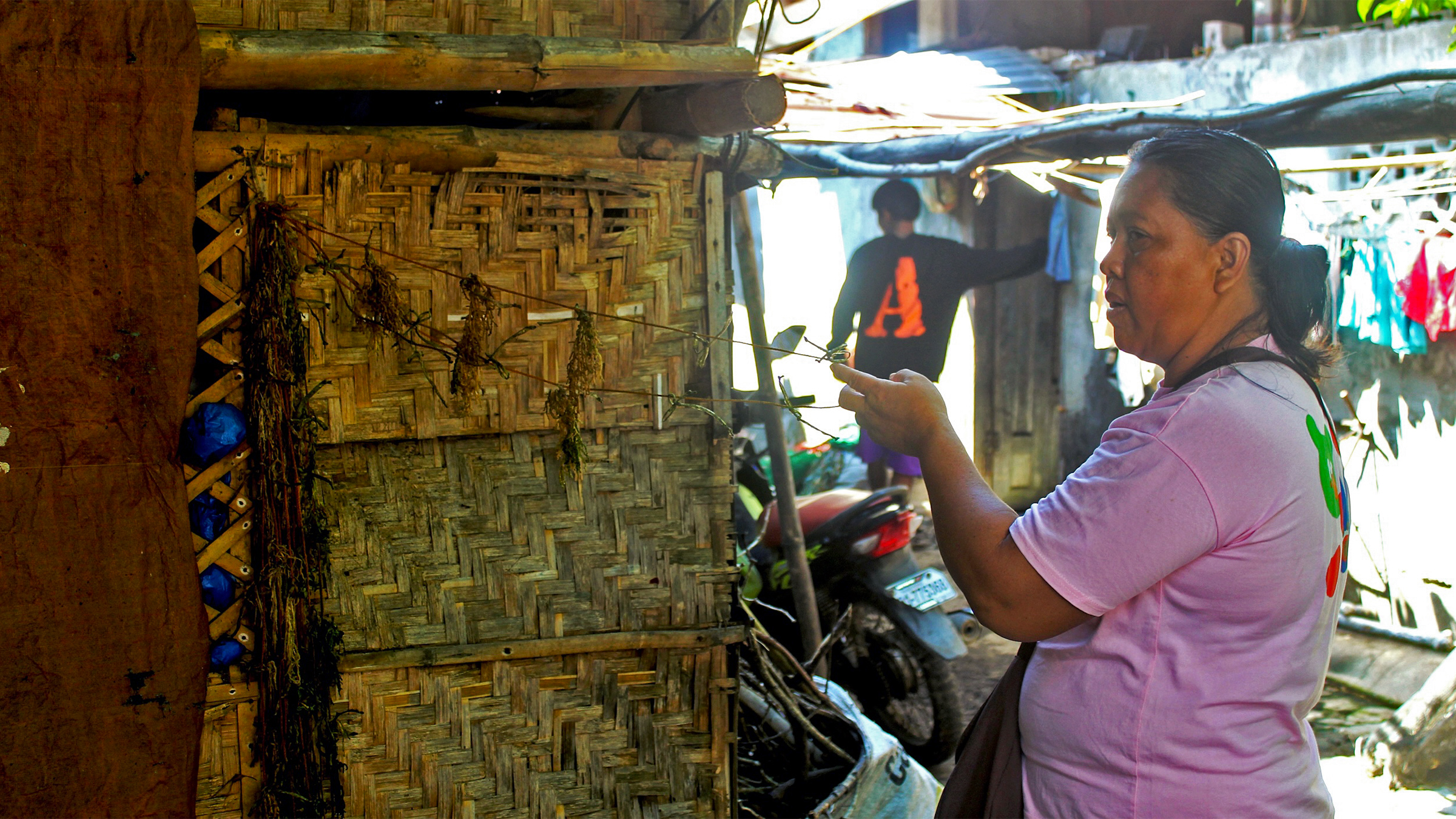
Banner image: Seaweed farmer Jonalyn Rentuaya holds a line of dried seaweed. While many community members have left since the spill, Rentuaya remains, saying she is hopeful the sea can be rehabilitated. Image by Pippo Carmona for Mongabay.
The Philippine lawyer who beat an oil giant: Rose Liza Eisma-Osorio on defending Tañon Strait
Norlan Pagal, fisherman and guardian of Tañon Strait, died on May 14th, aged 56
Cite this article
Pippo Carmona (2026). A year after a wastewater spill in the Philippines, communities fight to save a dying sea. Mongabay Conservation news. DOI: https://doi.org/10.66709/news-335061

