


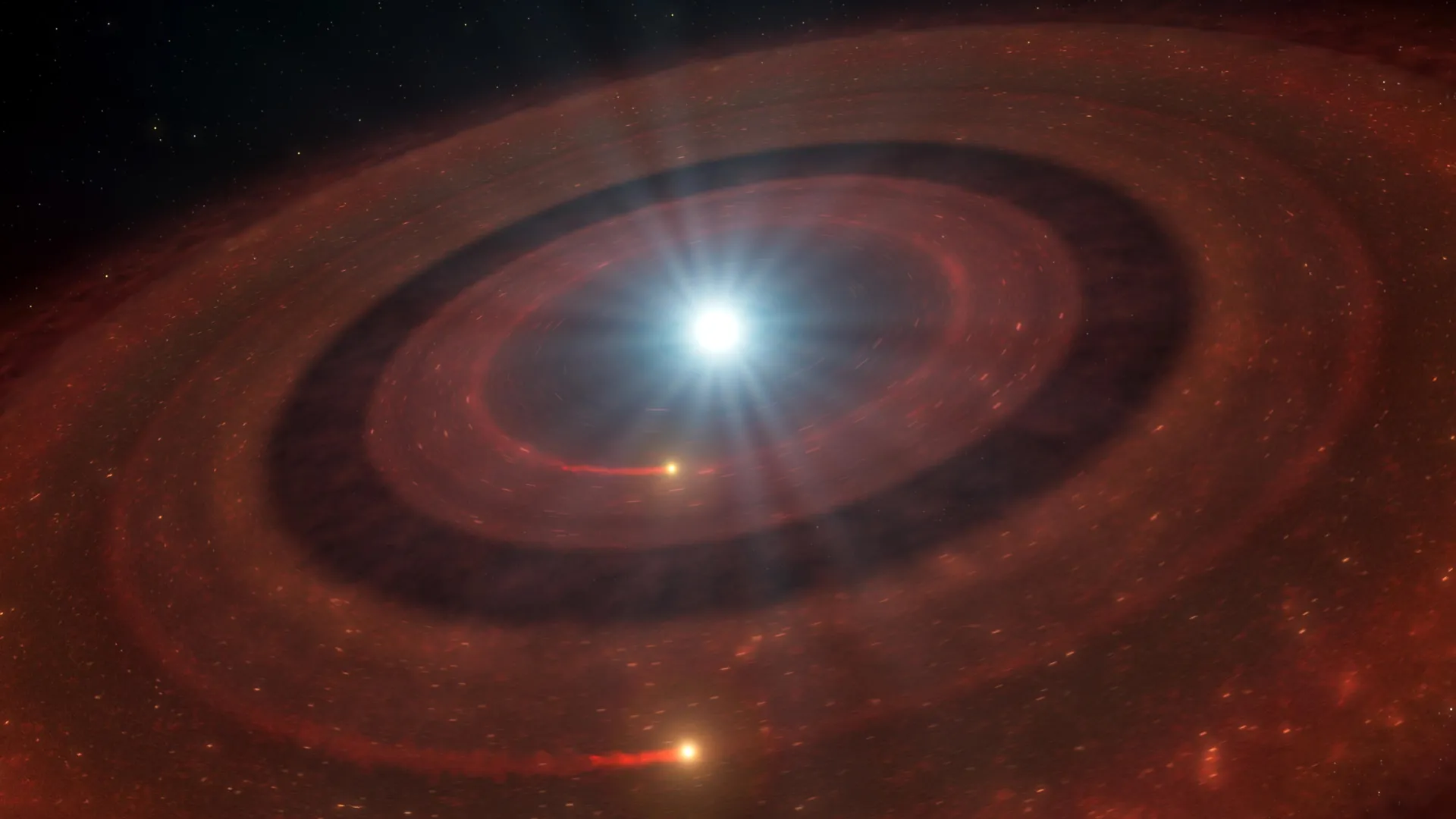
Astronomers have discovered an extraordinary ring of planetary wreckage around a dead star, offering a possible preview of what could happen to our own Solar System billions of years from now. Even more surprising, the debris is divided into two distinct rings, with a clear gap between them that may be maintained by planetary bodies that somehow survived their star’s death.
The discovery was made using the European Southern Observatory’s Very Large Telescope (ESO’s VLT). Unlike previously observed debris systems around dead stars, this one appears to contain two separate discs of material left behind by destroyed planets. Researchers believe two surviving objects may be shaping the unusual structure, including one potentially as large as Pluto or even the Moon.
“We have known for some time that planets may survive beyond the transformation of their central star, but this is the first example of a complex system with a double debris disc and potentially two surviving planetesimals,” says Nicola Gentile Fusillo, an astronomer at the Università degli Studi di Trieste in Italy and lead author of the study published in Nature Astronomy.
A Dead Star Surrounded by Planetary Wreckage
At the center of the system is J1328−1450, a white dwarf. These extremely dense stellar remnants form when stars similar to our Sun exhaust their fuel and reach the final stages of their evolution. After expanding dramatically and shedding their outer layers, they leave behind their exposed cores.
This transformation can be catastrophic for nearby planets. As a star swells, it may engulf and destroy worlds orbiting too close to it. More distant rocky objects can survive the initial upheaval, although gravitational disturbances may eventually tear some of them apart. Their remains can form rotating discs of debris around the dead star.
Astronomers have observed such debris discs around other white dwarfs, but J1328−1450 is different. Instead of a single ring of vaporized planetary material, it has two concentric rings, meaning one lies farther from the star than the other. The rings remain clearly separated, creating an unusual structure that scientists are now trying to explain.
“The structure we see in this system is particularly intriguing because the two gaseous rings are remarkably stable and remain separated by a gap,” says co-author Felipe Lagos-Vilches, an astronomer at the University of Warwick, UK, and at the Universidad Técnica Federico Santa María in Chile.
“The system is a rare glimpse of the violent, chaotic process by which a planetary system meets its end, and it hints that dead stars can have disc structures far more complex than previously realized,” adds Gentile Fusillo, who is also affiliated with the INAF-Astronomical Observatory of Trieste.
Two Surviving Worlds May Be Shaping the Rings
The researchers suspect that two surviving planetary bodies, each traveling along a separate orbit, are responsible for maintaining the double ring structure.
One of these objects, associated with the inner ring, is thought to be comparable in size to a typical asteroid, measuring only a few kilometers across. The other, farther from the star, could be much larger, potentially reaching the size of Pluto or even our Moon.
Such objects are known as planetesimals, a term used for smaller solid bodies associated with the formation and evolution of planetary systems. Although the two suspected survivors have not been directly observed, their gravitational influence could help explain why the debris remains organized into two distinct rings rather than forming one continuous disc.
The evidence comes from observations collected with the X-Shooter instrument on ESO’s VLT in Chile’s Atacama Desert. The instrument analyzes light across a broad range of wavelengths, allowing astronomers to examine the chemical makeup and motion of material surrounding distant objects.
Previously discovered debris discs around white dwarfs have shared a recognizable observational signature consistent with a single, flat, rotating disc. J1328−1450 breaks that pattern. Its observations instead reveal the unique fingerprint of a double disc, providing evidence of a far more complicated arrangement of planetary remains.
Chemical Clues Reveal the Remains of Destroyed Planets
The debris also contains important clues about the worlds that once orbited the star.
Astronomers detected calcium, oxygen, magnesium, and iron, elements commonly found in rocky planetary material throughout our Solar System. Their presence indicates that the rings contain remnants of solid bodies rather than simply gas left over from the star itself.
More intriguingly, the two rings have noticeably different chemical compositions. The inner ring contains substantial amounts of magnesium gas, while the outer ring is largely depleted of magnesium.
This difference suggests that the material in the two rings may have originated from separate planets with different compositions. If so, the system could preserve evidence of multiple destroyed worlds.
Another possibility is that both rings contain material from different layers of the same planetary body. For example, one ring could contain debris from a planet’s outer crust, while the other contains material from deeper inside, such as its core.
Either explanation would offer valuable insight into the destruction of rocky worlds and the complex processes that can continue long after a star has exhausted its fuel.
A Possible Preview of Our Solar System’s Future
The discovery also raises a compelling question about the ultimate fate of our own planetary neighborhood.
Billions of years from now, the Sun will undergo a similar transformation. It will expand into a red giant, shed its outer layers, and eventually become a white dwarf. During this process, the inner Solar System will experience enormous changes, and Earth itself may be destroyed.
Yet the observations of J1328−1450 suggest that the death of a star does not necessarily mean the complete disappearance of its planetary system. Some objects may survive, while others could be shattered into debris that continues orbiting the stellar remnant in complex arrangements.
By studying this distant dead star and its unusual double rings, astronomers are gaining a rare opportunity to investigate what remains after a planetary system experiences such a violent transformation.
“The system therefore offers a remarkable glimpse of what the future of planetary systems, including systems like our own, might look like,” concludes Lagos-Vilches.
