


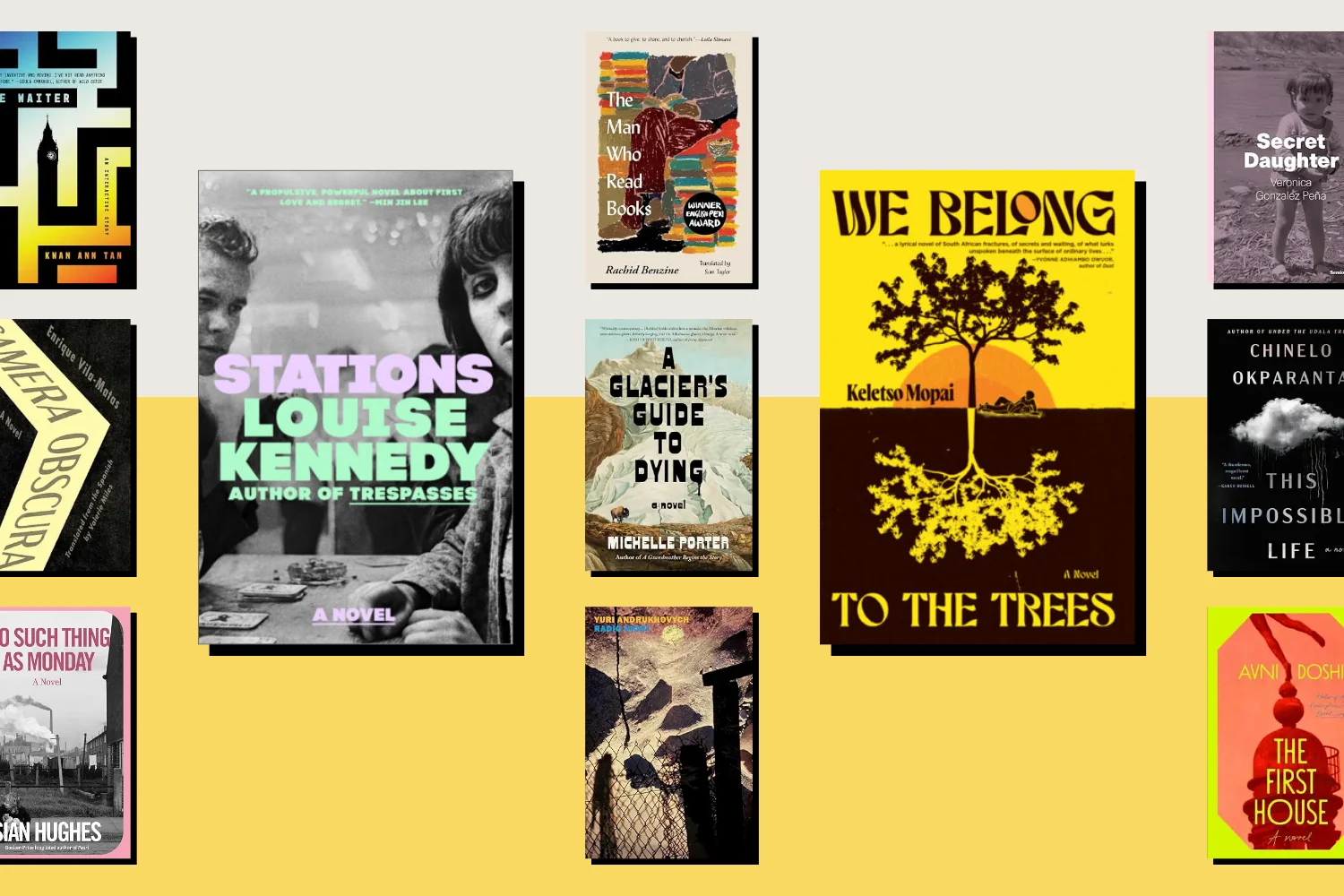
This month, we’re reading two new novels that explore the long shadow of shame and secrecy across Ireland and South Africa.
Stations: A Novel
Louise Kennedy (Riverhead Books, 288 pp., $28, November 2026)
This month, we’re reading two new novels that explore the long shadow of shame and secrecy across Ireland and South Africa.
Stations: A Novel
Louise Kennedy (Riverhead Books, 288 pp., $28, November 2026)
The first half of Stations, Louise Kennedy’s sophomore novel, reads like a typical tale of unrequited love—albeit with trademark Irish melancholy. But then things get properly dark.
Kennedy tells the story in snippets that span decades. It begins in County Kildare, Ireland, in 1982, during the Troubles. Roisin McCaffrey—an “actively unpopular” teenager—strikes up an unlikely friendship with her rabble-rousing classmate, Redmond “Red” Camelin, whom she describes as “like Dennis the Menace.” Both have strained relationships with their fathers.
Roisin’s father is an alcoholic who is unable to hold down a job. Although the McCaffreys are Northern Irish Catholics, he spent a year in the Royal Ulster Constabulary before moving the family south because he had become “a legitimate target for Republican paramilitaries.” Eventually, he leaves Roisin and her mother, settling in London with a new family that he also later abandons. Roisin “hated that people were known by what their fathers did, aware that she was known for her dad’s abscondment.”
Less is immediately clear about Red’s father, though Red runs away from home while in secondary school, preferring to crash on friends’ couches than cohabitate with his parents. Roisin intuits that “there was something dreadful in Red’s family.”
Roisin and Red engage in standard teenage flirtation and friendship—and, on one occasion, share a kiss—but Red insists that their relationship is strictly platonic. That’s not for Roisin’s lack of trying. After secondary school, she drops out of college to move to London, crashing in Red’s Pimlico squat and working odd jobs. Roisin amasses a roster of romantic conquests but never manages to interest Red. He, meanwhile, is drawn deeper into a dangerous drug scene. In the late 1980s—when “Hep C and HIV were rampant”—Roisin makes the difficult decision to cut ties with Red.
Kennedy leaves a gap between 1989 and 2007, when she finds Roisin again, this time at her father’s funeral. A chance encounter with a classmate (and ex-lover) who also moved from Kildare to London leads Roisin to embark on a monthslong search for Red. In the process, she uncovers disturbing details about his family and subsequent drug use.
Pain seeps through the pages of Stations. The various traumas that Roisin and Red endure—as victims of a sectarian conflict, as immigrants to the U.K., as the children of troubled fathers, and, in Red’s case, as an addict—are inseparable from Irish history. Their story begins when Ireland is still a poor country. In the “vast, disinterested city” of London, they are met with ridicule for their names and accents and struggle to make ends meet. For relief, they turn to substance use.
Despite their material hardships, for both for both Roisin and Red, returning to Ireland is not an option. They are eager to escape its anachronistic social norms—many of which are a result of the Catholic Church’s power in the country. “The outward show of Irishness, of heritage … she was getting as far away from that as possible,” Kennedy writes of Roisin. When Roisin tries to get ahold of Plan B in 1985, she tells her father’s British girlfriend that “it’s hard to get contraception in Ireland. Until four months ago, you could only get condoms on prescription.” At the time, there was also “no divorce in the Irish Republic.” (Ireland legalized divorce in 1996.)
Stations is hardly the first book to explore how the Catholic Church cast a shadow of shame and secrecy over much of Irish society. Claire Keegan’s acclaimed 2021 novella Small Things Like These, which details a cover-up of abuse at a convent, channeled many of the same themes.
Kennedy’s protagonists are hardly pious, but they are no less troubled by religious dogma than Keegan’s. Even at the end of Stations, in 2007—by which point Ireland had transformed dramatically—Roisin notes that most Irish drinking songs are still about the same old themes: “love and loss and loneliness.”—Allison Meakem
We Belong to the Trees: A Novel
Keletso Mopai (Seven Stories Press, 224 pp., $18.95, November 2026)
Since the apartheid era, one issue has remained at the center of political debates in South Africa: land. Specifically, who owns it, who is owed it, and who can lay claim to it. Until the 1990s, Black South Africans could only own land in 13 percent of the country; that decade, Nelson Mandela himself said that “with freedom and democracy, came restoration of the right to land. And with it the opportunity to address the effects of centuries of dispossession and denial.” Yet 30 years later, the country’s white minority still hold more 72 percent of its private farmland.

That dispossession, and the struggle to redress it, is at the heart of Keletso Mopai’s ambitious debut novel, We Belong to the Trees. Set in the northeastern town of Tzaneen in the mid-1990s, the book chronicles the mystery surrounding the murder of a young Black security guard at a farm owned by an Afrikaner family. What happened is revealed in overlapping layers, as a chorus of characters, from the victim’s brother to the farmer’s wife to an unnamed bystander, narrate their experiences of that night and the circumstances surrounding it. The story unfolds meticulously, if a touch too neatly, with new revelations in nearly every chapter. Soon, we learn of the victim’s family’s claims to the land, the brewing discontent among the Black farmworkers, and extramarital affairs that laid the groundwork for the tragedy.
Mopai has said that the novel was partly inspired by her father telling her as a young girl about her own family’s claim to a white-owned farmhouse and his efforts to take it back. It was not until later that she realized the political context of their dispossession. In the book, the Afrikaner farmer increasingly feels pressure to leave his land, bemoaning the “bloody shits [who] are on my neck with the land politics.” “My grandfather owned this farm,” he adds. “You know, just because Nelson Mandela is now president they think they own everything in this country.”
Paranoia and disorientation pervade the novel as the characters try to make sense of their place in a society that remains deeply unequal even as it’s undergoing profound change. Those racial disparities, of course, still mark the country, and in an era in which the Trump administration and Afrikaner lobby groups peddle false stories about a “white genocide” in South Africa, Mopai’s novel brings nuance and humanity to what remains one of the most fraught political struggles of our time.—Chloe Hadavas
November Releases, in Brief
A widower undertakes a literary experiment in Spanish author Enrique Vila-Matas’ Camera Obscura, translated by Valerie Miles. Sian Hughes draws inspiration from a 14th-century poem in No Such Thing as Monday, a darkly comic novel set in contemporary England. Veronica Gonzalez Peña traverses North America in her novel of disorientation, Secret Daughter. In Avni Doshi’s The First House, a divorcée sifts through the ruins of family life. Rachid Benzine’s The Man Who Read Books, translated by Sam Taylor, unfolds as a conversation between a bookseller and foreign correspondent in Palestine.
Nigerian novelist Chinelo Okparanta’s This Impossible Life chronicles two siblings across decades and continents caught in the crosshairs of global forces. With her debut novel, The Waiter, Malaysian author Kwan Ann Tan offers up an “interactive story” of a futuristic London. Scholastique Mukasonga reimagines stories from Rwandan folklore in Murmurs from the Hills, translated from the French by Mark Polizzotti. Ukrainian writer Yuri Andrukhovych’s pandemic-era thriller, Radio Night, is translated into English by Mark Andryczyk. And a Metis man communes with a melting glacier in Michelle Porter’s A Glacier’s Guide to Dying.—CH
