


When Call of Duty 4: Modern Warfare debuted in 2007, it was a revelation. Whereas earlier games in the series followed the familiar pattern of World War II stories, Modern Warfare recreated 21st century combat in groundbreaking graphic fidelity.
Players undertook nighttime counterterrorism raids, maneuvered tanks through urban environments that bore striking resemblance to Baghdad, and controlled drones through infrared displays on missions almost indistinguishable from real footage of U.S. bombing runs. Call of Duty has since become one of the most lucrative video game series in history, offering players all of the excitement of the war on terror with none of its controversy.
Workers rush to fill orders of the highly anticipated Call of Duty: Modern Warfare 2 in a GameStop store in Las Vegas on Nov. 10, 2009.Ethan Miller/Getty Images
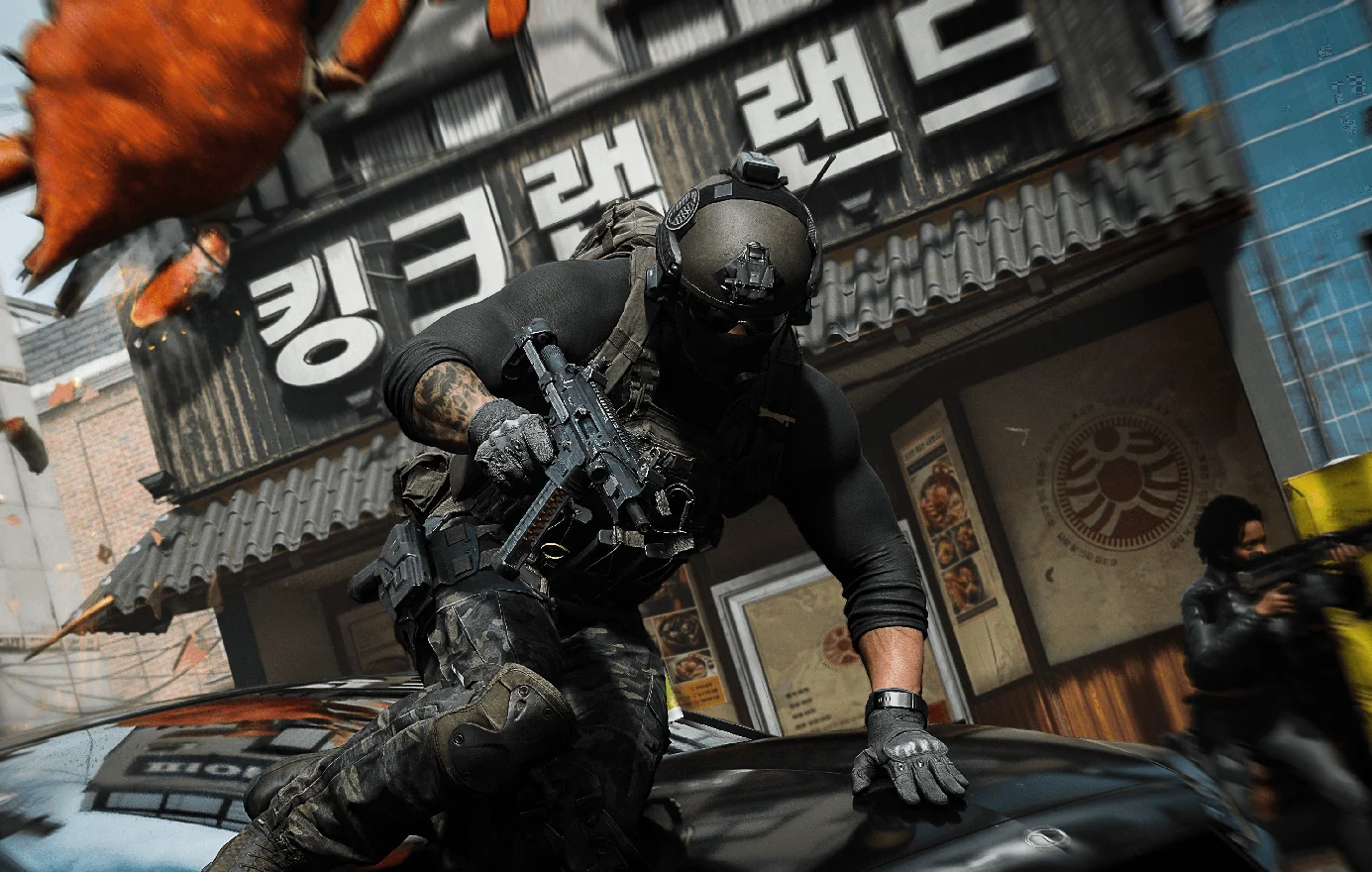
But in Call of Duty: Modern Warfare 4, released in late October to critical acclaim, the player’s first mission is to buy snacks from a Korean convenience store. It’s the calm before the storm, as North Korea, led by the murderous sister of its leader, is preparing an invasion of the South. Players move through the world primarily as a South Korean soldier facing combat for the first time, working as part of a mixed-nationality squad. Before the onset of combat, the characters laugh and gripe. “Korean chicks don’t like a man in uniform?” a U.S. soldier asks after halfheartedly catcalling a woman. “Service is mandatory for us,” a Korean sergeant replies. “You’re not special to them.” It’s a remarkably humanizing opening, and a disarming turn for a video game series that has long rested on the fantasy of being an elite soldier.
The series has historically avoided East Asia, in part to avoid angering Beijing and endangering sales in China. The decision to set the game there now is undoubtedly a reflection of South Korea’s growing cultural clout. But it also suggests that its old formula is no longer working. As the U.S. public recoils from militarism and its military leaders’ fixation on lethality, Call of Duty has crossed the Pacific to find more relatable protagonists and more defensible purposes.

U.S. Navy SEALS await a night mission to capture Iraqi insurgent leaders near Fallujah, Iraq, on July 27, 2007.John Moore/Getty Images
Call of Duty’s political and strategic logic has always been flimsy. But the magic of the game was that it never sought to justify U.S. foreign policy or the heinous acts it asked soldiers to commit on its behalf. It stayed at ground level, with soldiers motivated by duty and loyalty to their comrades. “You draw the line wherever you need it,” one of the series’ heroes, Capt. John Price, says in the 2019 game. “We get dirty, and the world stays clean.”
Those soldiers have mostly belonged to special forces units, leaving ordinary troops behind. Call of Duty honed and elevated the mythological status of special forces that emerged during the war on terror. The games let operators be inherently good even when the politics of their missions and the methods they used were questionable.
Read More
-

A person wearing a bright yellow jumpsuit and white under-sleeves lying on a light-colored floor with their hands raised near their head in a startled or defensive expression. A person wearing a bright yellow jumpsuit and white under-sleeves lying on a light-colored floor with their hands raised near their head in a startled or defensive expression. Is Netflix’s ‘The New Stanford Prison Experiment’ for Real?
The creators of “Is It Cake?” set out to answer the question of whether power corrupts.

-

Two men sit in silhouette on a rooftop at night, facing each other in profile against a illuminated city skyline. High-rise buildings with glowing windows dot the background, beneath a dark, cloudy sky. Two men sit in silhouette on a rooftop at night, facing each other in profile against a illuminated city skyline. High-rise buildings with glowing windows dot the background, beneath a dark, cloudy sky. AI Made the List—but Humans Still Did the Killing
In the film “NAZA,” Israeli soldiers reveal the workings of autonomous warfare.
-

A collage image with a photo of Pete Hegseth seen in profile, his mouth open as he yells. Beside him is the cover illustration from the book Psychology of Military Incompetence, depicting a general in uniform, also seen in profile, with military imagery framed inside his head. A collage image with a photo of Pete Hegseth seen in profile, his mouth open as he yells. Beside him is the cover illustration from the book Psychology of Military Incompetence, depicting a general in uniform, also seen in profile, with military imagery framed inside his head. The Book That Predicted Pete Hegseth’s Failures
“On the Psychology of Military Incompetence” examines the narrow minds of petty men.
In the 2010s, special forces operators had a cultural and political appeal that other soldiers did not. Special units such as the Navy SEALs, Green Berets, and Delta Force shouldered the operational burden of what was supposed to be a more adaptable approach to counterterrorism. If conventional troops were fallible, it was the elite operators undertaking high-risk, highly skilled operations who increasingly commanded public, commercial, and political respect. (This also helped launch the political careers of a disproportionate number of ex-Navy SEALs.) Even when its wars went poorly, the U.S. military could highlight its fearsome, capable special forces whose achievements seemed to vindicate the strategy that sent them abroad.
That impression of military strength—bolstered by the United States’ high-tech, long-range weaponry—has also helped allies like South Korea persuade their publics that hosting U.S. troops helps rather than hurts national security. Recent U.S. foreign policy, however, has put that argument in question.
U.S. Defense Secretary Pete Hegseth promised to retool the military around lethality, and the reactions of Trump administration officials after the capture of Venezuelan President Nicolás Maduro in January showed just how critical the talent of U.S. special forces was in justifying unilateral action. But the Iran war that followed has wreaked havoc on allies in the Persian Gulf, and special forces units have not played a decisive role in the conflict.

Families reunite with sailors from the U.S. Navy aircraft carrier USS Abraham Lincoln in San Diego after a historic 10-month deployment in the Middle East on Oct. 8.David Swanson/AFP via Getty Images
The military’s own condition has not helped. In recent months, the Pentagon has been run down by controversies over the poor conditions sailors faced aboard the USS Abraham Lincoln, Hegseth’s purge of many of the military’s most decorated officers, and the pull back of forward-deployed military assets. When U.S. President Donald Trump attempted to bully South Korea into sending naval vessels to the Strait of Hormuz, President Lee Jae-myung dithered for months, and only recently requested that a nearby anti-piracy naval mission expands its area of operations. Even countries that see the United States as their most important ally are wary of the risks of becoming entangled in its military operations, given Washington’s ongoing struggles to secure favorable outcomes in its conflicts.
The image of elite operators has fallen too. Eddie Gallagher, a Navy SEAL, was accused by his own compatriots of war crimes. Mathew Golsteyn, an Army Green Beret, was charged with murder until Trump pardoned him. In an explosive 2025 book, the journalist Seth Harp reported on the role of Delta Force operators who ran drug trafficking schemes in North Carolina, uncovering lurid tales of over-resourced special forces units who acted above the law. Even the Maduro raid’s success was dimmed by news that a special forces soldier with access to classified intelligence had placed an illegal bet on it.
These controversies have degraded the image of shadowy elite operators as zealously efficient professionals; they are instead associated with waste, degeneracy, and untrammeled violence in a political environment that celebrates militarism for its own sake.

A still from the video game Call of Duty: Modern Warfare 4. Activision Blizzard
What Modern Warfare 4 has done is kill the special forces hero paradigm. It simmers with disillusionment over years of special forces deification, a myth Call of Duty itself did much to promote. Price, the grizzled British ex-special forces operator who flouts the rules, appears as a deuteragonist, but his actions are typically in vain. The protagonist, instead, is the far less decorated Private Park Hyun-Jun, a clean-shaven South Korean Marine who carries out missions with little chest-beating patriotism even as his squad assumes greater significance in the broader war. The game is clearly suspicious of antiheros who claim to do bad things for good purposes and is unambiguous about the moral clarity of regular soldiers in the U.S.-ROK squad.
For a game ostensibly about shooting lots of big guns, there sure is a lot of international law. Players can refuse murderous orders, and those who accidentally shoot a civilian must restart from a checkpoint. One of the key plot points involves a North Korean soldier who defects, disgusted by the atrocities committed by his leaders. It’s a stirring contrast to “No Russian,” one of the most infamous missions from the 2009 Call of Duty game, where the player participates in the massacre of civilians in an airport to progress in the campaign. (After a public outcry, the level was made skippable.)
Video games often allow players to entertain immoral and violent fantasies, but the newest Call of Duty swaps out a more typical fantasy of untrammeled action with a yearning for moral agency within the comfort of a structured, law-abiding system.

A still from the video game Call of Duty: Modern Warfare 4. Activision Blizzard
While the game is set in Korea, it is not really a game about Korea. Its opening montage incorporates real footage of the 2022 Itaewon crowd crush; the U.S.-based developers seemingly failed to anticipate the outrage this would spark among Korean audiences. (The developers have since announced that the footage will be removed in an update.) Modern Warfare 4 has little to say about the culture or people it uses as a backdrop. Instead, the game says far more about the U.S.-South Korean relationship and the kinds of military figures it deems worthy of veneration.
“This operation represents the strength of our alliance,” a U.S. officer proclaims before an amphibious landing. “When we step off those ramps, we do so as one.” The characters in the game are unlikely heroes. The South Koreans have their gripes—one wonders aloud why there’s always an American in charge of the operation—and few soldiers in the joint squad look like hardened warriors prepared to take on the burdens of combat.
But the squad’s seamless unity through the campaign more than makes up for the fleshiness of its individual selves. It is a corporealization of what many U.S. allies wish the United States could be: a reliable partner, unquestionably committed to its friends’ security, whose capabilities are enhanced when it works with its allies. It’s a theme that harkens back to the series’ roots and the original games that mythologized the heroism of conventional World War II soldiers.
In order to save the world, perhaps we don’t want controversial, bloodied superheroes brimming with masculine vigor. Call of Duty seems to believe we might instead yearn for ordinary people who carry out lawful orders and live up to their commitments. A banal message, perhaps, but one that needs to be delivered in an age of global instability.
